How to Build a Business Model for a Startup in 7 Simple Steps
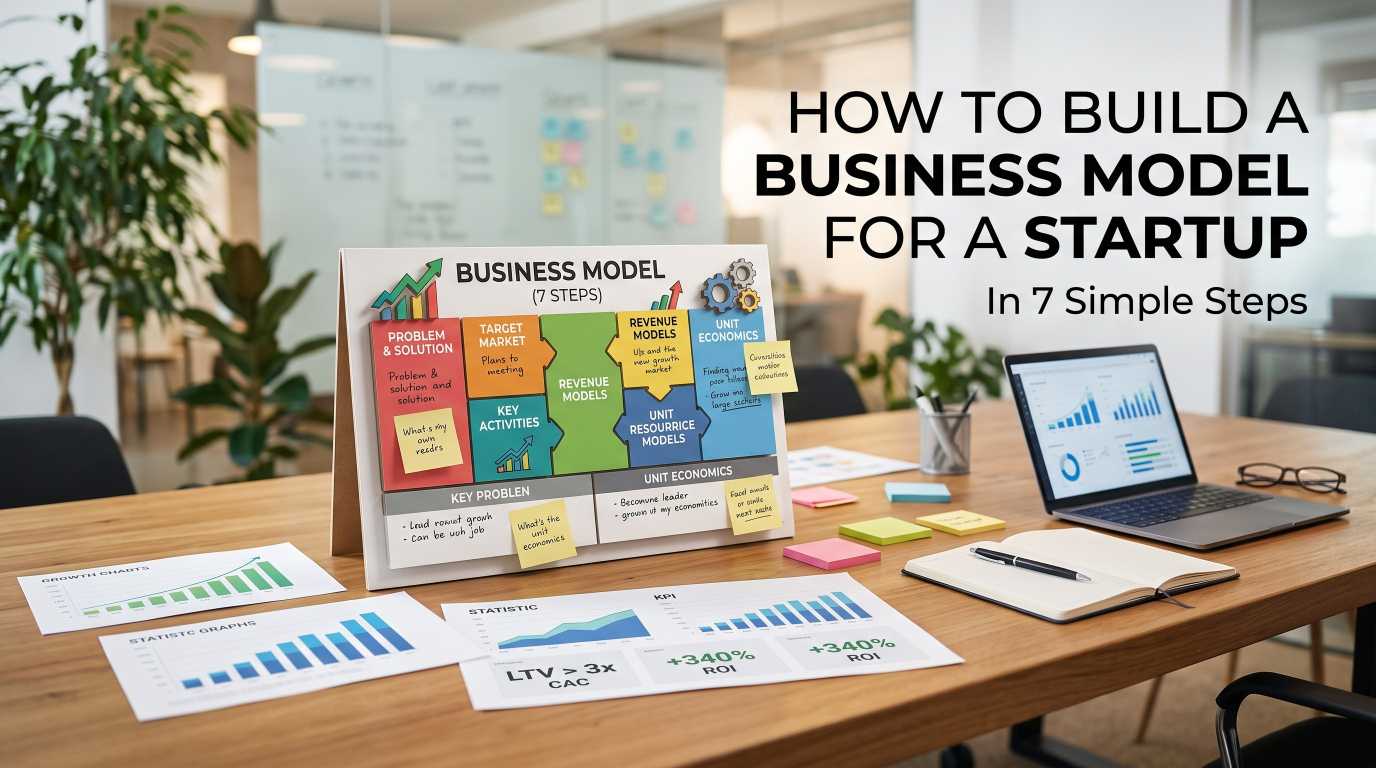
How to Build a Business Model for a Startup in 7 Simple Steps
Have you ever had a brilliant startup idea in the middle of the night, jumped out of bed, and thought, “This is it. This is going to make millions”?
Most founders have been there. You get a sudden spark of inspiration. You build a sleek website, set up social media accounts, and maybe even start writing code or designing a physical prototype.
Then comes day one. You open the doors, launch the product to the world, and… complete silence. No customers. No cash flow. Just cricket sounds.
Why does this happen so often? It rarely happens because the founder was lazy or because the product was poorly built. It happens because having a cool product is not the same thing as having a working business.
A product is just something you make. A business model is the engine that keeps the lights on, pays your team, attracts buyers, and puts money into your bank account.
If you want your new venture to survive and actually grow, you need to learn how to build a business model for a startup in 7 simple steps.
In this complete step-by-step guide, we are going to break down the exact roadmap you need. We will skip the dry MBA buzzwords, ditch the confusing financial jargon, and talk plainly—just like two friends chatting over coffee or breaking it down on an easy-going podcast.
Grab a notepad, take a breath, and let’s dive into step one.
What Is a Startup Business Model (And Why Does It Matter)?
Before we look at the steps, let’s clear up a huge myth.
A lot of beginner founders think a business model is a 60-page PDF full of complex charts and guesses about how much money they will make in five years.
It isn't.
The Real Definition in Plain English
At its core, a business model answers three basic questions:
What value are you creating? (What problem are you solving for people?)
How do you deliver that value? (How do people actually get your solution?)
How do you capture value in return? (How do you make real money doing it?)
Think of it like building a bicycle.
Your product is the frame and the wheels.
Your marketing is the paint job and the bell.
But the business model is the chain and the pedals. Without them, you can push the bike downhill for a few seconds, but the moment you hit flat ground or a hill, you stop moving.
Business Plan vs. Business Model: Don’t Mix Them Up
People often mix up a business plan and a business model, but they are very different:
A business plan is a detailed formal document. It spells out marketing strategies, legal rules, staff plans, and long-term milestones. It is mostly written for bankers and traditional investors.
A business model is the living logic of how your company survives day to day. It shows where money comes from, where money goes, and why customers choose you instead of your competitors.
When you start out, you do not need a massive 60-page business plan. You need a clear, realistic business model that works in the real world.
Step 1: Identify a Painful Problem and Define Your Ideal Customer
Every great company starts with a real, everyday headache. If there is no real pain, nobody will open their wallet to buy your medicine.
Stop Falling in Love with Solutions
The biggest trap for first-time founders is falling head-over-heels in love with their own idea.
You might say: “I want to build an AI-powered app that tells people what shoes match their socks!”
That sounds neat, but does anyone actually lose sleep at night worrying about their socks matching their shoes? Probably not. When you try to sell a nice-to-have vitamin instead of a must-have painkiller, you have to fight for every single sale.
Instead, ask yourself:
What daily chore annoys people so much that they complain about it to their friends?
What business process wastes hours of company time every single week?
What task costs people unnecessary money right now?
Narrow Down Your Target Customer Profile
You cannot sell to "everyone." If your target customer is "anybody with a smartphone," your marketing message will be so generic that nobody pays attention.
You need to pick a very specific group of people first. Ask yourself:
Who feels this pain most acutely? (Is it college students, busy moms, remote freelance designers, or local dental clinics?)
Where do they hang out online? (Are they scrolling on TikTok, reading Reddit threads, or networking on LinkedIn?)
What are they currently doing to cope with the problem? (Are they using messy spreadsheets? Are they paying a pricey agency? Or are they just suffering through it?)
When you can describe your customer’s daily struggle better than they can describe it themselves, they will naturally trust that you have the right fix.
Step 2: Create a Clear Value Proposition That Solves the Problem
Now that you know who hurts and why, what are you actually bringing to the table?
This is your value proposition. It is the plain-language promise you make to your customer.
How to Write a Value Proposition That Actually Works
A great value proposition is simple. A ten-year-old should be able to read it and instantly understand what you do.
Stay away from empty buzzwords like “We leverage synergistic cloud-native paradigms to optimize workflows.” That means nothing to a normal buyer.
Instead, use this simple fill-in-the-blank formula:
"We help [Specific Customer] achieve [Desirable Result] without [Painful Obstacle or Hassle]."
Let’s look at a couple of real-world examples:
Example A (Accounting Software): “We help freelance graphic designers send professional invoices and get paid in under 48 hours without messy spreadsheets.”
Example B (Meal Delivery): “We help busy working parents serve healthy, home-cooked dinners in under 15 minutes without grocery shopping or chopping vegetables.”
Notice how clear both examples are? You instantly know who it is for, what good thing happens, and what headache disappears.
Why Your Solution Must Be 10x Better or Noticeably Cheaper
People are creatures of habit. Even when a tool is annoying, people stick with it simply because switching takes time and effort.
To get people to leave their old routine, your startup cannot be just 5% better. It has to be either:
10x easier or faster (like hailing an Uber with one tap instead of calling a dispatch cab company and waiting on hold), or
Substantially cheaper and simpler (like Canva making quick graphic design free and easy compared to learning complex desktop publishing software).
Step 3: Choose the Right Startup Revenue Model to Make Real Money
Let’s talk about everyone’s favorite topic: cash flow.
How will your startup actually earn money? A business without revenue is just an expensive hobby. Choosing the right revenue model early on saves you months of confusion.
You can also check: How to Launch a Startup with a Small Budget
The Most Common Startup Revenue Models
Here are the most popular ways startups make money today, explained simply:
1. The Subscription Model (Recurring Revenue)
How it works: Customers pay a small fee every month or year to keep access to your product.
Best for: Software (SaaS), gym memberships, curated boxes, streaming services.
Why founders love it: It gives you predictable, steady income. If 200 customers pay you $20 every month, you know you start next month with $4,000 already in the pipeline.
2. The Direct Transactional Model
How it works: You sell an item or service once, and the customer pays you once.
Best for: E-commerce shops, handmade goods, digital courses, one-off consulting sessions.
Why founders love it: It is straightforward. You make a product for $10, sell it for $30, and keep the $20 profit immediately.
3. The Marketplace Model (Commission & Brokerage)
How it works: You connect buyers and sellers, then take a percentage fee on every transaction.
Best for: Platforms like Airbnb, Uber, Fiverr, or eBay.
Why founders love it: You don't need to own the inventory or provide all the physical services yourself.
The challenge: You have to attract both buyers and sellers at the exact same time (the classic chicken-and-egg problem).
4. The Freemium Model
How it works: Anyone can use a basic version of your tool for free, but power users pay to unlock advanced features, extra storage, or priority support.
Best for: Productivity apps, casual mobile games, communication platforms (like Slack or Dropbox).
The challenge: Only 2% to 5% of free users usually upgrade to paid plans. That means you need millions of active free users for the numbers to work.
How to Pick the Best Option for Your Idea
Do not overcomplicate this step. Look at your ideal customer and ask:
How are they already used to paying for solutions in this space?
Do they prefer an ongoing operational expense (monthly subscription) or a single one-time payment?
Match your revenue model to their existing habits. Never force your customers to learn a weird, confusing payment method just to use your service.
For Pricing: Check out our How to Choose a Startup Pricing Strategy
Step 4: Map Your Delivery Channels and Customer Acquisition Strategy
You have a killer product and a fair price. But how do people actually find out you exist? And once they buy, how do they get what they paid for?
This is where your channels come into play.
How Will Customers Discover You? (Customer Acquisition)
Customer acquisition simply means getting people into your sales funnel. You generally have two paths: organic channels and paid channels.
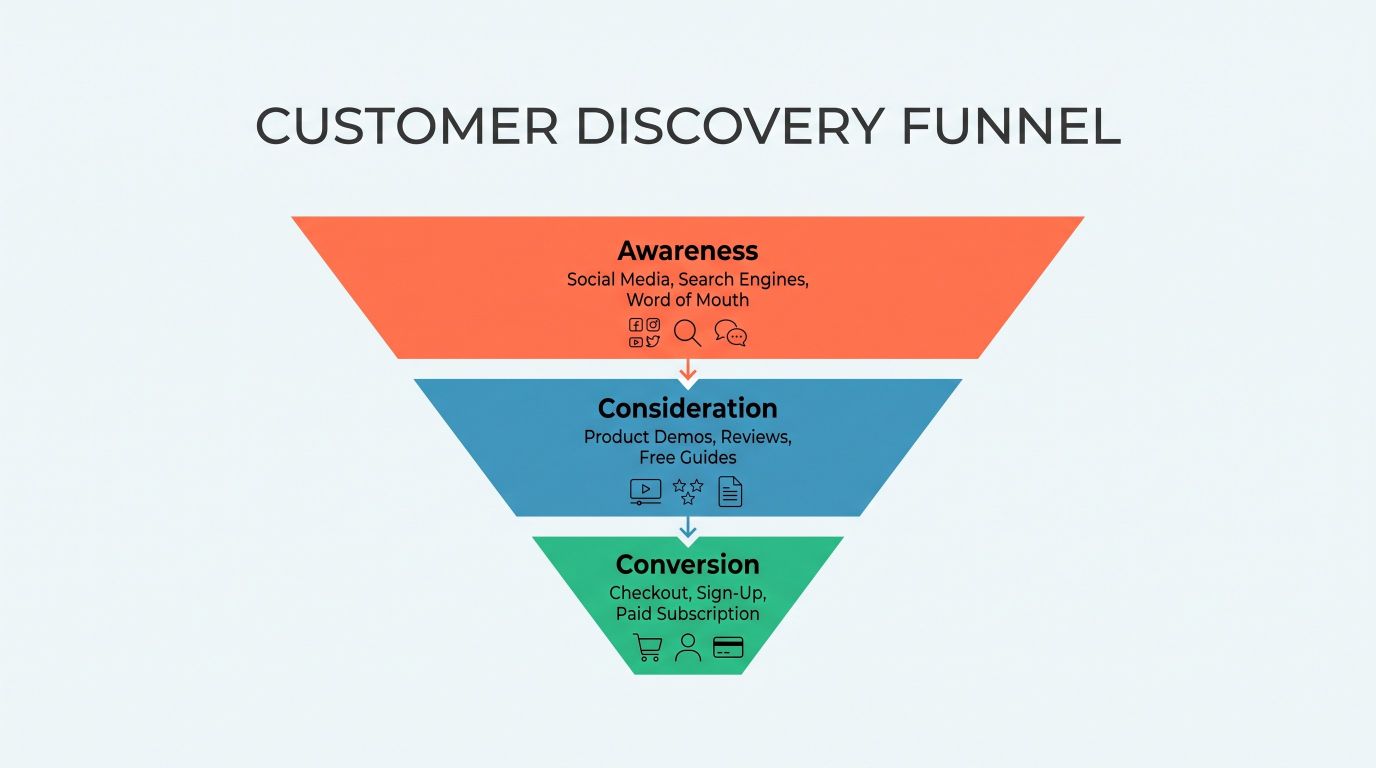
Organic Channels (Takes Time, Saves Cash)
Search Engine Optimization (SEO): Writing helpful articles and guides that rank high on Google when people search for answers to their problems.
Social Media Content: Sharing short behind-the-scenes videos, quick tips, or founder stories on YouTube, TikTok, or Instagram.
Word of Mouth & Referrals: Giving early customers such a great experience that they tell three friends without you even asking.
Paid Channels (Fast Results, Costs Money)
Paid Search Ads: Paying Google so your link shows up first when someone searches for high-intent keywords.
Social Media Ads: Running targeted video ads to your exact demographic on platforms like Meta or LinkedIn.
Influencer Partnerships: Paying a creator who already has the attention of your target audience to review your product honestly.
How Will You Deliver the Product? (Distribution)
Distribution is how your solution lands in the customer's hands:
If you make software, your delivery is digital: instant login access, onboarding emails, and cloud servers.
If you make physical goods, your delivery is physical: warehousing, packing boxes, postal couriers, and handling returns smoothly.
Make sure your delivery process is frictionless. If signing up or receiving the item takes too many clicks or days of waiting, customers will ask for refunds before they even try your product.
Step 5: Identify Your Core Activities, Key Resources, and Vital Partners
Every business needs behind-the-scenes support to keep the machine running smoothly. In this step, you outline what you must do, what you must own, and who you need on your side.
1. Key Activities: What Must You Do Every Single Day?
Ask yourself: What are the few vital actions our startup must execute flawlessly to stay alive?
For a software company, key activities are software development, bug fixing, and customer support.
For an online bakery, key activities are baking, food safety, packaging, and same-day delivery.
Avoid getting distracted by vanity tasks. Focus your energy on the daily habits that directly build the product, keep existing users happy, and bring in new sales.
2. Key Resources: What Assets Do You Need to Have?
Resources are the building blocks you rely on:
Physical assets: Office space, delivery vans, kitchen tools, manufacturing gear.
Intellectual assets: Patents, proprietary algorithms, brand trademarks, custom user data.
Human talent: Great engineers, friendly support reps, creative copywriters.
Financial capital: Personal savings, cash reserves, angel investment, lines of credit.
3. Key Partners: Who Can Help You Scale Faster?
You do not have to build every piece of your business from scratch. Smart startups partner with established companies to save time:
Suppliers: Trustworthy manufacturers who ship materials on time.
Software Platforms: Stripe for payments, AWS for server hosting, Shopify for storefronts.
Logistics Providers: Reliable shipping carriers who handle doorstep delivery.
By working with great partners, a tiny team of three people can easily run operations that used to require a staff of fifty.
Step 6: Calculate Your Real Costs and Understand Startup Unit Economics
This step is where many exciting startups fail quietly. You can have thousands of passionate users and still go bankrupt if it costs you $1.50 to make every $1.00 of sales.
Let’s look at your costs and unit economics so you always stay in the green.
Fixed Costs vs. Variable Costs
First, separate your outgoing expenses into two simple buckets:
Cost Type | Definition | Simple Examples |
Fixed Costs | Bills you must pay every month, no matter how many sales you make. | Office rent, basic software tools, accounting fees, team base salaries. |
Variable Costs | Bills that go up or down depending on how many units you sell. | Packaging boxes, raw ingredients, credit card transaction fees, shipping labels. |
When you are just starting out, keep your fixed costs as close to zero as possible. Work from home, use free tiers of business software, and hire freelancers for short tasks instead of taking on huge monthly payrolls right away.
The Two Most Important Startup Metrics
You don’t need an accounting degree to understand healthy startup finances. You just need to watch two numbers like a hawk:
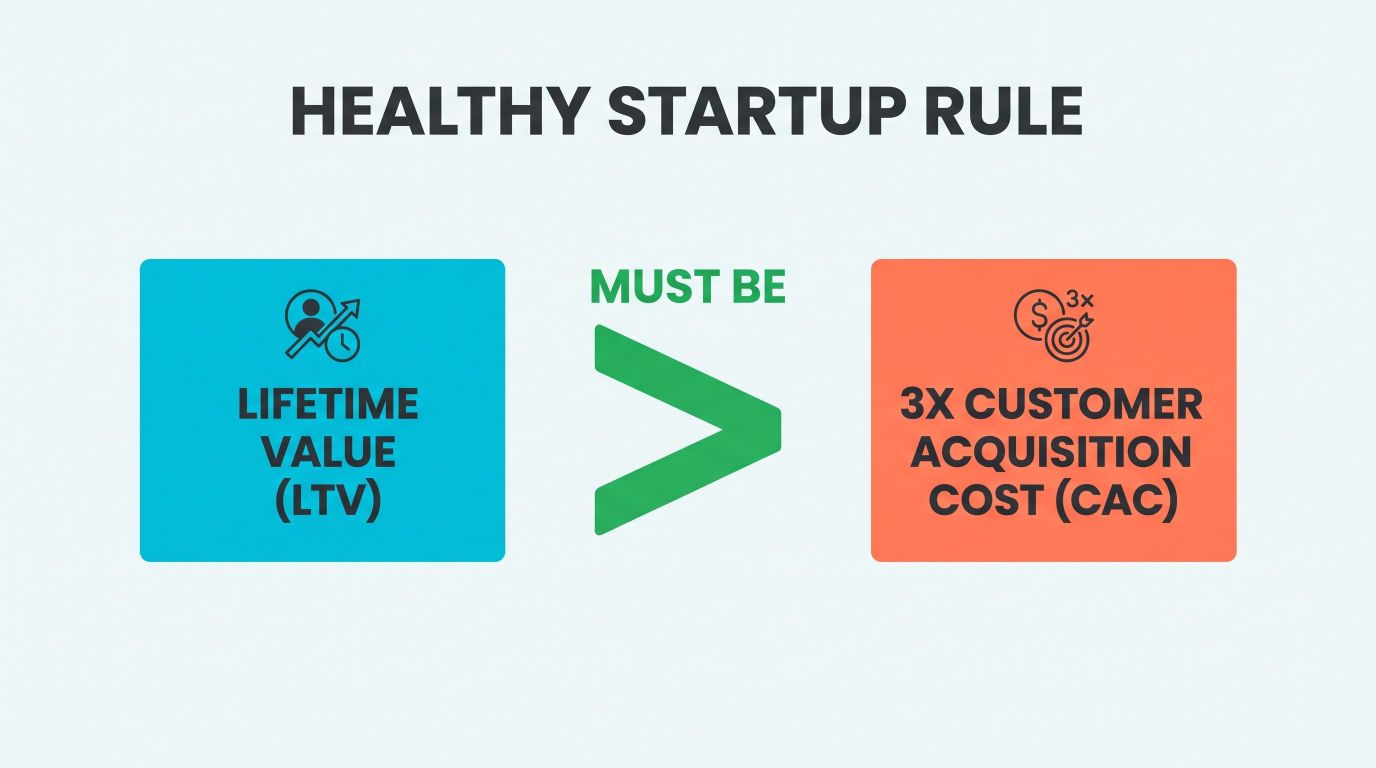
1. CAC (Customer Acquisition Cost)
This is how much money you spend on marketing and sales to win a single paying customer.
$$\text{CAC} = \frac{\text{Total Marketing \& Sales Spend}}{\text{Number of New Customers Won}}$$
Example: If you spend $500 on ads this month and get 10 new paying customers, your CAC is $50.
2. LTV (Customer Lifetime Value)
This is the total amount of money a customer pays you before they stop using your product.
$$\text{LTV} = \text{Average Order Value} \times \text{Number of Repeat Purchases}$$
Example: If a customer pays you a $25 monthly subscription and stays with you for an average of 10 months, their LTV is $250.
The Golden Rule of Unit Economics
Here is the simple rule successful founders live by: Your LTV should be at least 3 times larger than your CAC (LTV : CAC $\ge$ 3 : 1).
If your CAC is $50 and your LTV is $250, you are in great shape. You put $50 in, and you get $250 out over time.
But if your CAC is $100 and your LTV is only $60, you lose $40 every time you gain a customer. The faster you grow, the faster you run out of money!
Step 7: Test, Validate, and Adapt Your Business Model Fast
You have written down your assumptions, chosen your pricing, and mapped out your channels. But right now, your business model is still just an educated guess on paper.
Now it is time to take it out into the sunlight and test it with real human beings.
Build a Minimum Viable Product (MVP)
A Minimum Viable Product (MVP) is the simplest, leanest version of your idea that still solves the core problem for the user.
You do not need to build every bell and whistle.
You do not need automated dashboards right away.
You just need enough functionality so early adopters can test it and tell you if it works.
If you are starting a curated newsletter service, do not hire an agency to build a custom web portal. Just create a free Substack, write three great editions, and see if people actually read them and share them with friends.
Run Real-World Validation Experiments
Here are three quick, low-cost ways to test if people genuinely care about your startup business model:
The Smoke Test (Landing Page Test): Build a clean, simple landing page explaining your value proposition. Add a clear button that says “Join the Early Access Waitlist” or “Pre-Order for 30% Off.” Drive 200 targeted visitors to the page. If nobody clicks, your messaging or your offer needs work.
The Concierge Test: Deliver your service completely by hand before writing any software code. If you want to build an automated grocery delivery app, personally take orders over WhatsApp, drive to the store yourself, buy the items, and deliver them to your first ten customers. You will learn more in one afternoon of doing the work manually than in six months of theoretical planning.
The Cold Pre-Sale: Ask prospective customers to buy the product before it is fully built, in exchange for a big founder discount. Nothing validates a business model faster than a stranger willingly pulling out their credit card to pay you upfront.
When and How to Pivot Without Feeling Like a Failure
What happens if your tests show that customers don’t want to pay your subscription price, or that your acquisition costs are way too high?
You don’t quit—you pivot.
A pivot simply means changing one or two parts of your business model while keeping what you learned. You might:
Keep the product, but change your target customer (e.g., selling your tool to corporate teams instead of broke students).
Keep the customer, but change your revenue model (e.g., moving from a one-time purchase to a flexible monthly plan).
Keep the problem, but switch your delivery channel (e.g., selling directly online instead of pitching retail stores).
Almost every household name pivoted early on. Twitter began as an audio podcast directory called Odeo. YouTube started out as a video dating platform. Don’t get defensive when reality gives you feedback. Listen closely, adapt quickly, and keep testing.
Startup Business Model Breakdown: Real-World Example
To bring all seven steps together, let’s look at a realistic hypothetical startup named "DeskSnack" and see how its business model works from start to finish.
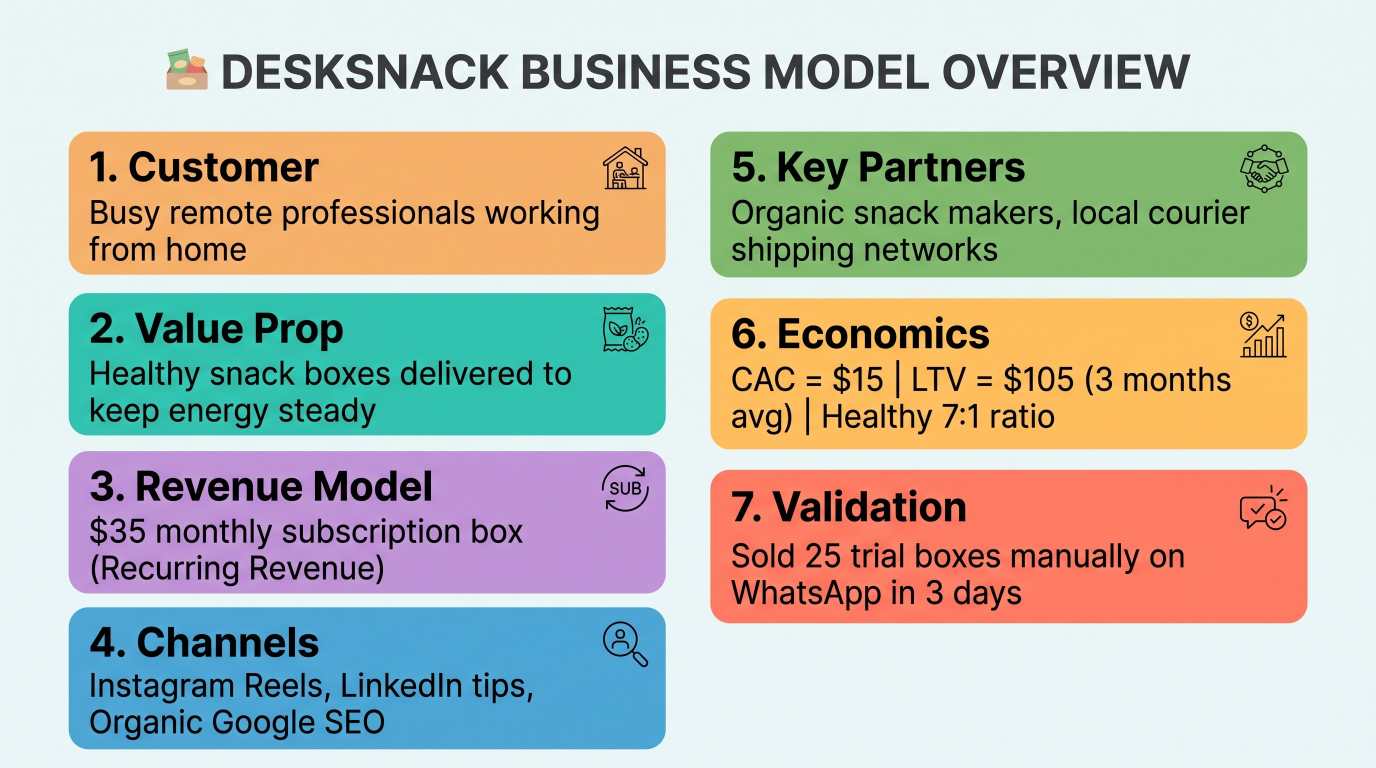
1. The Customer and Problem
Customer: Busy remote workers sitting at home desks all day.
Problem: Around 3:00 PM, they crash and crave snacks. They end up eating junk food because preparing fresh snacks takes too much time.
You can make customer support automation for see this article: How AI Is Changing Customer Service
2. The Value Proposition
"We help remote workers stay energized with nutritionist-curated healthy snack boxes delivered to their door every month, without any grocery shopping."
3. The Revenue Model
A recurring monthly subscription of $35 per box (free shipping included).
4. Channels
Acquisition: Short productivity videos on social media and helpful SEO blog posts about healthy workday nutrition.
Distribution: Monthly shipping parcels sent directly to home addresses via regional postal carriers.
5. Partners and Resources
Partners: Small organic food producers (who provide wholesale prices) and reliable fulfillment warehouses.
Resources: Curated supplier relationships, branded eco-friendly packaging, and an easy subscription billing portal.
6. Cost Structure and Economics
Cost per box (snacks + shipping): $15
Marketing spend per new customer (CAC): $12
Average customer retention: 4 months (LTV = 4 × $35 = $140)
Gross profit per customer: ($35 - $15) × 4 = $80 profit, minus the $12 CAC = $68 net profit per customer. The unit economics work cleanly!
7. Validation
Before renting warehouse space or buying thousands of printed boxes, the founder bought 20 plain boxes from a local store, filled them with healthy snacks from a wholesale market, and posted about it in two remote-work Slack groups. All 20 sold out in 48 hours. That proved real demand was there before spending big money.
5 Common Business Model Mistakes First-Time Founders Make
Even smart, hard-working founders make silly mistakes that drain their bank accounts. Keep an eye out for these five common pitfalls:
1. Pricing Too Low Just to Get Early Sales
Many beginners think: “If I make my product cheaper than everyone else, people will have to buy it!”
This is almost always a mistake. Competing purely on price triggers a race to the bottom. If your margins are tiny, you won't have enough gross profit left over to pay for marketing, fix bugs, or hire help. Price your solution based on the value and time you save the customer, not just on how cheap you can make it.
2. Believing "If We Build It, They Will Come"
You can have the most elegant, life-changing software on earth, but nobody will show up unless you build a clear path to their door. Spend just as much time figuring out your marketing and customer acquisition strategy as you do building your core product.
3. Relying Solely on Banner Advertising for Revenue
Unless you are building a platform that generates tens of millions of page views each month, display ads will barely pay your hosting bills. Charge your users directly for real value rather than trying to build an audience to sell to third-party ad networks.
4. Ignoring Cash Flow While Chasing Vanity Metrics
Followers, page views, and app downloads feel great to show off, but you cannot pay your rent with likes or app installs. Cash in the bank is the only metric that guarantees your startup lives to fight another day. Always know your monthly burn rate and how many months of runway you have left.
5. Waiting Too Long to Launch and Ask for Money
Building behind closed doors for twelve months without showing your product to a single customer is risky. If you launch after a year and discover nobody wants what you made, you have wasted twelve months of your life and your savings. Launch an imperfect version early, talk to users, and ask for the sale right away.
💡 Real Talk: Want to launch your app or website fast without getting bogged down by the tech? Partner with the expert team at GoodlySoft—we build custom, high-performing web and app solutions specifically for startups and growing businesses. Let’s discuss your project today!
Frequently Asked Questions (FAQ)
What is the simplest tool to map out a startup business model?
The Business Model Canvas is the most popular, practical tool in the startup world. It is a single-page visual template created by Alexander Osterwalder that lets you sketch all nine building blocks of your business—customer segments, value proposition, channels, customer relationships, revenue streams, key resources, key activities, key partnerships, and cost structure—on one page.
When should a startup founder start building a business model?
You should outline your business model before you write a line of code or spend money on inventory. You don't need a final, permanent model right away, but you must have a logical hypothesis of how your venture will make money before investing your time and capital.
Can a startup have more than one revenue model at the same time?
Yes, but you should be cautious. When you are just getting started, focus on one primary revenue stream until you reach steady, repeatable sales. Once your core engine is stable, you can add complementary revenue streams like premium consulting, digital add-ons, or enterprise plans.
How often should a startup update its business model?
In the early days, you should review your business model every few weeks based on customer feedback and sales data. Treat it like a living document. Once your startup finds strong product-market fit and revenue flows steadily, you can review and adjust it quarterly or annually.
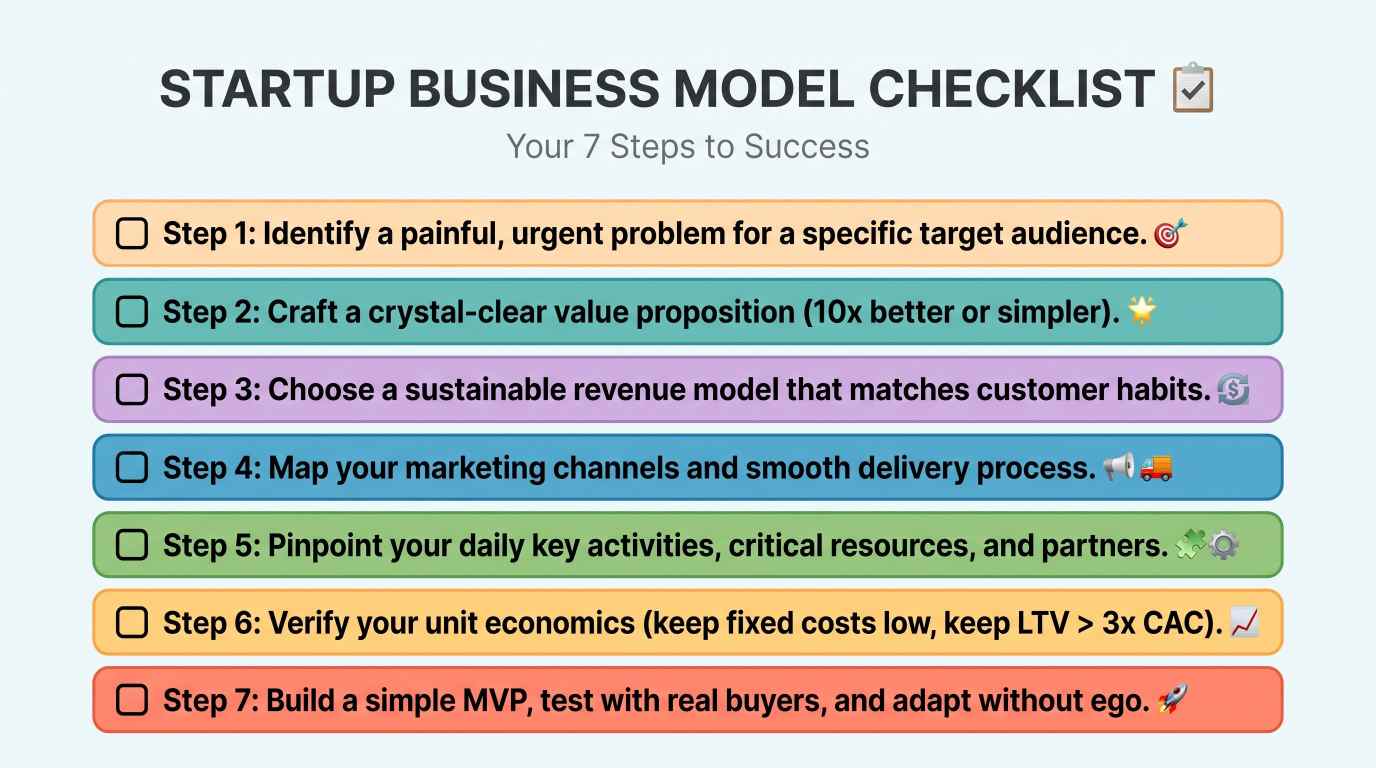
Summary Checklist: Your 7 Steps at a Glance
Here is a quick reference card to keep on your desk while you build:
Building a profitable startup isn’t about luck, magic, or finding a secret shortcut. It comes down to finding a real problem that genuinely bothers people, creating an easy solution, charging a fair price for it, and delivering on your promises every single day.
Now that you know how to build a business model for a startup in 7 simple steps, stop overthinking your idea. Pick your customer, talk to them today, map out your first version, and start testing your business model in the real world!
Ready to grow your business?
Contact us today to find out how our strategies can scale your operations to the next level.
Contact Us