How AI Is Changing Customer Service (And Why It Matters to You)
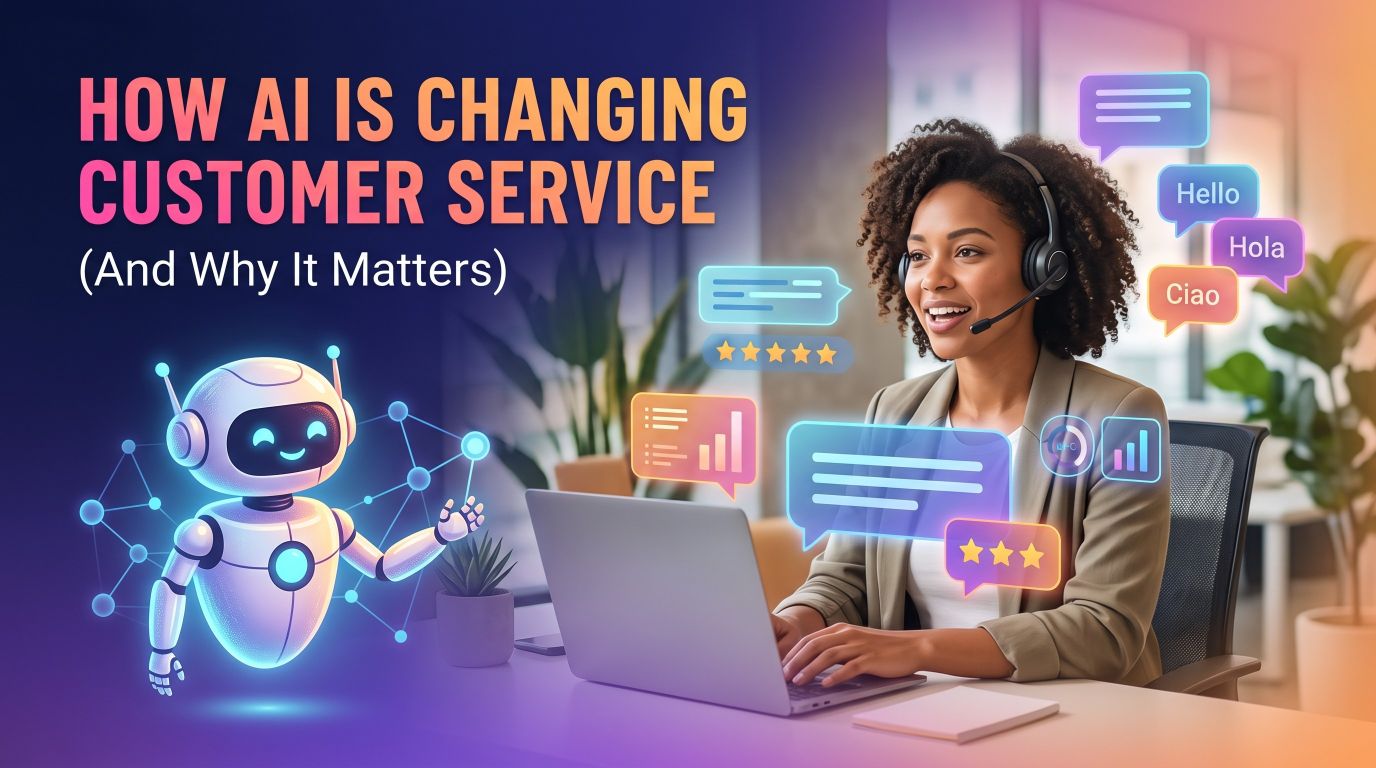
Have you ever called a support phone line, heard terrible elevator music, and waited forty-five minutes just to ask a simple question?
We all have. And let’s be honest: it is one of the most frustrating experiences in modern life. You have a broken order, a flight you need to change, or a software bug, and the clock is ticking while nobody answers.
Now, think about what happened the last time you typed a message into a chat bubble on a shopping website at 2:00 AM.
Within two seconds, the screen answered: “Hi there! I see your package arrived in Chicago this morning. Would you like me to change the delivery address?”
Before you could even finish your coffee, your issue was fixed. No wait times. No angry sighs. No bouncing between five different departments.
That right there is the big story.
Today, we are taking a deep look at how AI is changing customer service. We are not going to use confusing computer jargon or talk like a textbook. Instead, imagine we are sitting down with a cup of tea, chatting about how everyday business, shopping, and communication are shifting right before our eyes.
What Does AI in Customer Service Actually Mean?
Let’s start with the basics. When people talk about artificial intelligence in customer service, it sounds like science fiction. You might picture robots walking around an office wearing phone headsets.
In real life, it is much simpler.
AI in customer support is software that can read, understand, think about, and answer questions just like a person would, but at lightning speed. It learns from thousands of previous chats, emails, and manuals.
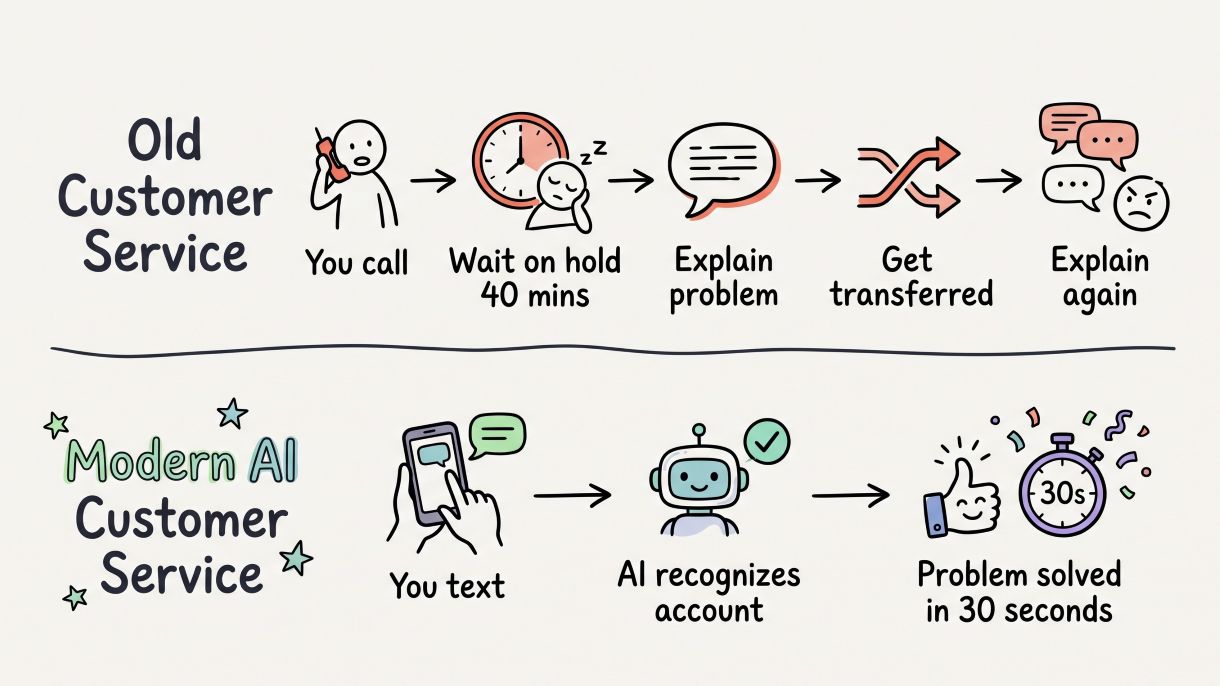
Years ago, websites used "rule-based bots." Those were the silly little windows where if you misspelled one word, the bot said: “Sorry, I did not understand. Please choose Option 1, 2, or 3.” They were frustrating because they could only follow rigid scripts.
Modern AI customer service is completely different. You can talk to it like you talk to a friend:
"Hey, I bought shoes yesterday, but I picked size 9 instead of 10. Can you swap them?"
The AI understands your slang, figures out which order you mean, checks the warehouse stock, and updates your size right away.
7 Big Ways How AI Is Changing Customer Service Today
Let’s break down the biggest shifts happening right now. These are the things that make your life easier when you shop, travel, or use your phone.
                          HOW AI TRANSFORMS CUSTOMER SUPPORT

           1. Instant answers 24/7 (Zero waiting in line)
           2. Fixes problems before you even notice them
           3. Breaks every language barrier instantly
           4. Helps human agents work faster and stay relaxed
           5. Knows your past issues so you never repeat yourself
           6. Recommends the exact solutions that fit your life
           7. Keeps business costs down while keeping smiles up
1. Goodbye Hold Music: True 24/7 Instant Help
The internet never goes to sleep. People work night shifts, live in different time zones, and do their online shopping on weekends.
In the old days, if your banking card got blocked on a Sunday evening, you had to wait until Monday morning at 9:00 AM to speak to someone. That ruined your weekend.
With smart systems running the front desk:
You get an answer within seconds, not hours.
It does not matter if it is 3:00 PM on Tuesday or 4:00 AM on New Year’s Day.
Millions of shoppers can ask questions at the exact same second without crashing the call center.
When someone asks how AI is changing customer service, this is always the first answer: it gives people their precious time back.
2. No More Repeating Your Story Three Times
Think about how annoying this common scenario is:
You call an agent and explain your problem for five minutes.
They say, "Sorry, let me transfer you to technical support."
The new agent answers: "Hi, who am I speaking with, and what is your problem?"
You want to scream!
Smart support tools solve this cleanly. When a chat or call starts, the system looks up your account. It sees what you bought, when you bought it, and what went wrong last week. If the bot needs to hand you over to a human worker, it passes a short summary along:
"Customer bought jacket #204. Size was wrong. Wants to exchange for Large. Please confirm warehouse stock."
When the human agent picks up, they say: "Hey Mark, I see you want to change that jacket to a Large. Let's get that done for you right now." That feels amazing as a customer.
3. Talking to Anyone in Any Language
The world is connected. A small handmade leather shop in Italy might sell bags to buyers in Japan, Canada, and Brazil.
In the past, that Italian shop could only answer emails in Italian or English. If a customer sent a message in Spanish or Japanese, the shop owner had to copy and paste sentences into a translation app, hoping they did not say something silly by mistake.
Today, multilingual language models translate messages instantly on both sides:
The customer types in Japanese.
The agent reads it in Italian.
The agent replies in Italian.
The customer receives a fluent, natural reply in Japanese.
This completely breaks down language barriers. Small businesses can now give world-class service to customers all around the world without hiring an army of translators.
4. Fixing Issues Before You Even Notice Them
What is better than quick customer support? Support you never even had to ask for.
This is called proactive support, and it is a massive part of how AI is changing customer service.
Here is an everyday example: Imagine an internet company. In the past, if a local cable snapped, hundreds of angry neighbors had to call support to report the outage.
Now, computer programs monitor the network constantly. The moment a signal drops in a neighborhood:
The system automatically texts the users: "We noticed a tiny drop in your signal on your street. A technician is already on the way. We expect it fixed by 3:15 PM."
It saves you the trouble of checking your router or waiting on hold. You already know what is happening.
The Old Reactive Way:  Something breaks -> You complain -> Company fixes it
The Modern AI Way:      System detects flaw -> System fixes it -> You get a quick update
5. Giving Human Agents "Superpowers"
A lot of people worry: "Does this mean companies will fire all their human workers?"
The short answer is no. The best companies do not use tech to replace humans; they use it to make their staff happier and faster.
Think of it like Iron Man’s suit. Tony Stark is still the human inside, but the suit gives him the power to fly.
When a customer agent handles a tricky issue, the background assistant does the heavy lifting:
It searches through 500 pages of product manuals in half a second.
It types out draft suggestions that the agent can review, tweak, and send with one click.
It takes care of boring copy-paste work like updating shipping addresses, issuing refunds, and filling out forms.
Because the computer handles the boring, repetitive chores, the human worker can focus on being kind, listening closely, and solving real human problems.
6. Recognizing How You Feel (Sentiment Analysis)
Have you ever sent an email when you were furious? Maybe you used all caps, lots of exclamation marks, or words like "terrible" and "unacceptable."
Old bots did not care. They would reply with a cheerful, robot message: "Thanks for your feedback! Have a sunny day! :)" That only makes an angry customer even angrier.
New tools use something called sentiment analysis. That is a fancy term for detecting human mood:
Customer Message: "My flight got canceled, I am stuck at the airport, and my bags are lost! Fix this NOW!"
       |
       v
AI Sentiment Check: [Urgent / High Frustration]
       |
       v
Action: Skip all automated menus -> Route straight to a senior specialist in 5 seconds
The system spots anger, stress, or urgency right away. It knows not to waste your time with generic menus. It routes you directly to an experienced human manager who can calm you down and fix the emergency.
7. Hyper-Personalized Shopping Suggestions
Customer service is not just about fixing things that break. It is also about guiding you when you are trying to make a choice.
Think about walking into a small neighborhood bakery where the baker knows your name and says, "Hey, your favorite blueberry muffins just came out of the oven!"
AI brings that friendly neighborhood feeling to giant online stores:
It looks at what you like, what you bought before, and what people with similar tastes enjoy.
If you ask, "What gift should I get for my 10-year-old nephew who loves space?", it does not just show you 1,000 random toys.
It suggests three top-rated telescope kits within your budget and explains why other parents liked them.
Comparing the Old Way vs. The AI Way
To see the difference clearly, let’s put the two models side by side:
Feature | The Old Support Model | Modern AI Customer Support |
|---|---|---|
Response Time | 20 to 60 minutes on hold | Under 5 seconds |
Availability | Monday to Friday, 9 to 5 | 24 hours a day, 7 days a week |
Memory | You must explain your story repeatedly | Remembers your account history instantly |
Languages | Only languages spoken by local staff | 50+ languages translated in real time |
Agent Stress | High (answering the same basic questions all day) | Low (focusing on interesting, complex tasks) |
Cost for Business | Very high per support ticket | Much lower, with higher satisfaction |
Why Customers Love It (When It Is Done Right)
When people hear about new technology, they can be skeptical. But when you ask regular shoppers what they actually want from customer care, their answers are simple:
Be fast.
Be accurate.
Do not make me work hard.
AI delivers on all three.
What People Care About:
Speed (40%) + Accuracy (35%) + Ease of Use (25%) = Happy Customers
Nobody wakes up in the morning wanting to chat with a support rep for an hour about a simple tracking code. You want your answer in ten seconds so you can get back to your life, your family, or your job. By removing friction, everyone stays happier.
The Big Challenges: What AI Still Cannot Do
We have talked a lot about the bright side. But let's keep things real: technology is not magic, and it is definitely not perfect.
If a business relies 100% on software without human supervision, things can go wrong quickly.
The Missing Ingredient: True Human Empathy
Computers do not feel feelings. They can write the words "I am so sorry to hear that," but they do not feel your pain.
Imagine a customer who is calling because an airline lost the luggage containing their wedding dress, and the wedding is tomorrow morning.
A computer might say: "Luggage claim file #4489 created. Standard delivery time is 48 hours."
That is technically correct, but it is awful customer service. That customer is crying and having a panic attack.
They need a warm human being who says: "Take a deep breath. I understand how stressful this is. I am going to stay on this line with you, call the baggage handler at the airport directly, and make sure that dress gets to your hotel tonight."
Empathy, warmth, and genuine care are strictly human traits. No algorithm can replace them.
When Software Makes Stuff Up
You might have heard the word "hallucination." In the tech world, that simply means a computer generated an answer that sounds confident, but is completely untrue.
For example, a travel chatbot might promise a customer: "Sure, you can take four giant suitcases on this plane for free!" — when the airline's policy actually limits passengers to one bag.
If a company lets a bot give out wrong facts, it hurts trust and costs money. That is why smart businesses set strict rules and guardrails, making sure the system only shares verified policies from their official help center.
Privacy and Data Security
People share sensitive details with companies every day: credit card numbers, home addresses, and phone numbers.
When businesses introduce smart systems, they have to protect that data with bank-grade security. Customers need to know their private conversations are never sold to outsiders or used for spam.
How Companies Can Use AI the Right Way (Step-by-Step)
If you run an online store, manage a team, or plan to build a business, you might wonder how to start without confusing your visitors.
Here is a simple, sensible path to follow:
[ Step 1: Collect Top 20 FAQs ]
             |
             v
[ Step 2: Set Up a Friendly Bot for Basic Tasks ]
             |
             v
[ Step 3: Always Give an Easy "Talk to Human" Button ]
             |
             v
[ Step 4: Ask Customers for Quick Feedback ]
Step 1: Start with the Easy, Repetitive Questions
Do not try to automate your whole company on day one. Look at the last 1,000 emails your team received. You will likely find that 60% of them ask the exact same four questions:
"Where is my order?"
"How do I reset my password?"
"What is your return policy?"
"Do you ship to my country?"
Set up your automated tools to handle those simple questions first. That immediately frees up hours of your team’s day.
Step 2: Always Provide a "Talk to a Human" Escape Hatch
Nothing makes a customer madder than being trapped in a loop with a bot that does not understand them, with no way to reach a human.
Never hide your human staff!
Always put a clear button that says: "Connect with an agent." If a user clicks it, let them through smoothly. Just knowing that a real person is standing by gives visitors peace of mind.
Step 3: Train Your Staff, Don't Replace Them
Talk to your customer care team openly. Explain that the new system is there to take the boring, repetitive chores off their plate so they don't burn out. Train them on how to manage the software, review drafts, and focus on helping your highest-value clients.
What the Future of Customer Support Looks Like
Technology moves fast. In the next few years, the way we solve everyday problems will feel even smoother and more natural.
Here is a sneak peek at what is coming next:
1. Voice Assistants That Sound Completely Natural
You will not have to push buttons like "Press 1 for Billing." You will simply talk like you talk to a friend on the phone. The voice assistant will listen, understand your everyday speech, answer naturally without weird robotic pauses, and resolve your issue in seconds.
2. Video Support and Visual Problem Solving
Imagine your coffee maker stops heating water. Instead of reading a 40-page manual or trying to describe a tiny flashing light over the phone, you point your phone’s camera at the machine.
An assistant will look through your camera and highlight your screen in real time: "See that blue switch on the side? Flip it up, and the water line will clear."
Problem solved in ten seconds.
3. Total Device Harmony
Your watch, phone, car, and home appliances will talk to each other to make life effortless.
If your refrigerator spots that a fan belt is wearing thin, it can alert the manufacturer, check your schedule, and ask you: "A maintenance check is due for your fridge. Can a technician come by this Thursday at 4:00 PM?" You tap "Yes," and it's done before your food ever spoils.
Frequently Asked Questions (FAQ)
Will AI completely replace human customer service workers?
No. While smart systems handle simple and repetitive tasks like tracking orders or checking store hours, human workers are still essential. People are needed to handle sensitive issues, solve unique problems, and provide genuine care and comfort. The most successful businesses combine smart technology with a strong human team.
How does artificial intelligence help small businesses?
It levels the playing field. In the past, only giant corporations had the money to keep support staff available around the clock. Today, even a solo entrepreneur can set up automated support to greet customers, answer product questions, and process orders 24/7.
Is AI customer service safe for my personal data?
Yes, as long as you are dealing with trustworthy companies that follow strict privacy laws. Good companies encrypt your chats and strip out sensitive payment data so your information remains secure.
Why do some people still dislike customer service bots?
Most people who dislike bots are remembering older, rigid systems that forced users to pick from numbered lists and could not understand simple phrases. Modern tools are much easier to talk to, understand normal everyday language, and quickly pass you to a human if you get stuck.
Final Thoughts: It’s All About People
When you look past all the hype, computer chips, and fancy buzzwords, one truth remains clear:
Customer service has always been about making people feel heard, respected, and helped.
Technology is simply a tool. When companies use it carelessly just to cut costs, customers notice and get frustrated. But when businesses use it thoughtfully—to cut wait times, break language barriers, and give people their time back—everyone wins.
The future of customer support isn’t a battle between humans and machines. It is about humans and technology working together to make everyday life simpler, faster, and friendlier for all of us.
What has your experience been like recently? Have you had a great experience with quick automated support, or do you still prefer speaking to a human right away? Share your thoughts in the comments below!
Ready to grow your business?
Contact us today to find out how our strategies can scale your operations to the next level.
Contact Us