How to Choose a Startup Pricing Strategy: The Simple Guide to Making Real Money
Setting the price for your product is terrifying.
If you ask too much, you worry nobody will buy it. If you ask too little, you run out of money and close your doors. Most founders spend months building an amazing app or product, and then they spend twenty minutes picking a random price on a Sunday night.
They think: "Well, my competitor charges ten dollars, so maybe I should charge nine dollars to win."
Please do not do that.
Pricing is not just a sticker on your homepage. It is the engine that keeps your company alive. It decides who your customers are, how much you can spend to find them, and whether your business actually survives.
In this guide, we are going to break down exactly how to choose a startup pricing strategy in plain English. No boring MBA jargon. No complicated math formulas. Just practical steps that work in the real world.
Why Pricing Strategy Matters More Than You Think
A lot of founders believe that if their product is good enough, pricing will take care of itself. That is simply not true. You can build the most helpful software in the world, but if your price is wrong, your business will fail.
Here is why your pricing model matters so much:
It tells people how valuable your product is: People associate price with quality. If you sell a business tool for $2 a month, people think it is cheap and unreliable. If you sell it for $50 a month, they take it seriously.
It pays for your growth: If you only make $5 per customer, you cannot afford to run ads, hire support staff, or write great articles. If you make $500 per customer, you can afford to market aggressively.
It filters your customers: Cheap products attract high-maintenance users who complain a lot. Fair, higher-priced products attract buyers who understand the value and respect your time.
When you learn how to choose a startup pricing strategy, you are not just picking numbers. You are deciding what kind of company you want to build.
The 4 Main Types of Startup Pricing Strategies
Before picking your exact number, you need to understand the four basic ways startups price their products. Let us walk through each one.
1. Cost-Plus Pricing (The Old Way)
This is the simplest way to price anything:
You calculate what it costs you to make one unit or serve one user.
You add a little extra profit on top (say, 20% or 30%).
That is your price.
Example: If your server costs and customer support cost you $10 per user per month, you charge $13.
Why it works: It is very safe and easy to calculate.
Why it fails for tech and startups: Digital products usually cost almost nothing to duplicate. If your software costs $1 per user to run, charging $2 makes no sense if that software saves a company $10,000 every week. You leave all your money on the table.
2. Competitor-Based Pricing (The Follower Way)
With this strategy, you look at what other companies in your space are charging and you match them or go slightly lower.
Why people do it: It requires almost no thinking, and your market is already used to paying that price.
Why it is dangerous: You have no idea what your competitor's bank account looks like. Maybe they have millions of dollars in investor cash and do not need to make a profit right now. If you copy their price, you might run out of cash trying to keep up.
3. Value-Based Pricing (The Winner Way)
This is the gold standard for startups.
Instead of looking at your own costs or your competitor's website, you look directly at your customer. You ask: "How much money, time, or headache am I saving this person?"
If your product helps a small business owner save 10 hours of manual work every week, how much is that worth to them? Easily $200 to $500 a month. If you charge them $50 a month, they will happily pay it because they are getting way more value than what they spend.
Rule of thumb: Always try to give at least 5x to 10x the value of what you charge. If you charge $10, make sure they feel like they are getting $50 or $100 in return.
4. Penetration Pricing (The High-Risk Way)
Penetration pricing means you enter the market with a super-cheap price just to get thousands of signups quickly. Once people are hooked, you raise your prices.
The danger: Most customers who sign up because a tool is dirt cheap will cancel the second you raise prices. This strategy rarely works for bootstrapped startups without deep pockets.
Step-by-Step: How to Choose a Startup Pricing Strategy
Now that you know the basic models, let us walk through the exact steps you should take to pick your pricing model today.
Step 1: Know Exactly Who You Are Selling To
You cannot price a product until you know who holds the credit card.
Are you selling to a college student, a freelance designer, a 20-person agency, or an enterprise company with 5,000 employees?
Selling to consumers (B2C): People are spending their own personal money. They are sensitive to price. Usually, this means prices under $20/month.
Selling to small businesses (B2B SMB): Owners care about efficiency and saving time. They will gladly pay between $30 and $200/month if it makes their job easier.
Selling to enterprise corporations: They care about security, compliance, and reliability. They often have budgets starting at $10,000 to $100,000 a year, and low prices actually make them nervous.
Pick one main group to start with. Do not try to sell to both high school students and giant banks at the same time.
Step 2: Find Your "Value Metric"
A value metric is the thing you charge for. It is how your price grows as your customer gets more value from your product.
Getting your value metric right is often more important than the price itself.
Here are a few common examples:
Per user / seat: Example: Slack or Google Workspace. You pay more as your team gets bigger.
Per feature / usage: Example: Mailchimp charges by how many email contacts you have. AWS charges by how much cloud storage you use.
Flat rate: You pay one fixed price and get unlimited access.
How to pick the right value metric:
Your metric should align with your customer's success.
If you run an email software, your customers want more subscribers. Charging based on list size makes sense.
If you run an accounting tool, charging per invoice or per company connected makes sense.
When your customer grows, your revenue should grow too.
Step 3: Talk to Potential Customers (Without Asking "How Much Would You Pay?")
If you ask someone directly, "How much would you pay for this?", they will always give you a useless answer. Either they will say a tiny number because they want a deal, or they will say a huge number just to be polite and make you feel good.
Instead, ask these four simple questions (known as the Van Westendorp Price Sensitivity test):
At what price would this product feel so cheap that you would doubt its quality?
At what price would this feel like a bargain or a great deal?
At what price does it start feeling expensive, but you would still consider buying it?
At what price is it too expensive, so you would walk away?
When you ask 15 to 20 potential buyers these four questions, clear price ranges will show up. You will instantly see your floor (the lowest safe price) and your ceiling (the maximum people will pay).
Step 4: Pick a Tiered Structure (The Rule of Three)
Most successful digital products and software tools offer three tiers. Why three? Because humans love choices, but hate being overwhelmed.
Here is the classic setup:
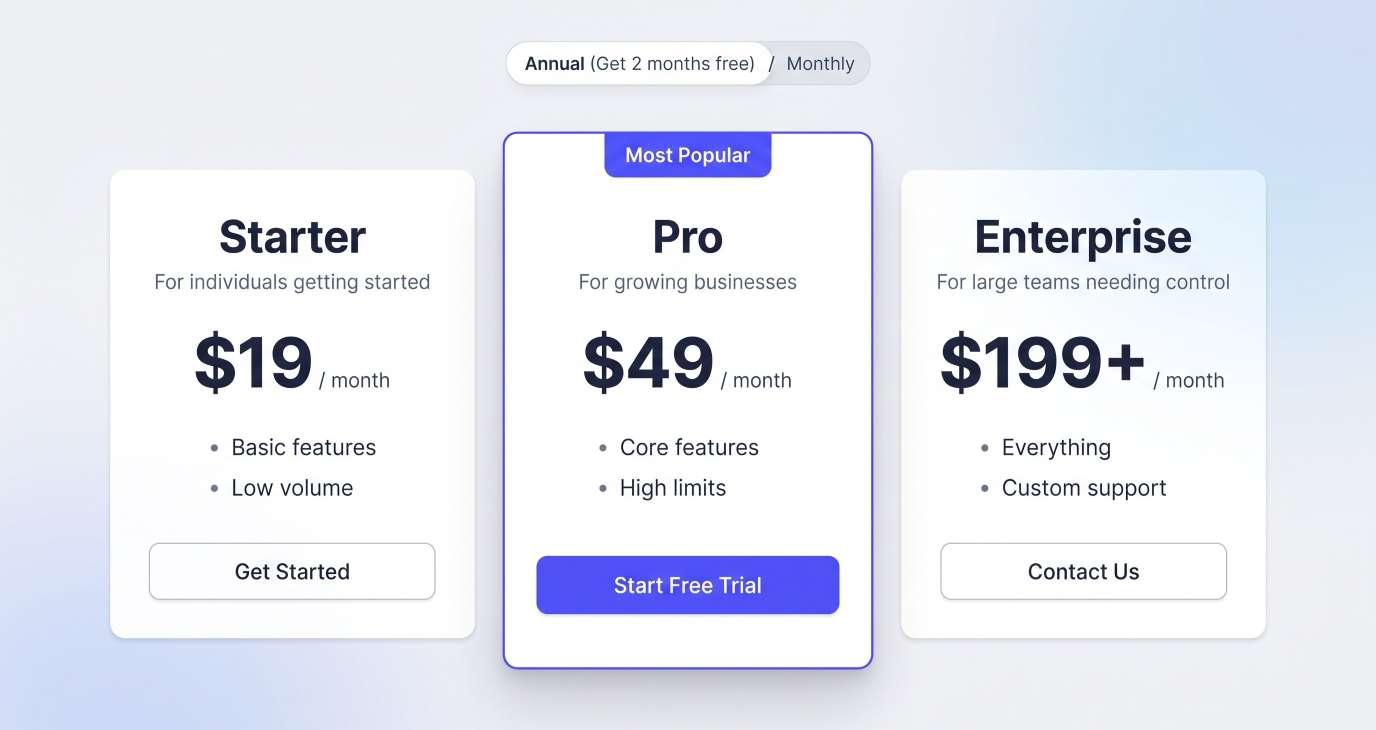
Tier 1 (The Anchor): Low barrier to entry. Gives basic features to let people start quickly.
Tier 2 (The Sweet Spot): The plan you actually want most people to buy. Make this plan look like the best value by highlighting it on your page.
Tier 3 (The Stretch): For power users or bigger teams. Even if only 5% of users buy it, this plan will generate a large chunk of your profit.
Should You Offer a Free Plan? (Freemium vs. Free Trial)
This is one of the biggest arguments in the startup world. Should your product be free to start?
Let us look at the real differences so you do not make an expensive mistake.
The Truth About Freemium
Freemium means users can use a basic version of your tool forever without paying a dime.
The dream: Millions of users sign up, tell their friends, and 2% of them upgrade to paid plans.
The reality: Free users eat up customer support time, cost money for server hosting, and often never upgrade.
If you are a solo founder or have a small budget, be very careful with freemium. Only use freemium if your product has built-in viral growth (like when sharing a document forces the receiver to sign up to view it).
Why Time-Based Free Trials Work Better
A 14-day or 30-day free trial is usually much better for an early-stage startup.
It creates urgency: The customer actually tests the product during those two weeks.
It sets expectations: They know from day one that this is a professional, paid product.
It protects your time: You only spend your energy helping people who have genuine buying intent.
Common Pricing Mistakes Almost Every Founder Makes
Learning how to choose a startup pricing strategy also means learning what traps to avoid. Keep these red flags in mind:
1. Pricing Way Too Low
Early founders often suffer from impostor syndrome. They feel guilty asking for real money. But charging $5 for a business tool often kills your brand. Higher prices attract better, more committed clients who actually use your product and give helpful feedback.
2. Making Your Pricing Page Too Complicated
If a buyer has to spend five minutes reading a giant comparison table with 40 rows of checkmarks, they will get confused and leave. Keep your pricing page dead simple. Clearly state:
Who each plan is for.
What main limits apply.
The simple monthly or yearly price.
3. Forgetting to Offer Annual Billing
Always offer an annual plan with a small discount (usually two months free, or roughly 15% to 20% off).
Why? Because upfront annual cash is rocket fuel for a young company. It gives you immediate cash in the bank to fund your development and customer service without waiting a whole year to collect it month by month.
4. Never Changing Your Prices
Your price is not set in stone. As your product gets faster, gains more features, and proves its value, your price should go up. You can always let early users keep their original price (called grandfathering) while asking new users for a higher, updated rate.
Simple Action Checklist for Your Startup
Here is a quick checklist you can print out or save to your notes:
✔️ Write down your target customer: Consumer, Small Business, or Enterprise.
✔️ List the primary benefit: Are you saving them time, making them money, or reducing stress?
✔️ Select one clear value metric (e.g., per user, per volume, per project).
✔️ Research three direct competitors to understand the baseline market rate.
✔️ Run the 4 Van Westendorp questions with 10 to 15 real target users.
✔️ Design three clear plans: Starter, Pro, and Premium/Enterprise.
✔️ Add an annual toggle that gives two months free for upfront payment.
✔️ Launch, watch how people behave, and do not be afraid to adjust after 60 days.
Frequently Asked Questions (FAQ)
What is the best pricing strategy for an early-stage startup?
For most tech and software startups, value-based pricing is the best option. It links your income directly to the positive impact you create for your customer, allowing you to charge profitable rates while giving users great return on investment.
How often should a startup raise its prices?
Many startups review their pricing every six to twelve months. As you add better features and build customer trust, updating your prices ensures your revenue keeps up with the growing quality of your product.
Should I ask for a credit card upfront on a free trial?
Without a credit card: You get more signups, but fewer will convert into paying customers. This is great for getting feedback in the early days.
With a credit card: You get fewer signups, but those who register are serious buyers who convert at a much higher rate.
If you are just launching and need real user feedback, start without asking for a credit card. Once your product is solid, test requiring a card to improve lead quality.
Final Thoughts: Keep It Simple and Start Testing
Do not let pricing freeze your launch.
You do not need to find the 100% perfect price on day one. Pick a fair, realistic price based on the value you deliver to your user, start talking to customers, and watch how they react.
If people buy without asking a single question, your price is probably too low. If everyone says no, you either need to adjust your price or do a better job explaining why your product is worth every penny.
Take your time, focus on customer value, and build a business that makes real money from day one.
Ready to grow your business?
Contact us today to find out how our strategies can scale your operations to the next level.
Contact Us