How to Calculate Customer Acquisition Cost (CAC)
Imagine spending $1,000 on social media ads, getting 10 brand-new customers, and thinking you just crushed it.
On paper, you spent $100 per customer. But wait—did you pay a copywriter to write those ads? Did you pay for the email software that closed the sale? What about the salary of your sales rep who spent two hours on Zoom explaining the offer?
If you leave those out, you aren't actually running a profitable business. You are just guessing.
Knowing your numbers is the difference between scaling a company and quietly running out of cash. In this guide, we are going to break down how to calculate customer acquisition cost, why CAC customer acquisition cost matters so much, and how to lower your cost per customer so you keep more profit in your bank account.
No complicated math degree required. Let’s sit down and talk through it like two friends having a cup of coffee.
What Is Customer Acquisition Cost (CAC)?
Let’s keep this super simple.
Customer Acquisition Cost (CAC)—often referred to simply as CAC cost or acquisition cost—is the total amount of money you spend to convince a stranger to buy your product or service.
Think of it as buying customers in bulk. If your business is a lemonade stand, your lemons, sugar, cups, poster board, and the pocket money you pay your cousin to hold the sign on the corner all go into your total cost. If you spend $50 in total and 25 people stop by to buy a cup, your cost per customer is $2.
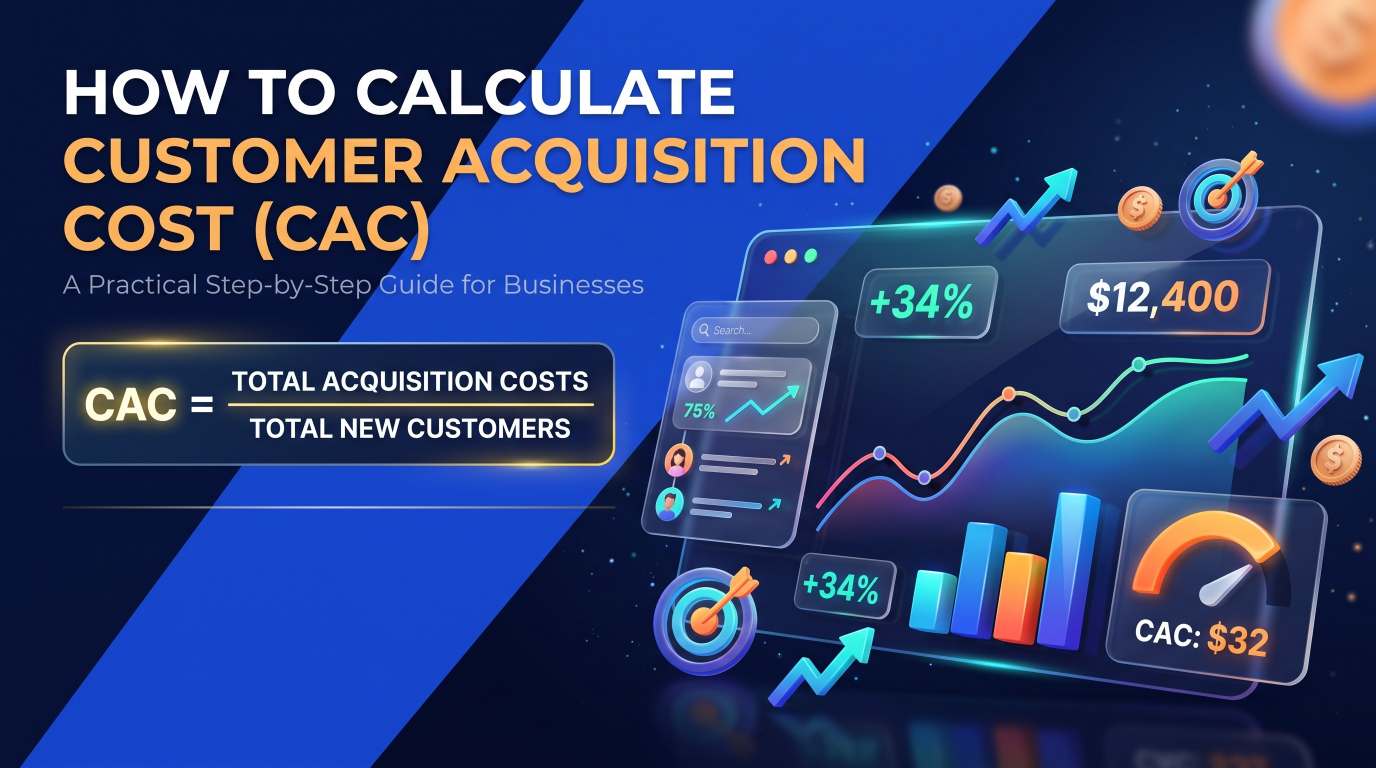
Total Money Spent on Marketing & Sales ÷ Total New Customers Won = CAC
When people ask, "What is CAC customer acquisition cost?", that is the entire concept in one sentence. It tells you exactly how much fuel (money) your business engine burns to produce one new buyer.
Why CAC Cost Is the Most Important Metric in Business
You might hear marketers talk about impressions, clicks, follower counts, and reach. Those are called vanity metrics. They make you feel good, but they do not pay the electric bill.
Here is why your actual CAC cost is the real boss of your business:
1. It Protects Your Bank Account from Silent Leaks
Many founders wake up after six months of solid sales and wonder, "Where did all the profit go?" Usually, the culprit is an invisible, creeping acquisition cost. When you calculate CAC accurately, you spot waste before it drains your bank account.
2. It Helps You Price Products Accurately
If your item sells for $50, your supplier charges you $20, and your cost per customer is $35, you lose $5 every single time you make a sale. You can't make up for that loss with "higher volume." The more you sell, the faster you go broke.
3. Investors Care More About CAC Than Your Pitch Deck
If you ever want a business loan or venture funding, the first two questions investors ask are:
"How much does it cost you to get a customer?"
"How much money does that customer spend with you over time?"
If you know those two numbers by heart, you immediately look like a seasoned professional.
The Basic CAC Formula (And Why Most People Get It Wrong)
The textbook formula for finding your cost per customer looks clean and harmless:
$$\text{CAC} = \frac{\text{Total Marketing and Sales Expenses}}{\text{Number of New Customers Acquired}}$$
The Mistake Almost Everyone Makes
Most beginner business owners only include direct advertising spend in that top number.
They say: "I spent $500 on Google Ads this month, and I picked up 20 customers. My CAC is $25!"
That is wrong. That is only your ad cost per acquisition (CPA), not your true business CAC cost.
To get the real truth, your total expenses must include every single penny that touched that customer journey.
What Actually Goes into the CAC Calculation?
Let’s open the hood of your business and list every expense you need to count when you learn how to calculate customer acquisition cost.
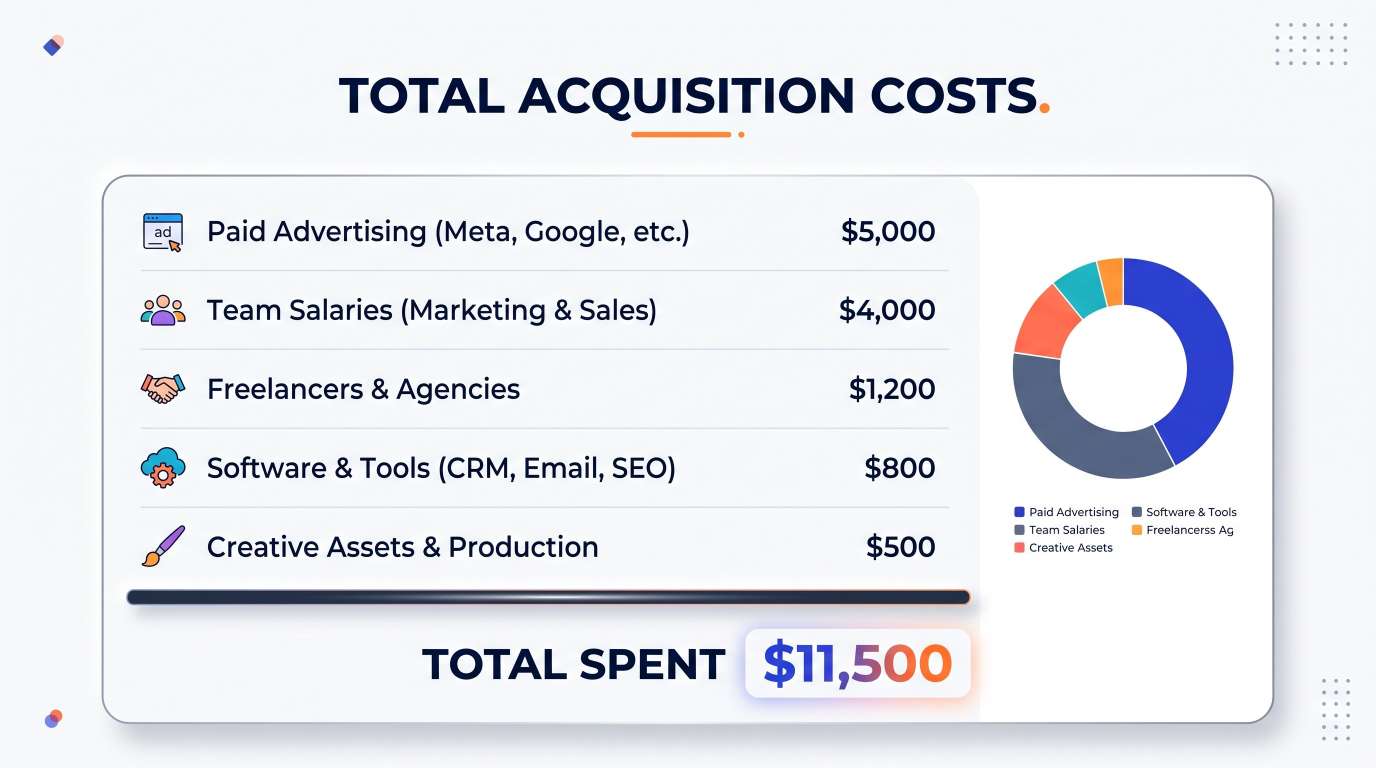
1. Paid Ad Spend
This is the obvious one:
Facebook, Instagram, and TikTok ads
Google Search and YouTube campaigns
Print flyers, billboards, or local event sponsorships
2. Team Salaries and Commissions
Human time is money. Include:
The percentage of marketing team salaries dedicated to acquisition
Sales reps' base pay, closing commissions, and bonuses
Customer onboarding specialists who close trial users
3. Software and Tech Subscriptions
The modern marketer runs on software:
Email marketing platforms (Mailchimp, Klaviyo, ActiveCampaign)
CRM software (HubSpot, Salesforce)
Analytics and landing page builders (Shopify apps, Unbounce)
4. Freelancer and Creative Production Fees
Did you hire a voice actor for an explainer video? A graphic designer on Upwork for ad creatives? A freelance copywriter for your sales pages? Every invoice belongs in your total spend bucket.
5. Overhead and Miscellaneous Expenses
Rent for your sales bullpen, demo equipment, or sample boxes sent to prospects all count toward the real cost of getting someone to sign on the dotted line.
How to Calculate Customer Acquisition Cost in 4 Clear Steps
Let’s walk through the math step by step with zero confusion.
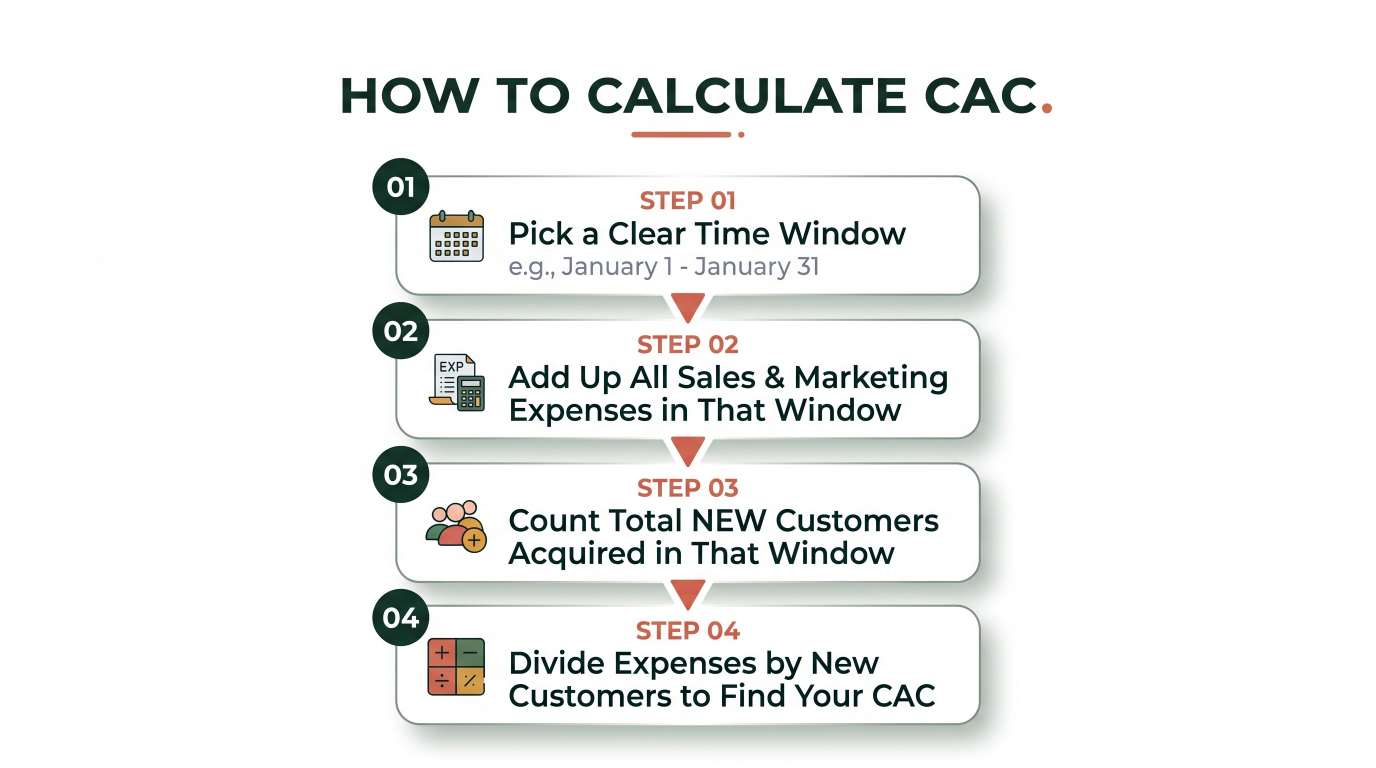
Step 1: Pick a Specific Time Window
Always calculate your cac customer acquisition cost over a defined period. The most common windows are:
Monthly: Good for quick checks on ad campaigns.
Quarterly (3 Months): Smooths out seasonal spikes and gives a clearer picture.
Annually: Best for high-level business reviews and investor reports.
Step 2: Sum Up Every Single Acquisition Expense
Gather your receipts, bank statements, and payroll sheets for that exact window.
Example: Let's look at the first three months of the year (Q1):
Paid digital ads: $12,000
Sales and marketing salaries: $15,000
Software licenses: $1,500
Freelance creative work: $1,500
Total Costs = $30,000
Step 3: Count Your New Customers
Count only brand-new, paying clients who came onboard during that same time frame.
Do not count returning buyers who renewed an existing subscription.
Do not count people who signed up for a free trial but never paid.
Do not count reactivated lost clients (keep them in a separate bucket called retention).
Example: In Q1, your company onboarded 300 brand-new customers.
Step 4: Do the Division
Take your total expense and divide it by the number of new buyers:
$$\frac{\$30,000}{300 \text{ new customers}} = \$100$$
Your cost per customer for Q1 is $100. Every time your business rings the register with a new buyer, you spent a clean $100 to make it happen.
Real-World Examples: Three Different Businesses
Seeing the math applied to real business models makes everything click into place.
Scenario A: The Local Service Business (Plumbing Co.)
Monthly Google Ads: $1,500
Truck wrap lease payment: $200
Local community paper ad: $300
Part-time booking agent salary: $1,000
Total Spent: $3,000
New clients booked: 60
CAC: $\frac{\$3,000}{60} = \mathbf{\$50\text{ per customer}}$
Scenario B: The E-commerce Apparel Store
Meta & TikTok ads: $8,000
Influencer gifting (cost of goods sent): $1,200
Email & SMS app subscriptions: $500
Creative video editor: $800
Total Spent: $10,500
First-time shoppers: 350
CAC: $\frac{\$10,500}{350} = \mathbf{\$30\text{ per customer}}$
Scenario C: The B2B Software Company (SaaS)
LinkedIn Ads: $5,000
Two Sales Development Reps (SDRs): $10,000
CRM & Outreach tools: $1,000
Trade show booth pass: $4,000
Total Spent: $20,000
New enterprise accounts signed: 10
CAC: $\frac{\$20,000}{10} = \mathbf{\$2,000\text{ per customer}}$
Notice how the SaaS company has a CAC of $2,000, while the t-shirt shop has a CAC of $30. Is the SaaS company failing? Not at all! That brings us to the next critical concept: context.
The Secret Partner of CAC: Customer Lifetime Value (LTV)
Evaluating your CAC cost by itself is like looking at one half of a coin. You cannot tell if a $100 CAC is amazing or terrible until you know what that customer pays you over their entire relationship.
This is where Customer Lifetime Value (LTV) comes in. LTV is the total revenue an average customer generates before they stop buying from you.
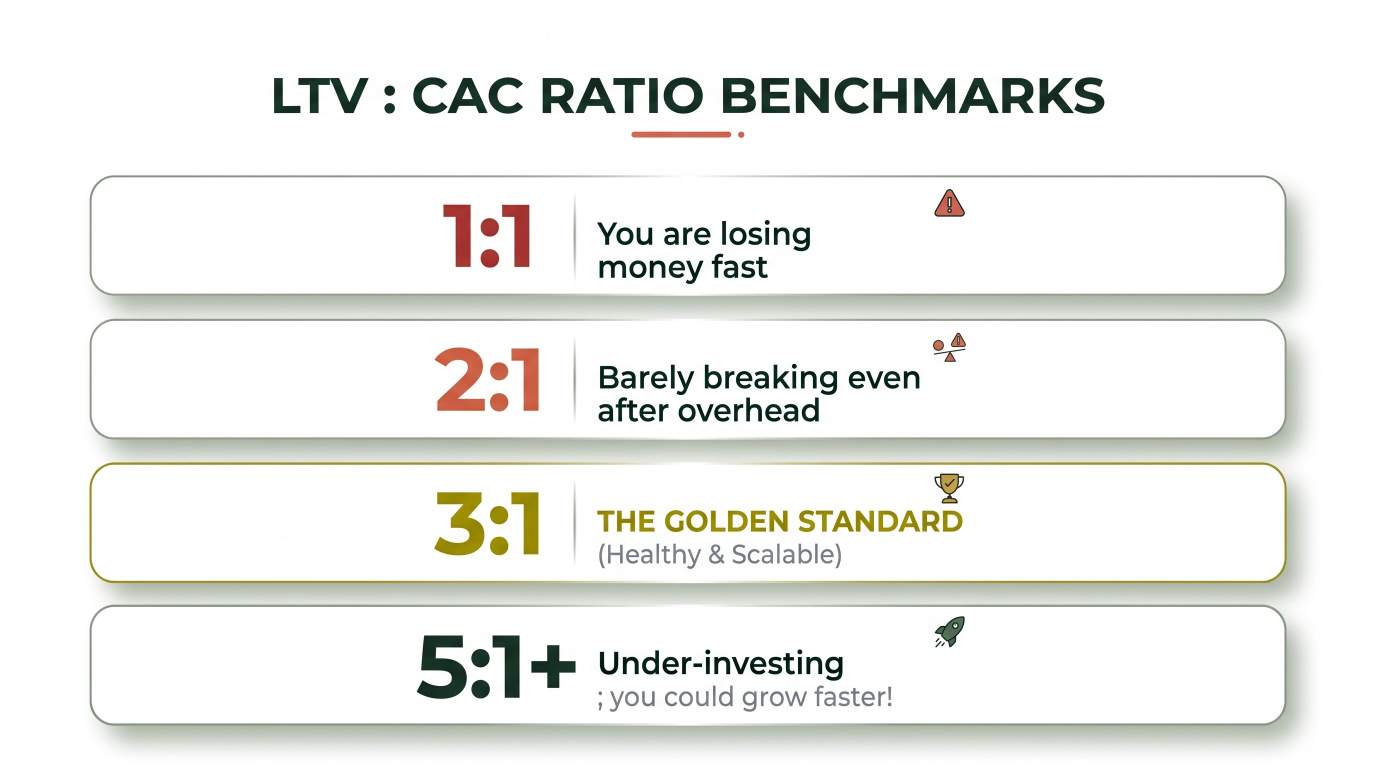
Understanding the LTV to CAC Ratio
LTV:CAC Ratio | What It Means for Your Business | Action to Take |
1:1 or less | You spend $100 to make $100. You are actively losing cash on overhead. | Stop spending on ads immediately and fix conversion rates or pricing. |
2:1 | You make twice what you spend, but rent and taxes eat up all remaining profit. | Work on upselling and reducing ad waste. |
3:1 | The Gold Standard. For every $1 you feed into the machine, $3 comes back out. | Keep scaling your marketing channels with confidence. |
5:1 or higher | Your returns are huge, but you are likely leaving massive market share on the table. | Invest more aggressively in customer acquisition to grow faster. |
If you run a subscription coffee club where a subscriber pays you $30 a month and stays for 10 months, their LTV is $300. If your CAC is $75, your ratio is $300 : $75, which simplifies to 4:1. That is a healthy, thriving business.
CAC Payback Period: The Cash Flow Protector
Even if your LTV:CAC ratio is a perfect 3:1, you can still go bankrupt if you run out of cash before the customer pays you back. This is called the CAC Payback Period.
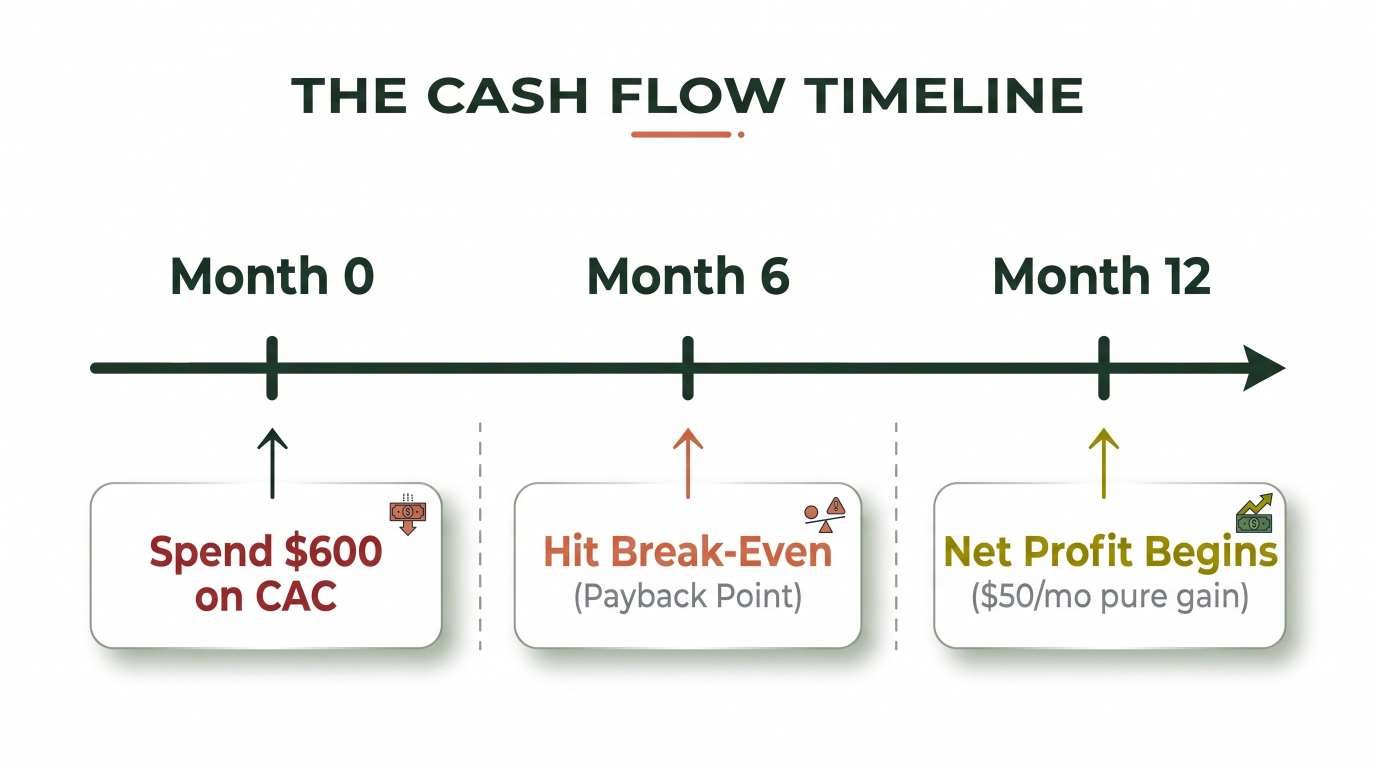
The payback period is the number of months it takes for a customer to generate enough gross profit to pay back the money you spent to acquire them.
$$\text{Payback Period (Months)} = \frac{\text{CAC}}{\text{Monthly Revenue per Customer} \times \text{Gross Margin}}$$
Under 6 months: Outstanding. Your cash recycles quickly, allowing you to reinvest and grow fast.
12 months: The typical sweet spot for software and recurring subscription businesses.
18+ months: Risky. You need large cash reserves or outside loans to survive the waiting period.
7 Proven Ways to Lower Your Cost per Customer
If you run the numbers and discover your cost per customer is uncomfortably high, don't panic. You don't have to slash your marketing budget to zero. You just need to make your pipeline more efficient.
Here are seven battle-tested strategies to bring your CAC cost down:
                  7 WAYS TO CUT CAC

  [1] Optimize Landing Pages  ──►  More conversions per click
  [2] Set Up Retargeting     ──►  Recover warm prospects cheaply
  [3] Launch Referrals       ──►  Near-zero acquisition cost
  [4] Produce Organic SEO    ──►  Durable traffic with no ad fee
  [5] Prune Bad Ad Channels  ──►  Stop funding money-losing ads
  [6] Improve Email Nurtures ──►  Close hesitant leads for pennies
  [7] Cut Churn Early        ──►  Keep buyers longer to lift value
1. Optimize Your Website Conversion Rate (CRO)
If 1,000 visitors land on your page and 10 buy, your conversion rate is 1%. If you improve your headline, add customer reviews, and speed up checkout so that 20 people buy, you just cut your cost per customer in half without spending an extra dime on traffic.
2. Set Up Smart Retargeting
Most people do not buy on their first visit. Instead of spending top dollar to constantly chase cold traffic, run simple retargeting ads to people who visited your site over the past 30 days. These warm prospects convert at a far lower CAC.
3. Build a Word-of-Mouth Referral Program
Your happiest customers are your best sales team. Offer them a store credit, free month of service, or cash reward for introducing friends. A customer who comes in through a referral has an acquisition cost near zero.
4. Invest in Long-Term Organic Content (SEO)
Paid ads stop delivering the second you turn off your credit card. High-quality guides, helpful videos, and podcast episodes stay on search engines for years. They bring in inbound visitors day after day for free, driving down your blended cac customer acquisition cost.
5. Cut Out Underperforming Channels
Check your analytics at least once a month. If Google Search delivers customers at $40 each, but Pinterest ads cost you $180 per customer, shift your money into what works. Stop funding vanity campaigns that fail to convert.
6. Strengthen Your Email Follow-Up Sequences
Many leads abandon their cart or browse your store without buying right away. An automated three-part email series that answers common questions and offers an introductory discount will convert those hesitant shoppers for pennies.
7. Reduce Customer Churn
When customers stay loyal, your average revenue per customer skyrockets. That extra cushion allows you to comfortably afford new customer acquisition and makes every marketing dollar go further.
Blended CAC vs. Paid CAC: What's the Difference?
When you study how to calculate customer acquisition cost, you will run into two terms: Blended CAC and Paid CAC. It is important to know the difference so you never misread your dashboard.
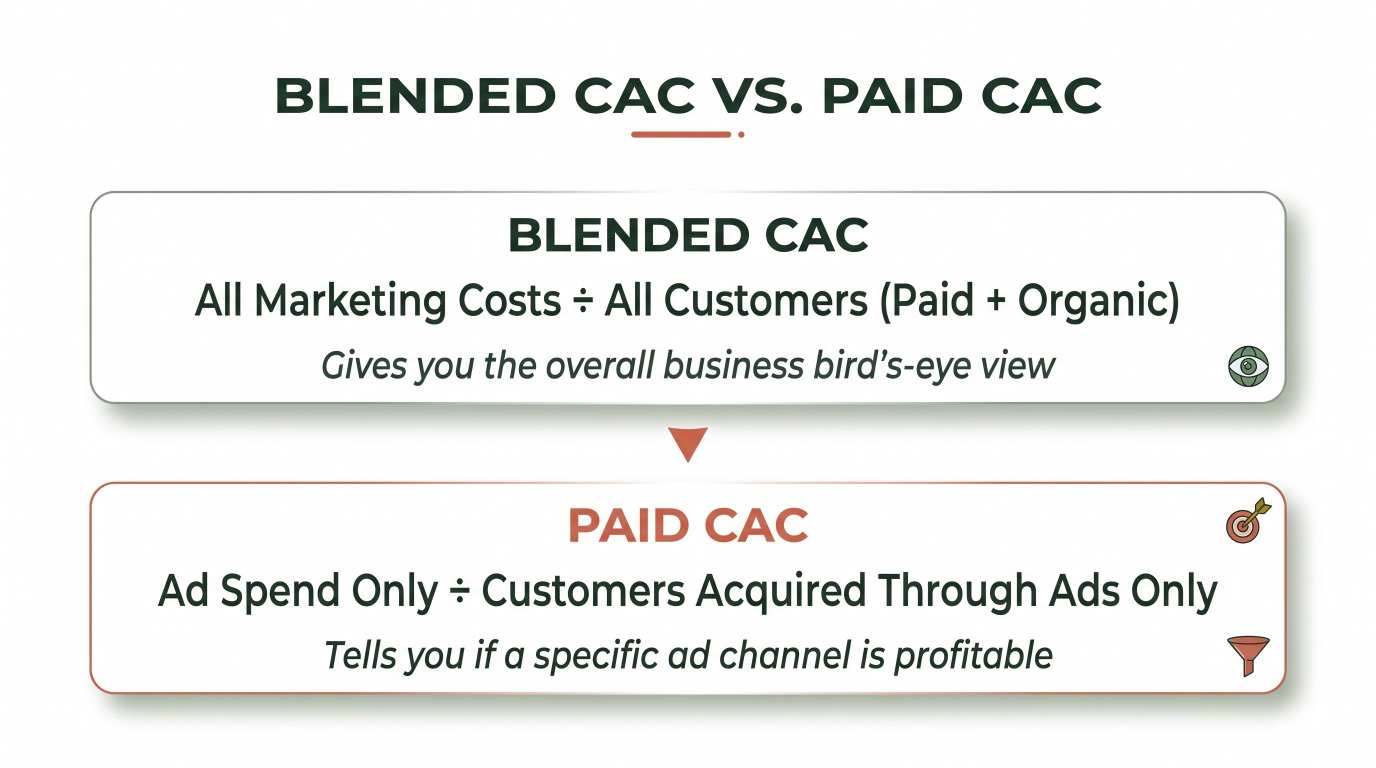
Blended CAC: Takes your entire marketing bill and divides it by all new customers, regardless of where they came from (search engines, friends, social posts, or paid ads). It gives you the big-picture view of your company’s health.
Paid CAC: Takes only your direct ad spend and divides it by the customers who directly clicked and bought through those ads. This tells you if an individual ad channel (like Meta or Google) is performing well on its own.
Track both. If your Blended CAC looks great only because your organic traffic is carrying the weight of a wasteful ad campaign, your Paid CAC will expose the problem immediately.
4 Common Traps to Avoid When Tracking CAC
Calculating your numbers sounds straightforward, but small mistakes can distort your results. Watch out for these four frequent traps:
Trap 1: Ignoring Long Sales Cycles
If you sell high-ticket consulting or enterprise software, a buyer might take four months to close. Dividing this month's ad expenses by this month's closed deals gives an inaccurate picture because today's deals came from ad money spent last quarter. Match your marketing spend to the actual sales cohort for reliable results.
Trap 2: Counting Returning Customers as New Ones
If an existing customer buys another pair of shoes or renews their subscription, do not add them to your new customer count. That belongs in customer retention, not customer acquisition.
Trap 3: Leaving Out Small Software Subscriptions
A $29 plugin here and a $49 stock photo tool there might not seem like much, but a dozen small subscriptions add up to thousands of dollars per year. Log every marketing-related software expense into your calculation.
Trap 4: Treating All Customer Segments the Same
A small customer paying $15 a month might cost you $20 to acquire, while an enterprise client paying $500 a month might cost $400. Group your CAC calculations by customer tier so you know which segment provides the strongest return.
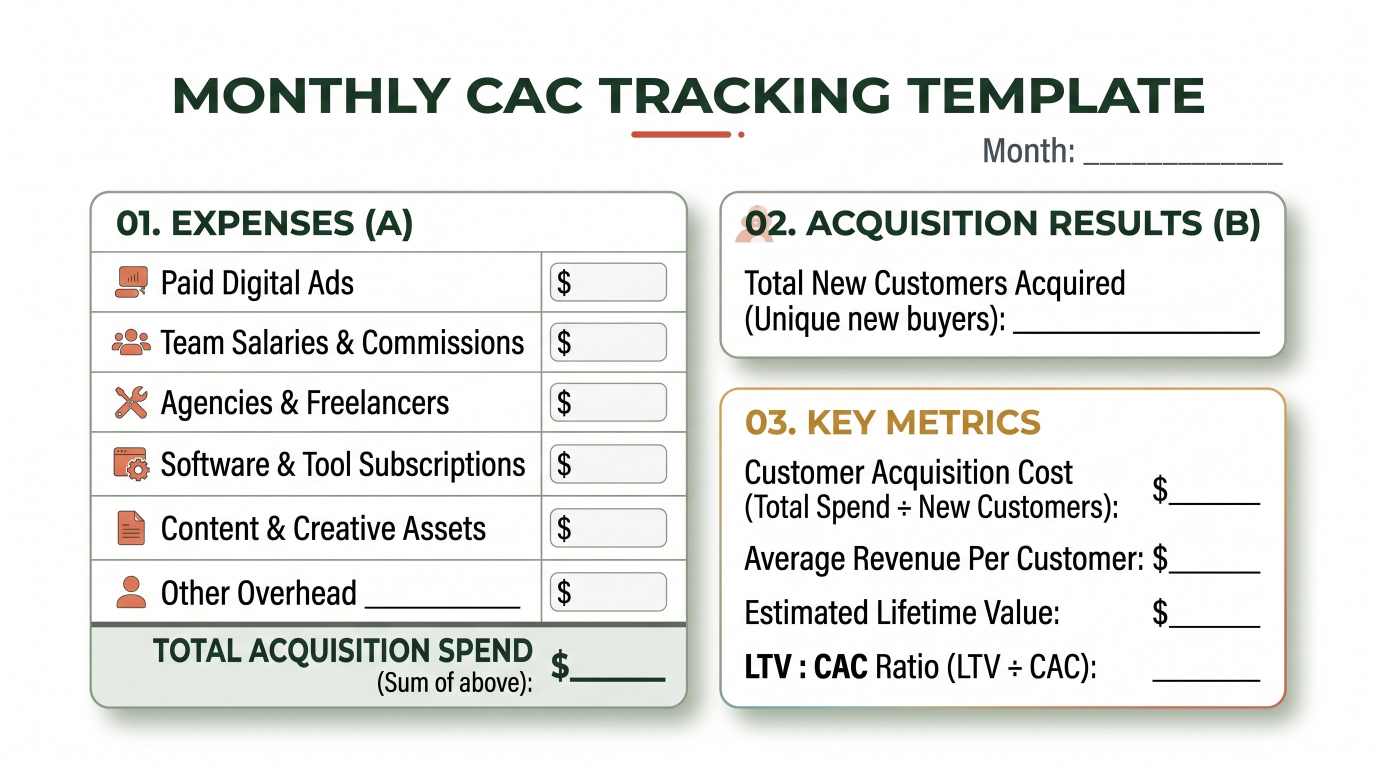
Free CAC Calculator Template
Here is a simple template you can copy and paste into any spreadsheet to track your metrics month by month:
Frequently Asked Questions About CAC
What is a good CAC customer acquisition cost?
There is no single "good" number because pricing structures vary across industries. A good CAC is simply one that works alongside your Lifetime Value (LTV). As a rule of thumb, aim for an LTV:CAC ratio of at least 3:1. If your average customer generates $300 in lifetime gross profit, a good CAC is $100 or less.
How often should you calculate customer acquisition cost?
Most businesses should calculate CAC cost once a month to catch negative trends early. High-volume e-commerce brands often review paid CAC weekly, while enterprise B2B companies track it quarterly to account for longer sales cycles.
What is the difference between CPA and CAC?
Cost Per Acquisition (CPA) usually measures the cost of a specific user action inside an ad platform—such as getting a click, an email lead, or a trial signup. CAC customer acquisition cost measures the overall business cost required to turn someone into a paying customer.
Can CAC ever be zero?
In practical terms, no. Even if you don't run paid ads and rely purely on social media or search engines, your time, hosting costs, and production tools carry real value. Free traffic still requires an investment of human effort.
The Bottom Line
Learning how to calculate customer acquisition cost is not about running complicated formulas for the sake of it. It is about understanding the real story behind your balance sheet.
When you know your true CAC cost, you stop second-guessing your business decisions. You know exactly what you can afford to spend, which marketing channels deserve more budget, and how many new buyers you need each month to hit your financial goals.
Your next action step: Open your financial accounts for last month. Add up your true marketing and sales expenses, count your genuine new customers, and run the calculation. Once you see your actual cost per customer, you have the clear roadmap you need to grow sustainably.
Ready to grow your business?
Contact us today to find out how our strategies can scale your operations to the next level.
Contact Us