How to Launch a Startup with a Small Budget
Have you ever had a brilliant idea while taking a shower or driving home, only to kill it five minutes later because you thought, "I don't have enough money to build this"?
You are not alone. Almost every entrepreneur starts right there.
Every day, tech news talks about some company raising millions of dollars. You see fancy offices, ping-pong tables, and massive teams. Because of that, most people believe that starting a startup requires a huge bank account.
Here is the truth: it does not.
In fact, spending too much money early on is one of the most common ways to kill a new business. Having limited cash forces you to be smart, talk directly to people, and build things that customers actually want to buy.
In this guide, we will break down exactly how to launch a startup with a small budget. We will keep things simple, practical, and honest—just like a friend walking you through the exact steps over a cup of coffee.
1. What Does It Really Mean to Launch a Startup on a Budget?
Before we talk about tools and marketing, let’s clear up a big myth.
Launching on a small budget does not mean cutting corners or building cheap, broken products. It means protecting your cash until you know for sure that people want what you are selling.
In the startup world, people often call this "bootstrapping." Bootstrapping simply means funding your startup company with your own savings, basic free tools, and early sales, rather than chasing investors right away.
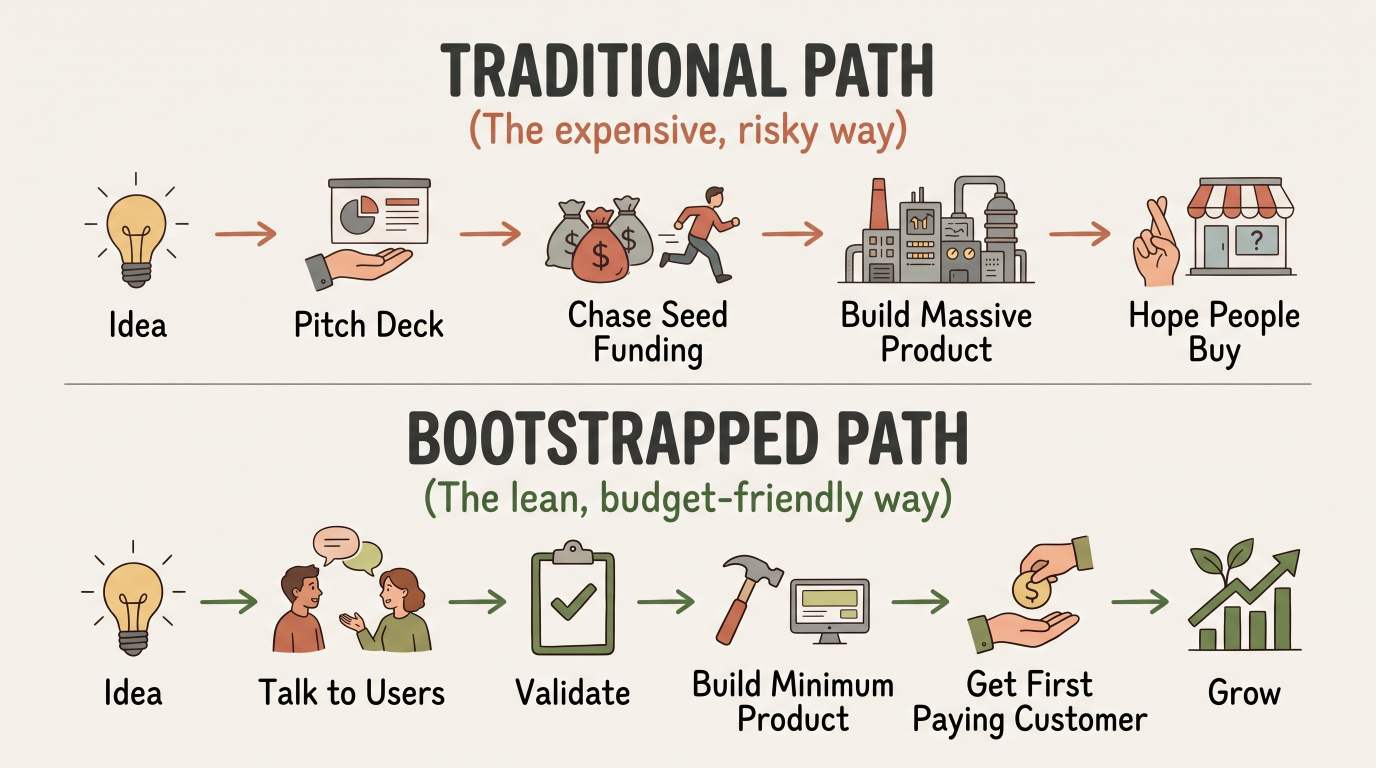
When you look at legendary startup accelerators like Y Combinator, their number one piece of advice is rarely "go raise money." Instead, partners at Y Combinator tell founders to:
Talk to users.
Make something people want.
Spend as little as possible while doing steps 1 and 2.
If you keep your costs close to zero at the beginning, you buy yourself time. And time is the most valuable asset you have when finding out what works.
2. Finding and Testing Startup Ideas That Don't Cost a Fortune
Great startup ideas do not need to be revolutionary or invent flying cars. Most successful businesses simply solve an everyday headache in a cleaner, faster, or cheaper way.
How to Pick the Right Problem
If you have a limited budget, avoid ideas that require:
Heavy physical manufacturing or inventory upfront.
Huge legal or compliance hurdles.
A "network effect" where the product is useless until one million people join (like a new social network).
Instead, look for:
Software or digital tools: You build it once and deliver it online.
Productized services: Solving a painful problem manually before writing software.
Curated communities or niche marketplaces: Connecting buyers and sellers in a narrow market.
Content and workflow tools: Helping professionals save time in their daily work.
How to Validate Without Spending a Single Dollar
Never spend months building something before you check if anyone cares. Here is how you validate your concept for free:
Step 1: The One-on-One Conversation
Find 15 to 20 people who experience the problem you want to solve. You can find them on LinkedIn, Reddit forums, Twitter (X), or local business meetups.
Do not pitch your idea right away. Ask questions like:
"How do you currently handle this problem?"
"What is the most frustrating part of that process?"
"Have you tried paying for any tool or service to fix it? Why did you stop using it?"
If people are not actively trying to solve the problem today, they will not pay for your solution tomorrow.
Step 2: The Simple "Smoke Test" Landing Page
Set up a clean, one-page website explaining the problem and your promised solution. Put a simple button that says: "Join the Early Access List" or "Pre-Order Now."
Share this page where your target audience hangs out. If 100 people visit and 15 to 20 leave their email address, you have proof that people are interested. If nobody signs up, you just saved yourself thousands of dollars and months of wasted effort.
3. Building an MVP (Minimum Viable Product) for Next to Nothing
Once you know people want a solution, your next mission is to build an MVP.
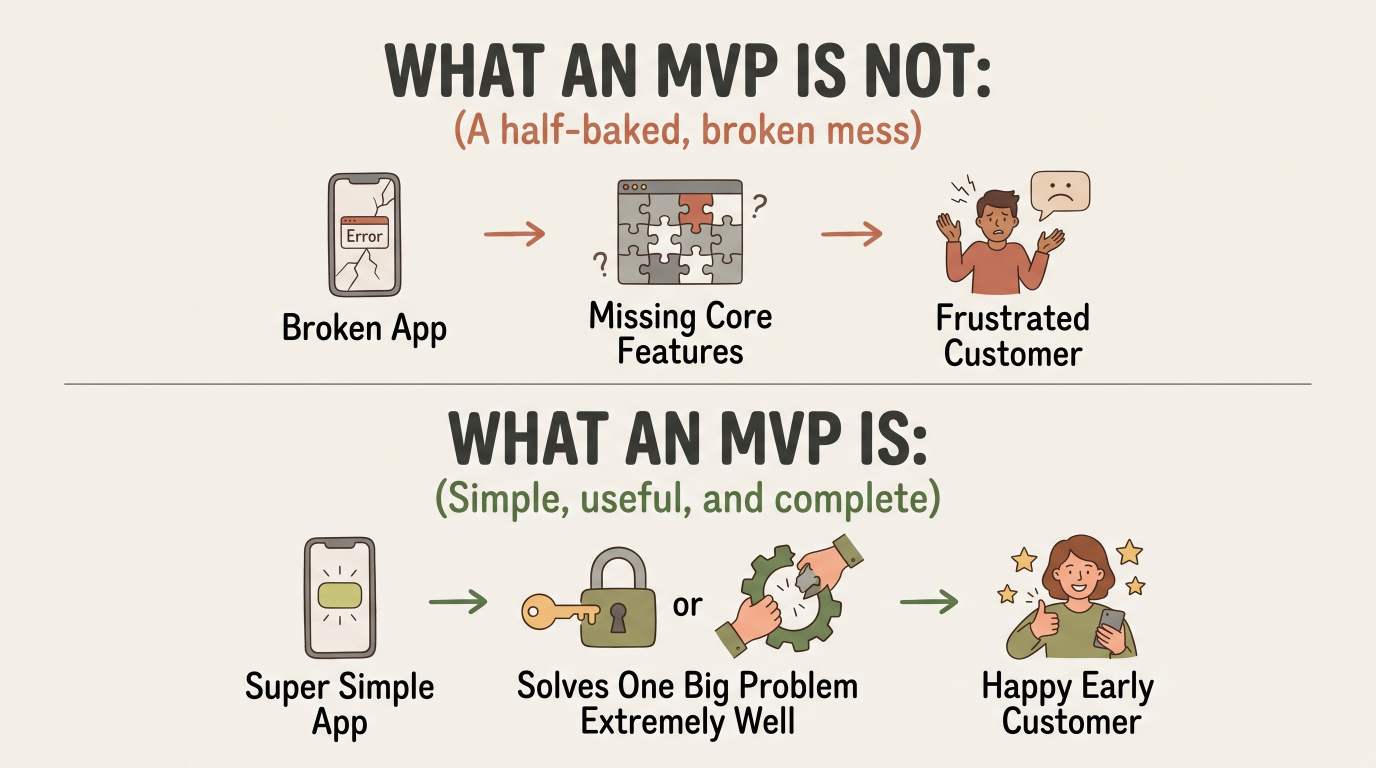
MVP stands for Minimum Viable Product. It simply means the smallest, simplest version of your idea that still solves the core problem for the user.
The "No-Code" Revolution
Ten years ago, starting a software startup required hiring expensive developers or spending a year learning deep coding languages. Today, you can build full web applications using no-code and low-code tools.
Here are reliable tools that keep your initial setup cost under $50 a month:
Category | Free or Low-Cost Tool | What You Can Use It For |
Landing Pages | Carrd, Framer, Webflow | Creating clean marketing pages in hours |
Databases | Airtable, Google Sheets | Storing customer data, orders, and content |
Automation | Make, Zapier | Connecting your forms, emails, and payments automatically |
Web Apps | Bubble, FlutterFlow | Building interactive web platforms without traditional code |
Payments | Stripe, Lemon Squeezy | Collecting payments globally with zero upfront fees |
The "Concierge" Method: Doing Things Manually First
One secret weapon for budget founders is doing the work behind the scenes by hand.
Imagine you want to build an automated tool that matches freelance writers with tech companies. Instead of spending $10,000 to code an automated matching algorithm, start with a Google Form.
When a company fills out the form, you manually look through your list, email two good writers, and introduce them. The customer gets the result, you learn exactly what both sides need, and your total development cost is zero.
Once you are overwhelmed by manual work, that is the exact moment to write software or automate it.
4. Setting Up Your Business Structure on a Shoestring Budget
Many first-time founders waste weeks thinking about fancy logos, business cards, trademark paperwork, and office spaces. None of those things bring you revenue.
Here is how you handle the business setup cleanly and affordably:
Keep Your Operations Lean
Domain and Email: Buy a clean
.comor modern extension (like.ioor.co) for around $10 to $15 per year. Set up a simple Google Workspace or Zoho Mail account for professional communication.Branding: Do not pay thousands to an agency for a logo. Use free tools like Canva, pick two readable fonts, choose one simple color palette, and move forward. Your customers care about value, not how artistic your logo icon is.
Legal Entity: In the very beginning, research local requirements in your country. In many places, you can start as a sole proprietorship for minimal cost and only incorporate a formal entity (like an LLC or Delaware C-Corp) once you start making steady sales or taking customer contracts.
Bank Account: Use modern online business banking platforms that have zero monthly maintenance fees and low international transaction costs.
5. Free and Low-Cost Marketing Strategies That Actually Work
If you build an amazing product in the middle of a desert, nobody will buy it because nobody knows it exists. But marketing does not mean running expensive Google or Facebook ads. In fact, running paid ads before you have tested your message is like burning dollar bills.
Here are the best low-cost marketing engines to get your first 100 paying customers.
1. Cold Outreach with Personal Value
Find the exact people who need your solution. Send them a polite, short, and personalized message on LinkedIn or email.
Bad cold message:
"Hi, check out our new platform at link.com. We are the best in the market. Buy now!"
Good cold message:
"Hi Alex, noticed you are running marketing at [Company]. I saw your team produces lots of blog content every week. We built a simple free checklist that cuts editing time down by 30%. Happy to send it over if you find it helpful—no strings attached."
When you offer immediate value first, people listen.
2. Building in Public and Sharing Your Journey
People love following real human stories. When you share the honest journey of starting a startup, you attract early adopters who want to see you win.
Share:
What problem you are solving today.
The mistakes you made this week.
Screenshots of your early prototypes.
Lessons you learned from early user feedback.
Platforms like Twitter (X), LinkedIn, and YouTube are great for this. You don’t need high-end camera gear; a clean smartphone video with good lighting is more than enough.
3. Community Engagement (Reddit, Discord, Niche Forums)
Join the online groups where your potential buyers already spend time asking questions.
Do not drop spam links. Instead, be the most helpful person in the comments. Answer detailed questions, share free frameworks, and solve real problems. Once you earn respect as an authority in that community, add a simple link in your profile or mention your tool only when it directly answers someone's question.
4. Organic Search (SEO)
SEO stands for Search Engine Optimization. It means creating helpful articles and guides that rank high on Google when people search for solutions.
SEO takes time, but it produces traffic that costs you nothing per click.
Find specific, long-tail questions your buyers type into search bars.
Write detailed, easy-to-read guides that answer those questions directly.
Keep your articles structured with clear headings, simple examples, and zero fluff.
6. Should You Look for Seed Funding Early On?
You might wonder: "Should I pitch angel investors for seed funding right away?"
Let's look at the pros and cons honestly.
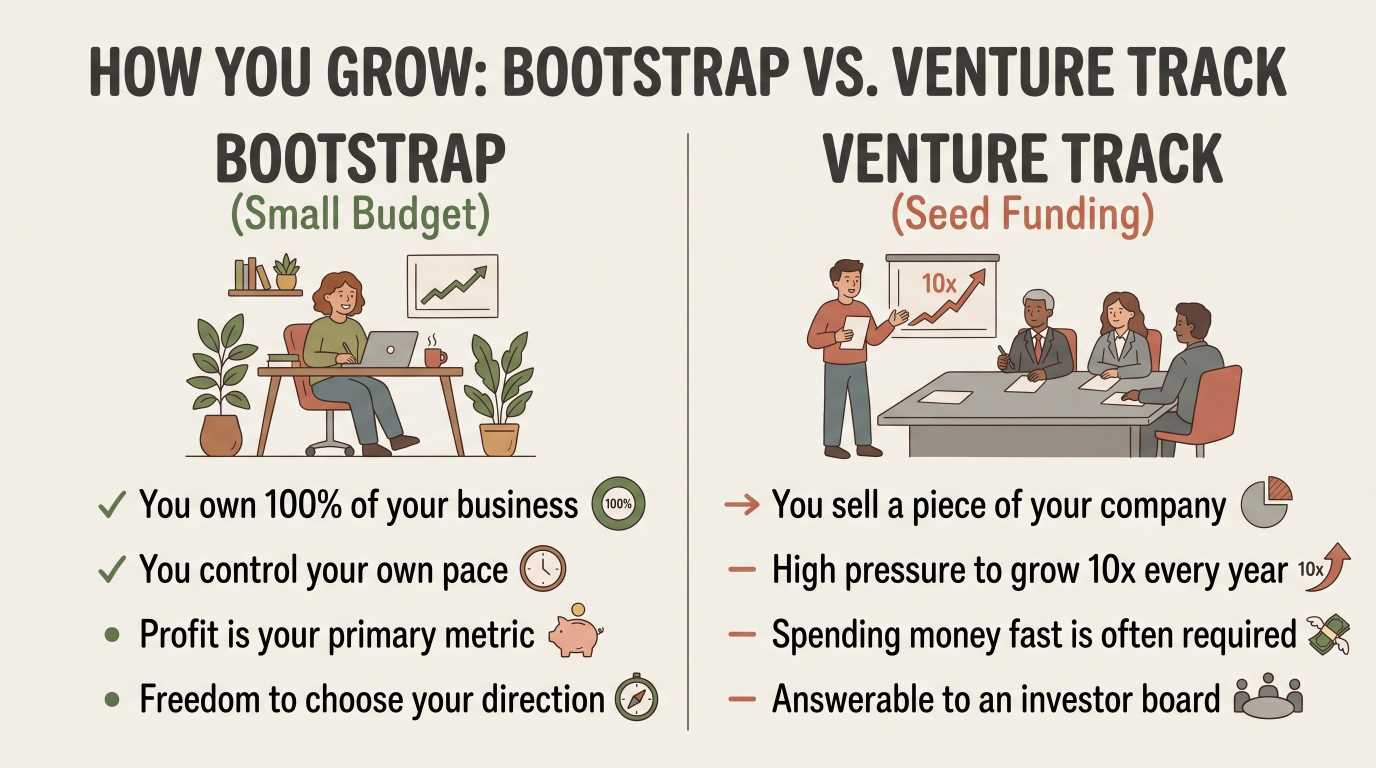
Getting seed funding can be useful if your product requires deep scientific research, expensive hardware, or rapid global scale. But for most online businesses, services, and software apps, raising capital too early has big downsides:
You lose ownership: Selling shares early means you own less of what you build.
You lose focus: Pitching investors takes months of full-time meetings. That is time you are not spending with paying customers.
Premature scaling: Having too much cash makes you spend money on things you don't need, like hiring too fast or spending on unprofitable ads.
When you prove your startup can make money on a small budget first, your negotiating position changes completely. Even if you decide to apply to top accelerators like Y Combinator later, having real users and organic traction makes you stand out from thousands of people who only have slide decks.
7. The 5 Common Traps That Drain a Small Budget Fast
When money is tight, a few bad decisions can stop your startup journey before it even gets off the ground. Avoid these five traps:
Trap 1: Hiring People Too Soon
In the early days, you and your co-founder should do as much as possible yourselves. Answer customer support emails, write copy, and test features. When you do the work directly, you understand the business inside and out. Hire only when a specific job is completely overwhelming your schedule and directly creating revenue.
Trap 2: Overpaying for Software Subscriptions
Be careful with monthly software tools. A $29 tool here and a $49 tool there quickly add up to hundreds of dollars every month. Review your bank statements monthly and cancel any tool you have not opened in the last 14 days.
Trap 3: Perfecting Features Nobody Uses
Do not spend weeks adding advanced settings, custom dark mode, or five different login options before you even have five active users. Stick strictly to the single feature that solves the customer's main headache.
Trap 4: Relying Solely on Paid Ads
Paid ads stop delivering customers the second you stop paying money. If your business model does not already work organically through direct outreach or word of mouth, ads will usually lose you money.
Trap 5: Giving Away Everything for Free Forever
It is fine to offer a free trial or a basic tier to get feedback. But if users love your product and refuse to pay even $5 a month when asked, you do not have a real business—you have an expensive hobby. Ask for payment early to confirm real demand.
8. A Step-by-Step 30-Day Launch Plan
To make this immediately actionable, here is a practical, week-by-week checklist you can follow starting today:
Week 1: Problem Discovery and Idea Selection
Pick one specific target customer (for example: local real estate agents or independent graphic designers).
Write down the top 3 daily struggles they complain about.
Reach out to 15 people in that niche and interview them for 15 minutes each.
Identify the single biggest pain point they are willing to pay to fix.
Week 2: Simple Landing Page and Pre-Validation
Set up a one-page site using a basic website builder.
Clearly write what problem you solve and the result you deliver.
Include a simple email signup or call-to-action button.
Share the page with the people you interviewed and relevant niche groups.
Aim for at least 25 to 50 email signups.
Week 3: Build the Bare-Bones MVP
Choose the simplest path: a no-code tool, a simple document, or a manual concierge service.
Build only the core feature.
Test the flow yourself to make sure nothing crashes.
Connect a payment gateway so you can accept money immediately.
Week 4: Soft Launch and First Paying Customers
Email everyone on your early access list with a special founding member offer.
Personally message 50 more qualified leads with direct, helpful outreach.
Onboard your first 5 to 10 customers manually.
Watch them use the product, take notes on where they get stuck, and ask for honest feedback.
Ready to Build Your Startup Without Breaking the Bank? 🚀
Building a startup on a small budget is all about speed, focus, and smart execution. But when you are ready to turn your validation and feedback into a real, functioning product, you need a development partner who understands the "lean startup" mindset.
That is where we come in.
Whether you need a simple, high-converting web application or a robust mobile app to get your first paying customers, we are here to help. We specialize in building fast, scalable, and budget-friendly MVPs for early-stage startups—focusing only on the core features that bring value to your users.
Let us handle the code while you focus on the growth.
👉 Get a Free, No-Obligation MVP Consultation Today! (Tell us your startup idea, and we’ll help you map out the fastest, most cost-effective way to build it.)
Frequently Asked Questions (FAQ)
Can I launch a startup while working a full-time job?
Yes, absolutely. In fact, keeping your day job is one of the safest ways to launch on a small budget. Your salary covers your living expenses, which removes desperate financial pressure from your new business. Dedicate 1 to 2 focused hours every evening and a half-day on weekends to build steadily.
How much money do I actually need to get started?
For most digital products, software tools, or service-based businesses, you can launch an MVP for between $50 and $300 total. This covers your domain name, basic web hosting, and a few essential tools for the first couple of months.
What if someone steals my startup ideas?
Founders worry about this constantly, but ideas alone have almost zero value. Execution is everything. Everyone is busy working on their own lives and projects; nobody is waiting around to steal an unproven idea. Talking openly about your idea is the only way to find users, partners, and customers.
When is the right time to seek outside investment?
The best time to look for funding is when you already have a working product, happy customers, and consistent revenue growth, but you need extra cash to pour fuel on the fire (such as expanding server capacity or hiring key engineers to keep up with demand).
Final Thoughts: Start Small, Move Fast, Stay Consistent
You do not need a million-dollar seed round, a massive team, or an office in Silicon Valley to build a meaningful, profitable startup company.
What you really need is:
A real problem that causes people headaches.
A simple solution that works reliably.
The discipline to spend carefully and talk to your customers every single day.
Stop waiting for the "perfect" time or a giant pile of cash. Pick a problem, talk to people, build your basic prototype, and launch. The best time to start is today.
Ready to grow your business?
Contact us today to find out how our strategies can scale your operations to the next level.
Contact Us