How to Start Investing in Real Estate With Little Money

Most people believe a huge myth: you need $50,000, $100,000, or a wealthy family to buy property.
If you look at social media, every real estate investor seems to be standing in front of a shiny apartment complex or holding keys to ten luxury houses. That makes everyday people think, "Real estate is not for me. I don't have that kind of cash."
Here is the truth: you can start building real estate wealth right now, even if you only have $100, $500, or a few thousand dollars saved in your bank account.
People have been doing this for decades. It is not magic, and it is not a get-rich-quick trick. It simply comes down to understanding specific strategies designed for low-capital investors. In this guide, you will learn the exact methods, the simple math behind them, the hidden risks, and a clear game plan to make your first move.
Why Invest in Real Estate Instead of Just Keeping Money in the Bank?
Before looking at the methods, let us answer an important question: why does everyone talk about real estate in the first place?
When you leave your cash sitting in a standard savings account, inflation slowly eats away your buying power. A loaf of bread or a gallon of gas costs more every year, but your cash stays flat.
Real estate helps protect and grow your money through four distinct engines:
Cash Flow: The rent money left over after paying all property expenses, insurance, taxes, and loan payments. This is recurring income.
Appreciation: Over long periods, property values generally rise. A home bought twenty years ago typically sells for much more today.
Loan Paydown: If you buy a physical property using a loan and rent it out, your tenants pay down your mortgage debt every month. They are essentially buying the asset for you.
Tax Advantages: In many countries, property owners can deduct maintenance costs, mortgage interest, property taxes, and depreciation from their taxable income.
Even when you start small, tapping into these engines early gives your money room to compound over time.
Building Your Own Real Estate Platform or Deal Calculator?
Running numbers by hand gets tedious fast. Whether you are building a custom cash-flow calculator, a property-matching portal, or an automated lead tool for local deals, having clean tech makes all the difference.
Explore Custom Real Estate Web & App Solutions
7 Proven Ways to Start Investing in Real Estate With Little Money
You do not need to use all seven of these strategies at once. Read through them, pick the one that fits your current savings and lifestyle, and master that single path first.
1. Real Estate Investment Trusts (REITs): Start With Less Than $50
If you want zero headaches, no tenant phone calls, and no physical repair work, REITs (pronounced "reets") are the easiest starting point.
What Is a REIT?
A Real Estate Investment Trust is a company that owns, operates, or finances income-producing real estate. Think of it like a mutual fund or an exchange-traded fund (ETF), but instead of buying tech stocks, the fund buys shopping centers, apartment buildings, warehouses, healthcare facilities, or cell towers.
By law in places like the United States, REITs must pay out at least 90% of their taxable income to shareholders in the form of dividends.
How It Works in Real Life
You open a basic brokerage account on your phone or computer.
You search for a publicly traded REIT or a broad REIT index fund (like the Vanguard Real Estate ETF).
You buy a single share, or even a fraction of a share, for as little as $10 to $50.
The REIT collects rent from commercial tenants and sends a share of that profit directly to your brokerage account every month or quarter.
Who This Is Best For
Beginners who work a full-time job, have under $1,000, and want passive cash flow without managing physical properties or applying for bank loans.
2. Real Estate Crowdfunding Platforms: Pool Funds Online
Technology has made it possible to team up with thousands of other regular investors online to buy large commercial assets.
What Is Crowdfunding?
Crowdfunding platforms gather money from many individual investors to buy commercial properties, build apartment complexes, or fund private construction loans. Instead of needing $2,000,000 to buy a small shopping plaza, the platform collects $500 from 4,000 people.
How to Get Started
Popular platforms (such as Fundrise or Arrived) allow non-accredited investors (everyday people without high net worth) to create an account with as little as $10 to $100.
You browse available portfolios or single-family rental funds.
You deposit your funds.
Professional real estate managers take care of finding tenants, fixing leaky roofs, and collecting rent.
You earn returns through quarterly dividend payouts and property value appreciation when buildings are sold.
The Trade-Off: Liquidity
Crowdfunded real estate is generally an illiquid investment. That means you cannot always withdraw your money the next morning if you need quick cash. Most platforms expect you to leave your investment untouched for three to five years. Treat this as patient money.
3. House Hacking: Live for Free and Build Equity
House hacking is arguably the most powerful way to buy your first physical property with very little personal money.
What Is House Hacking?
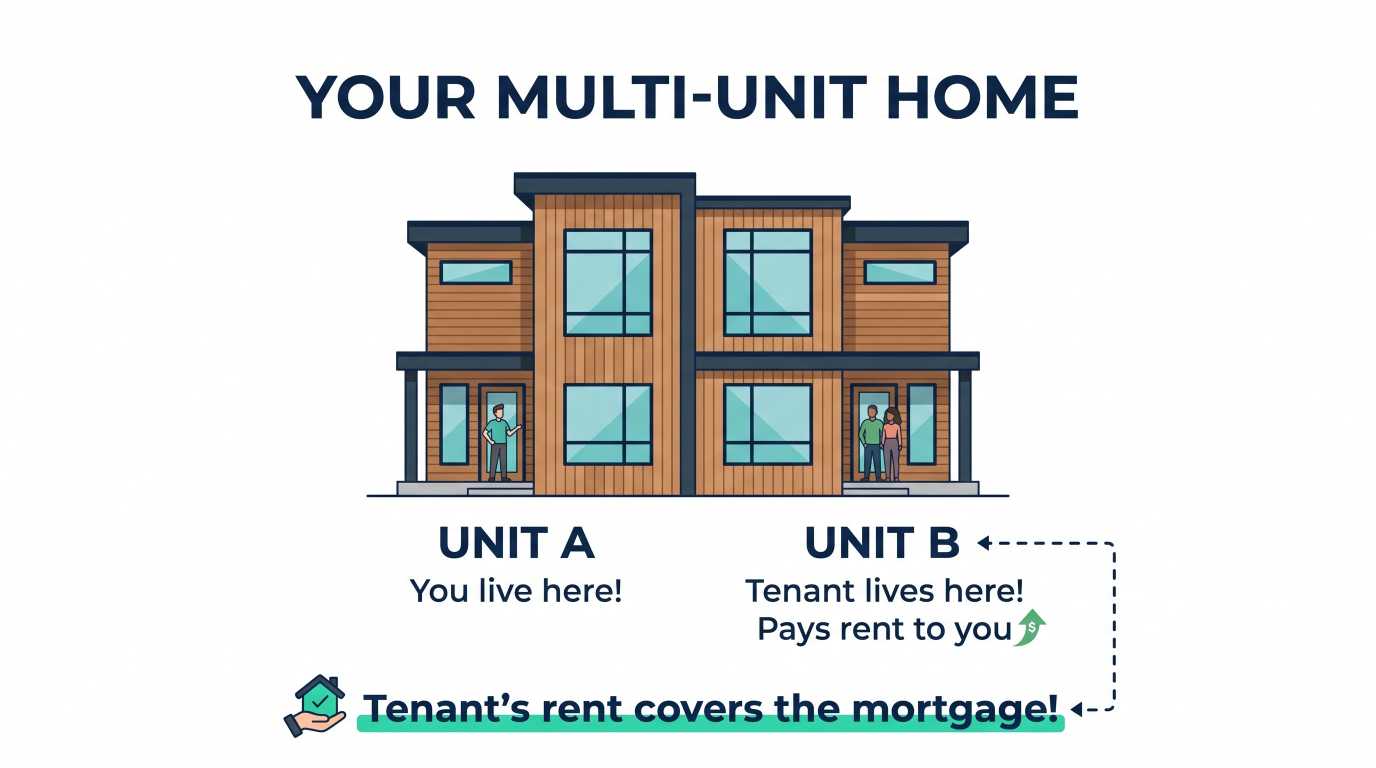
House hacking means buying a small residential property (a single-family home with spare bedrooms, or a 2-to-4 unit property like a duplex or triplex), living in one section, and renting out the remaining space.
The rent collected from your roommates or neighbors covers your mortgage, insurance, and maintenance costs. In many cases, you live 100% housing-cost free while your tenants pay off your property.
Why Low Down Payments Make This Possible
If you buy an investment property purely to rent out, banks usually demand a 20% to 25% cash down payment. On a $300,000 home, that is $60,000 to $75,000 in cash.
However, if you live in the property as your primary residence, government-backed loan programs require far less:
FHA Loans (US): As low as 3.5% down ($10,500 on a $300,000 home).
Conventional 97% Loans: As low as 3% down.
VA Loans (for qualifying military members and veterans): 0% down.
USDA Loans (for eligible rural areas): 0% down.
A Simple Real-World Example
Imagine you buy a two-family duplex for $250,000 using an FHA loan with 3.5% down ($8,750).
Your total monthly mortgage payment (principal, interest, taxes, and insurance) is $1,900.
You live in Unit 1.
You rent out Unit 2 for $1,300 per month.
Your out-of-pocket housing cost is now only $600 ($1,900 - $1,300).
Compare that $600 to paying $1,500 a month to rent an apartment from someone else. You save $900 every month, build home equity, and gain firsthand experience as a landlord.
4. Real Estate Wholesaling: Earn With Sweat Equity Instead of Cash
Wholesaling does not require you to buy a house, qualify for a mortgage, or fix drywall. Instead, you act as a finder of deeply discounted properties.
How Wholesaling Works
Many homeowners find themselves in tough situations. They might have inherited an old, damaged house they cannot afford to fix, fallen behind on property taxes, or need to relocate immediately. They do not want to clean the house, list it with an agent, pay commissions, or wait six months for a buyer.
Here are the four basic steps of a wholesale deal:
Find a Motivated Seller: You locate an owner willing to sell their property below market value for a fast cash sale (for example, $120,000 for a home worth $180,000 after repairs).
Put the Home Under Contract: You sign a purchase contract with the seller that includes an "assignment clause" or gives you the legal right to purchase.
Find a Cash Buyer: You bring the opportunity to a real estate investor or house flipper who is looking for their next project.
Assign the Contract: You transfer your rights to buy the house to that investor for an assignment fee (for instance, $5,000 or $10,000).
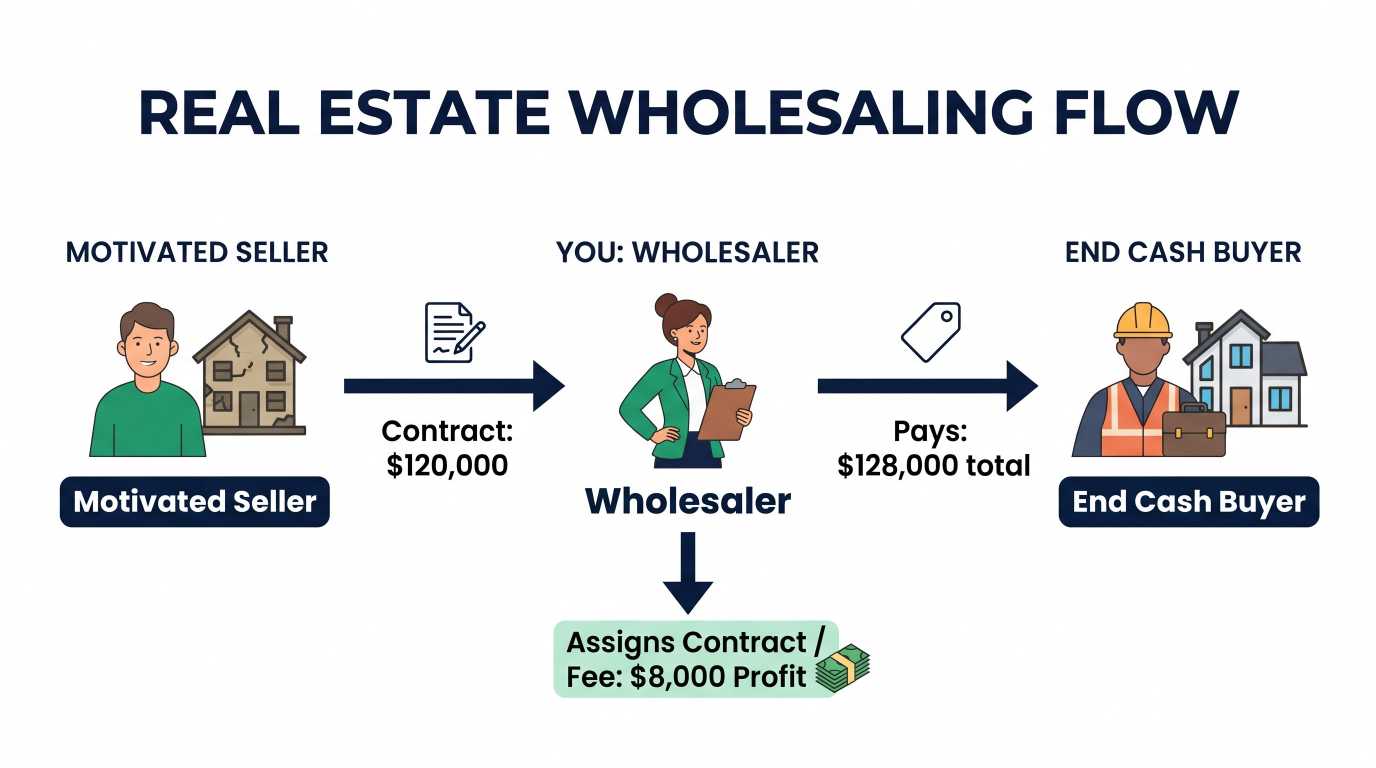
The investor buys the house for $128,000, the seller gets their $120,000 quick cash sale, and you walk away with an $8,000 assignment fee without ever purchasing the home yourself.
What It Requires
While it requires very little financial capital, wholesaling requires major time, negotiation skills, hustle, and local market research. It is a sales job, not passive investing.
5. Seller Financing: Skip the Bank Entirely
When most people buy real estate, they visit a traditional bank, hand over tax returns, and wait 45 days for loan underwriting. With seller financing (also called owner financing), the seller acts as the bank.
Why Would a Seller Do This?
If an older homeowner owns a property free and clear of any bank mortgage, selling it all at once can trigger large capital gains taxes. Furthermore, they may not want a lump sum sitting in a low-interest bank account.
Instead, they might prefer earning steady monthly interest payments. They get reliable passive income without the hassle of property maintenance.
How to Structure It
You and the seller negotiate terms directly:
Purchase Price: Agreed value of the property.
Down Payment: Often flexible. Sellers may accept a smaller down payment (sometimes 5% to 10%, or occasionally sweat equity and repairs) compared to strict commercial bank rules.
Interest Rate: Usually comparable to current market mortgage rates.
Loan Term: Often structured over 5 to 15 years, sometimes with a balloon payment at the end.
Because you negotiate directly with a person rather than an algorithm, you have room to craft creative terms that match your current budget.
6. Lease Options (Rent-to-Own Strategies)
A lease option is an agreement where you lease a property with the exclusive legal right (the "option") to buy it at a set price within a specified time frame (usually 1 to 3 years).
The Mechanism
Lease Agreement: You pay standard monthly rent to the property owner.
Option Fee: You pay an upfront fee (often 1% to 3% of the purchase price) to lock in your right to buy the home later at today's agreed price.
Rent Credit: Often, a portion of your monthly rent payment goes directly toward reducing the final purchase price.
Why This Helps Low-Capital Investors
If property values rise over those two or three years, you still get to buy the home at the lower price agreed on day one. You can either:
Exercise your option, get a mortgage, and keep the built-in equity.
Partner with an end buyer, assign your option, and pocket the difference.
If the market drops or the property turns out to have major hidden issues, you are not forced to buy. You can simply walk away at the end of the lease, risking only your initial option fee.
7. Strategic Partnerships: Bring the Hustle, Find the Capital
There are thousands of busy working professionals (such as doctors, software engineers, attorneys, and business owners) who have plenty of extra money but zero time to search for real estate deals, manage contractors, or handle leasing.
If you have time, energy, and market knowledge, you have valuable currency.
How to Structure a Partnership
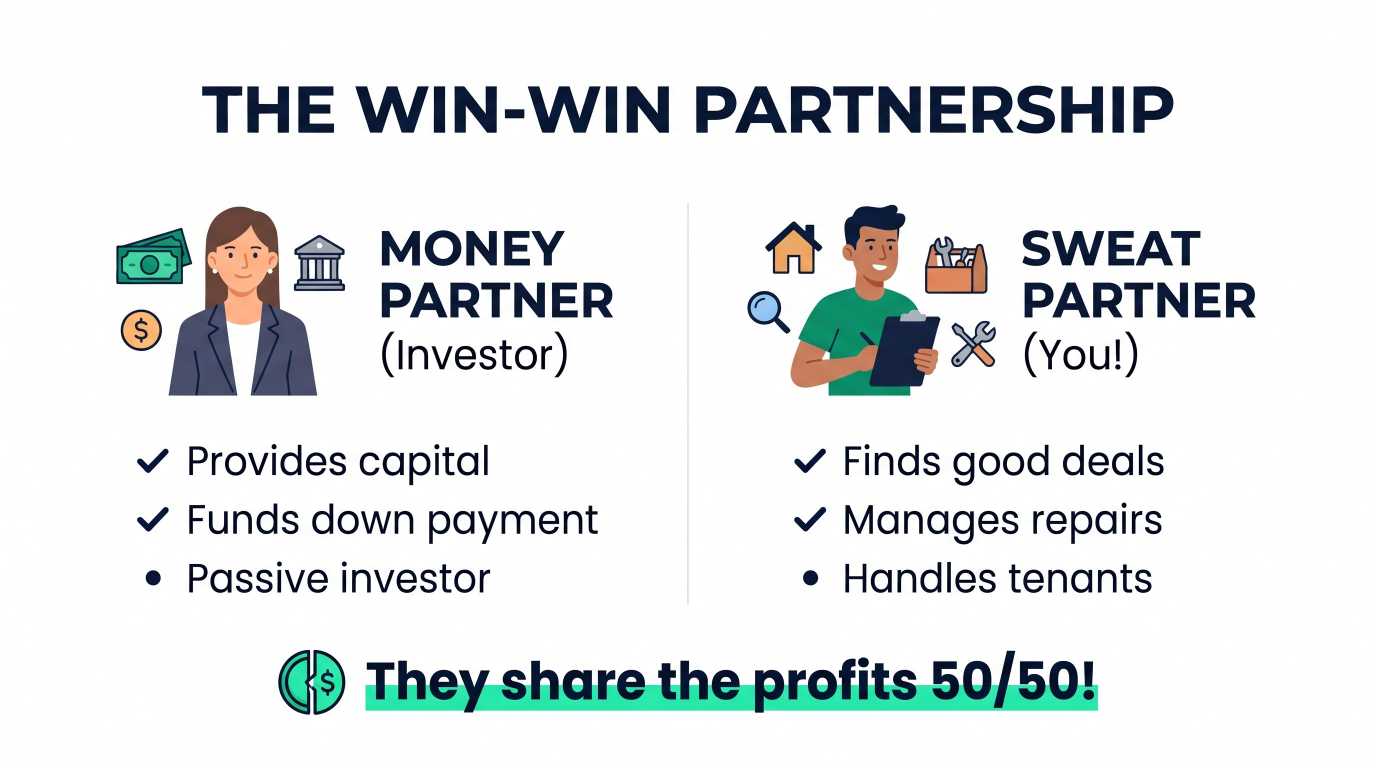
Partner A (Capital Partner): Provides the down payment and qualifies for the bank mortgage.
Partner B (Operating Partner / You): Finds the property at a discount, coordinates painters and plumbers, advertises the listing, and screens prospective tenants.
Both parties sign a clear legal operating agreement outlining ownership shares (often a 50/50 split), cash distribution schedules, and an exit strategy. This lets you build a real-world track record using other people's capital.
Step-by-Step Action Plan for Beginners
Reading about strategies is entertaining, but taking action builds wealth. Follow these four clear steps to make real progress over the next 30 days.
[Step 1: Financial Clean-Up]
         |
         v
[Step 2: Pick One Strategy]
         |
         v
[Step 3: Learn Local Numbers]
         |
         v
[Step 4: Make Your First Move]
Step 1: Clean Up Your Personal Finances
Before investing in property, get your personal financial baseline solid:
Check your credit score: A higher score saves you tens of thousands of dollars in mortgage interest. Aim for 680 or higher (740+ gets you the best rates).
Pay off high-interest consumer debt: If you have credit cards charging 22% annual interest, paying them off gives you an immediate, guaranteed 22% return. Do that before buying real estate.
Build a modest emergency cushion: Keep at least 3 months of basic living expenses in cash so you never have to sell an investment in a panic.
Step 2: Choose One Strategy That Fits Your Life
Avoid shiny object syndrome. Do not try to wholesale on Monday, research REITs on Wednesday, and hunt for duplexes on Friday.
Have $50 and 15 minutes a month? Start with REITs.
Have $500 and want simple commercial exposure? Use Crowdfunding.
Ready to move and have 3.5% saved? Pursue House Hacking.
Have lots of free time, grit, and sales drive? Start Wholesaling.
Step 3: Learn How to Analyze a Deal
A good real estate investor never buys based on emotion or paint colors. They buy based strictly on the numbers.
Here are the core metrics you must understand:
Metric | Simple Definition | How to Calculate |
Gross Rental Yield | Annual rent divided by total purchase cost |
|
Net Operating Income (NOI) | Total income left after paying all operating expenses (not including mortgage) |
|
Cap Rate (Capitalization Rate) | Unleveraged rate of return of a property |
|
Cash-on-Cash Return | Annual pre-tax cash flow divided by total actual cash invested |
|
If a property does not produce positive cash flow after factoring in mortgage payments, property taxes, insurance, repairs, and vacancies, walk away. Never rely purely on the hope that prices will go up tomorrow.
Step 4: Network Locally
Real estate remains a people business. Join local real estate investor associations (often called REIAs). Attend local community meetups. Introduce yourself to local real estate agents who work specifically with investors. Tell them what you are looking for. Often, the best deals never appear on public websites; they are shared through casual conversations.
Common Mistakes Beginners Must Avoid
When you start with limited money, your safety margin is smaller. Avoid these four common traps:
Underestimating Maintenance and Vacancy: Rental properties need repairs. Water heaters leak, roofs age, and tenants move out. When running your calculations, always reserve 5% to 10% of monthly rent for maintenance and another 5% for vacancy.
Ignoring Tenant Screening: One destructive or non-paying tenant can wipe out an entire year of profits. Check credit reports, verify proof of employment, contact previous landlords, and conduct criminal background checks. Consistency here saves your sanity.
Overleveraging: Borrowing money is a great tool, but too much debt during an economic downturn can force you into foreclosure. Never buy deals with razor-thin margins where a single empty month makes you miss a mortgage payment.
Skipping the Home Inspection: Always hire an independent, licensed home inspector before closing on any physical property. They inspect foundations, electrical panels, plumbing lines, and structural elements that you cannot see during a casual walk-through.
A Realistic Starting Budget: Where to Put Your Money Today
To help you decide your immediate path, here is how you can deploy different budget amounts right now:
Under $100: Open a zero-commission investment account. Purchase fractional shares of a broad REIT exchange-traded fund. Turn on automatic dividend reinvestment (DRIP).
$500 to $2,000: Allocate across one or two top-rated real estate crowdfunding platforms to get exposure to commercial properties across different geographic regions.
$5,000 to $15,000: Explore low-down-payment house hacking (FHA or conventional) on an affordable duplex, triplex, or single-family home with extra rooms in an emerging neighborhood.
$0 (Time Only): Focus on wholesaling or sweat-equity partnerships. Spend your weekends analyzing property tax records, talking to motivated sellers, and learning local contract laws.
Getting Started
You do not need millions in the bank to begin your real estate journey. Whether you buy your first $20 REIT share on your smartphone today, research duplexes in your town for a future house hack, or partner with someone who has the capital you lack, taking that first modest step changes your financial trajectory. Focus on learning the fundamentals, keep your personal expenses low, make conservative calculations, and let steady compounding do the heavy lifting over time.
Turn Deal-Finding Into an Automated Pipeline
Top wholesalers and investors don’t track leads on messy sticky notes. They run custom landing pages, automated SMS/email follow-ups, and clean buyer dashboards. If you are ready to turn your property search into a streamlined web platform or mobile app, let’s talk architecture.
See How We Build Custom Investor Tools
Ready to grow your business?
Contact us today to find out how our strategies can scale your operations to the next level.
Contact Us