How to Build an AI-Powered Startup Team for 2027
Building a startup used to mean one thing: hiring as many people as your budget allowed, filling office desks, and hoping everyone moved in the same direction.
If you wanted to build software, you hired ten engineers. If you wanted to sell software, you hired ten sales reps. If you wanted to grow, you hired an army of copywriters, designers, and managers to keep the wheels turning.
That playbook is officially broken.
As we look ahead to 2027, the math behind growing a business has changed completely. You do not need fifty people in an office to build a multi-million-dollar company anymore. Today, a lean group of five focused people using smart systems can produce the work that used to take fifty.
This is the era of the modern startup. If you want to build a company that survives and wins, you need to know how to build an AI-powered startup team for 2027.
In this guide, we will break down everything in plain English. No heavy tech jargon. No confusing corporate buzzwords. Just a direct, step-by-step roadmap that any founder or builder can follow.
What Does an AI-Powered Startup Team Actually Look Like?
Before talking about who to hire, let’s clear up a huge myth.
An AI-powered startup team does not mean you replace human beings with robots. It does not mean you run your entire company on auto-pilot while sitting on a beach.
It means every single person on your team has high leverage.
Think of leverage like a power tool. In the old days, if you wanted to dig a massive ditch, you hired fifty people with basic shovels. Today, you hire one skilled person who knows how to drive an excavator. The excavator does the heavy lifting, but the human decides where to dig, how deep to go, and checks for underground pipes.
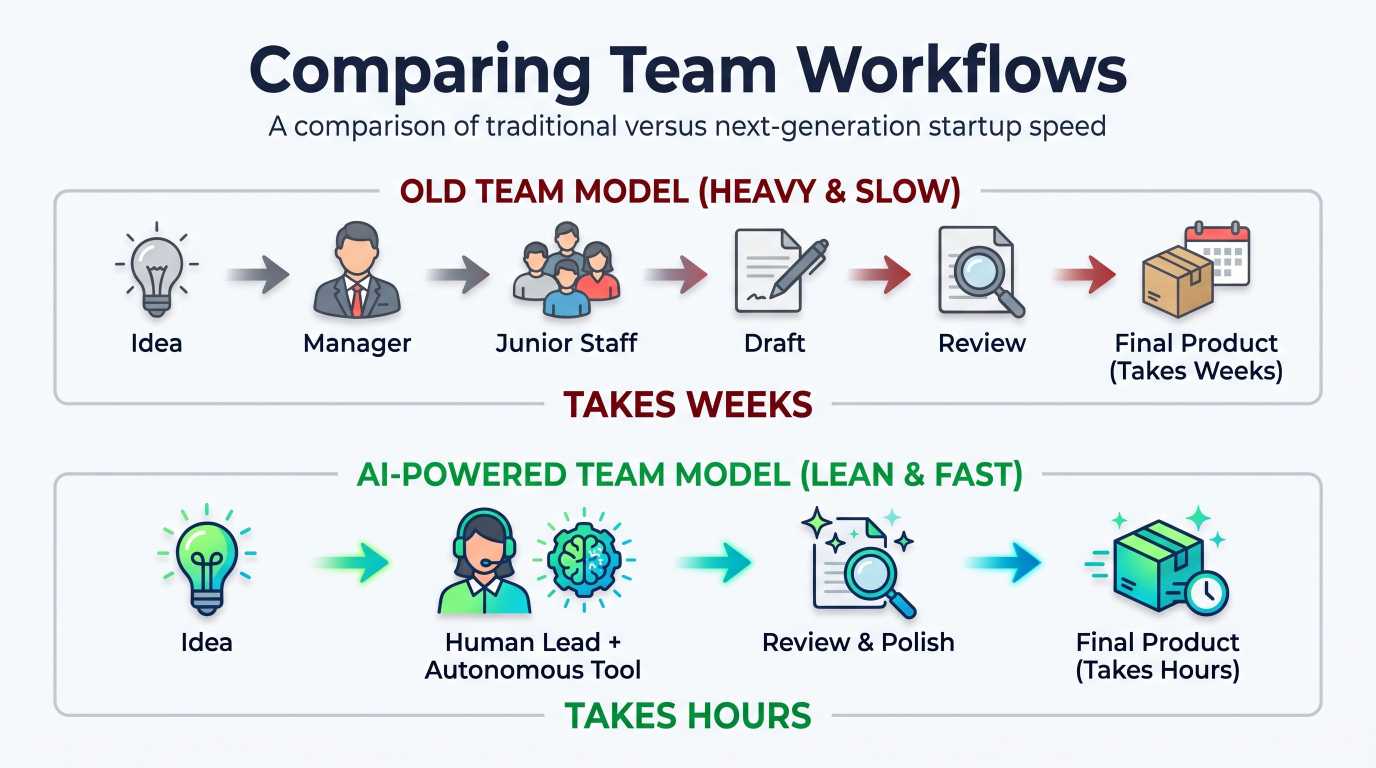
In an AI-powered team:
Humans handle: Vision, taste, empathy, critical decisions, and genuine client relationships.
Smart tools handle: First drafts, repetitive code, data sorting, scheduling, and standard customer tickets.
This setup lets a tiny company move ten times faster than a traditional corporate competitor with hundreds of employees.
The Big Shift: Why the 2027 Startup Playbook Is Different
Why are we specifically focusing on 2027? Why not run your business the way startups did a few years ago?
Because the tools have matured. In earlier years, automated tools were simple novelty toys. They wrote clunky blog posts that sounded robotic and generated funny images with too many fingers.
Now, software tools can understand context, run multi-step workflows, write production-grade code, and connect directly with databases.
Here is how the ground beneath our feet has shifted:
Area | The Old Startup Way | The 2027 AI-Powered Way |
Team Size | 20 to 50 people to hit scale | 4 to 8 high-leverage specialists |
Hiring Focus | Specialists doing repetitive tasks | Generalists who direct tools |
Product Speed | Months to build a prototype | Days to build and test live |
Monthly Payroll | $150,000+ per month | Lean and highly profitable early on |
Problem Solving | "Who can we hire for this?" | "Can a tool solve 80% of this?" |
When your payroll is small, your stress is low. You do not need to raise millions from venture capitalists just to keep the lights on. You keep control of your company, stay profitable, and adapt instantly when the market moves.
Have an idea? Don’t spend months building it. Our team designs and ships high-performance web and mobile apps in weeks, not quarters. Book a Quick Scope Call
The 4 Core Roles for an AI-Powered Startup Team
If you are building your team for 2027, forget the old org chart. You do not need vice presidents, directors, and endless junior staff.
Instead, you need four key roles. These can start as founders wearing multiple hats, and later turn into full-time hires.
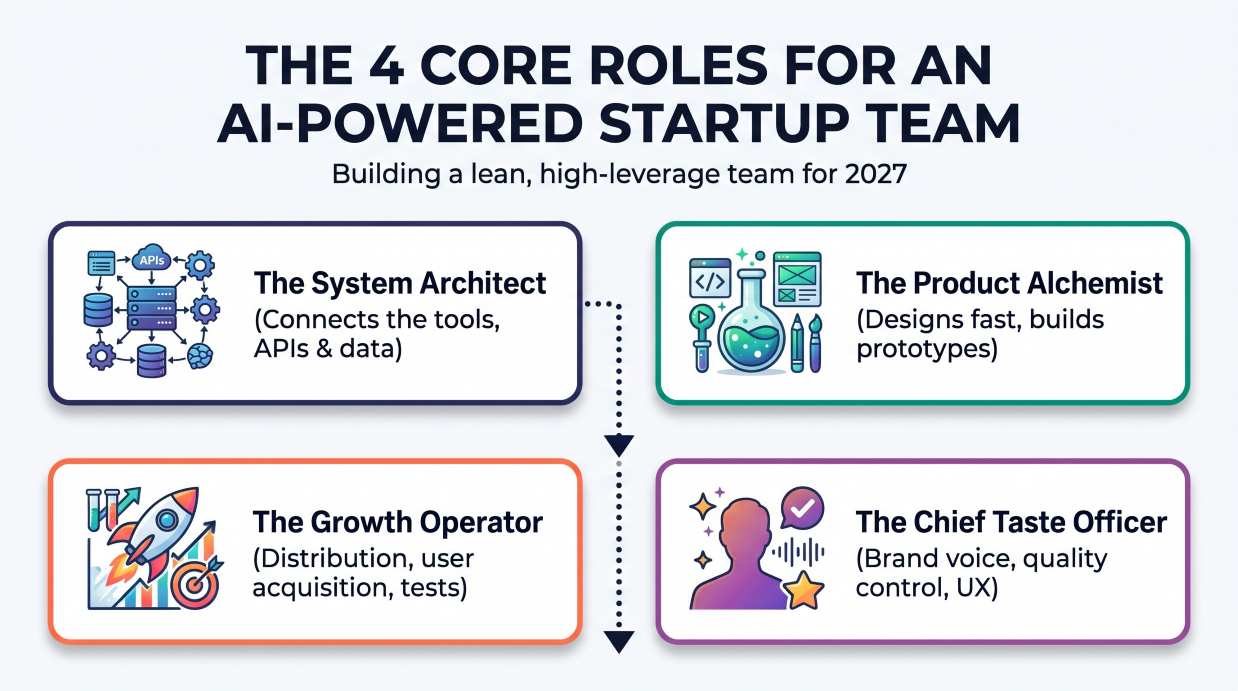
1. The System Architect
This is the person who connects the pipes. In the past, this role might have been called an operations manager or a systems engineer.
The System Architect asks one simple question every morning: "What repetitive task are our humans doing that a software system could handle?"
They spend their time:
Connecting software tools together using APIs and workflow builders.
Setting up internal knowledge bases so team members can find company information instantly.
Making sure user data stays completely private and secure.
They do not write thousands of lines of raw code from scratch. Instead, they assemble existing tools into an efficient engine.
2. The Product Alchemist
In traditional startups, you had a UX designer, a frontend engineer, and a backend engineer. Building a single new button could take three meetings and two weeks.
The Product Alchemist does this alone, in hours.
They use modern code-generation platforms and visual design systems to take an idea from rough napkin sketch to working software inside of a few days. They treat code like clay: quickly shaping it, testing it with real users, and reshaping it based on live feedback.
They are not purists who care about showing off complex code. They care about shipping working solutions to real customer problems.
3. The Growth Operator
Distribution is the hardest part of any business. Having a great product means nothing if nobody knows it exists.
The Growth Operator manages your marketing and sales funnels. But instead of writing one email or one social post at a time, they build automated discovery engines.
They run multiple small marketing experiments simultaneously:
Testing different website headlines to see what converts.
Segmenting potential leads so outbound messages are personal and helpful.
Analyzing customer churn data to alert the team when a user gets stuck.
They look at marketing as a numbers game powered by smart software and clear user data.
4. The Chief Taste Officer (The Quality Filter)
Here is something critical that many founders miss: when automated tools make it easy to create content and software, the world gets flooded with low-quality junk.
Anyone can click a button and generate a generic 500-word article, a boring video script, or a buggy app.
Because of this flood, human taste is more valuable than ever.
The Chief Taste Officer acts as the ultimate quality filter. They protect the brand:
They review content to make sure it sounds human, warm, and authentic.
They test software interfaces to ensure they feel smooth and easy to use.
They ensure customer support answers are kind, direct, and helpful.
They ensure that while the company moves at machine speed, it never loses its human soul.
How to Hire for an AI-Powered Startup Team
Hiring for a high-leverage startup requires a completely different mindset. If you hire using old resumes and standard interview questions, you will end up with employees who wait around for instructions.
You need self-starters who naturally use technology to multiply their output.
Look for High Agency, Not Just Long Resumes
What is high agency? A high-agency person is someone who finds a way to get things done, no matter what obstacles appear.
If a server goes down, they do not shrug and wait for someone else to fix it. If they do not know how to build a landing page, they spend an evening learning how to do it with new tools.
During interviews, ask questions like:
"Tell me about a time you had to solve a problem with zero budget and no instructions."
"What is a new piece of software you adopted in the last three months, and how did it change your daily workflow?"
If a candidate brags about how many junior staff used to report to them, be careful. You want builders who like rolling up their sleeves, not managers who simply delegate tasks down a chain.
Test Their Practical Tool Fluency
Do not take someone's word that they know how to work with modern tools. Test them with a simple, paid test project.
Give them an open-ended assignment:
Provide a messy raw dataset or an unformatted document.
Ask them to analyze it, pull out three key insights, and draft a short executive summary.
Give them two hours.
A traditional worker will open a spreadsheet and manually format cells for two hours. A modern, tech-literate worker will use automated scripts or smart processing tools to clean the data in three minutes, spend the rest of their time thinking through the findings, and deliver a polished report.
Hire the person who uses leverage to produce deeper insight.
Practical Workflows: A Day in the Life of a Modern Team
Let’s look at how an AI-powered team actually operates during a normal workday. This makes the concept practical and easy to visualize.
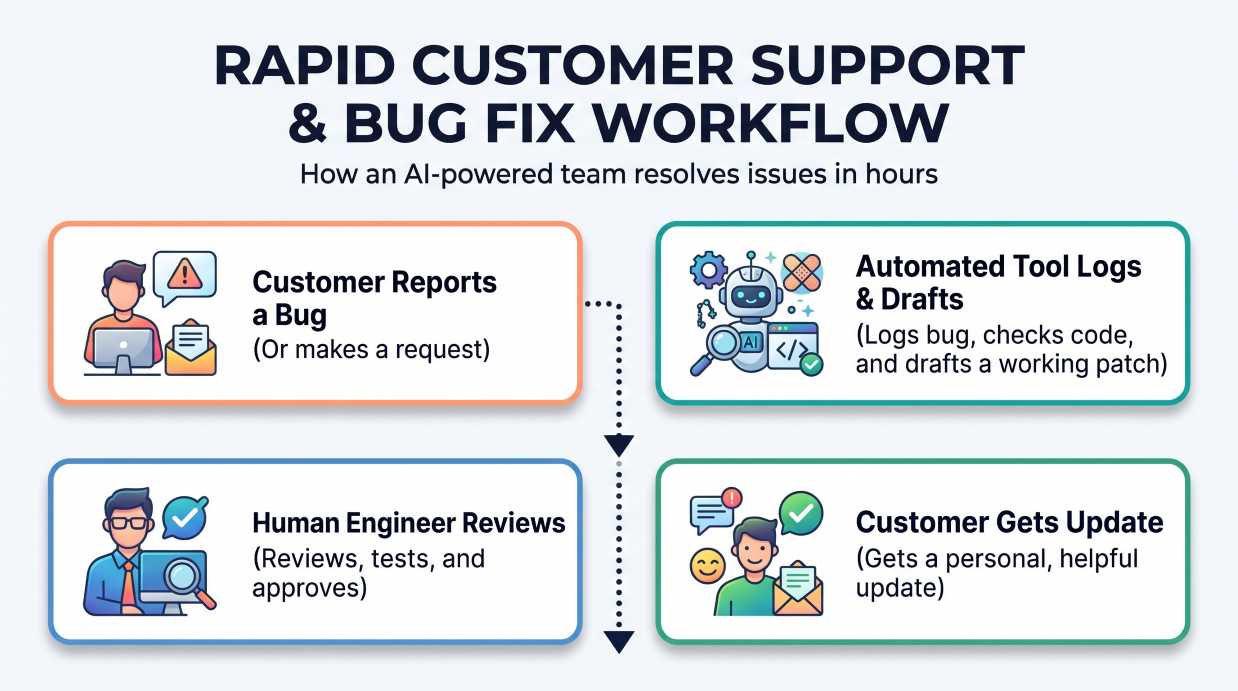
Morning: Fast Customer Support and Bug Fixes
A customer logs in and notices a bug in their billing dashboard.
In a traditional startup, a support ticket sits in a queue for 24 hours. A rep reads it, forwards it to engineering, and an engineer files a ticket for next week's sprint.
In an AI-powered startup, an automated pipeline parses the customer's message, replicates the error log in seconds, and drafts a proposed code patch. The human engineer wakes up, inspects the proposed fix, approves it with one click, and pushes the update.
The customer receives a polite, personal message within an hour saying their issue is resolved.
Afternoon: Rapid Content Creation and Testing
The team wants to test a new product idea for a specific audience.
Instead of hiring a creative agency for $10,000, the Growth Operator outlines the core value proposition.
Smart design tools help draft three visual variations of a landing page.
The Chief Taste Officer reviews the copy, rewires awkward sentences, injects real founder stories, and ensures the tone feels welcoming.
By 3:00 PM, the campaign is live and collecting real feedback from interested visitors.
The Tech Stack: The Essential Tool Categories for 2027
To build an AI-powered startup team for 2027, you need the right tool stack. You do not need dozens of expensive apps. You only need tools across five basic categories:
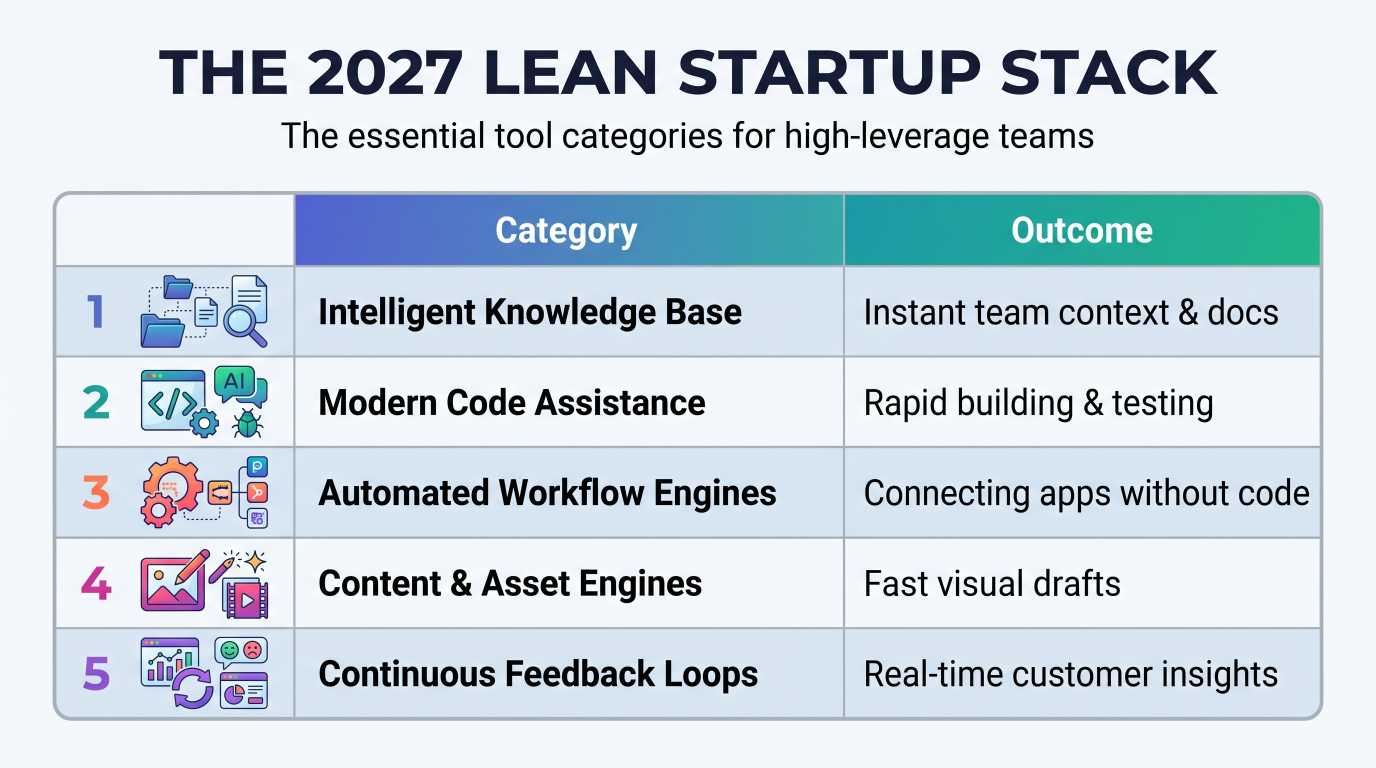
1. Intelligent Internal Knowledge Bases
Your team should never waste time asking, "Where is that client folder?" or "What is our policy on refunds?"
Use a central workspace that connects all your company docs, emails, and chat messages. Anyone on the team can ask a simple question in plain language and get an immediate answer sourced directly from internal documentation.
2. Code Generation and Testing Platforms
Software engineering is no longer about typing every bracket by hand. Modern code assistants write boilerplate functions, spot security holes, and generate unit tests automatically.
Your engineers spend their brainpower on system architecture and user safety instead of writing standard code templates over and over.
3. Workflow Automation Engines
These are the invisible bridges between your software tools. When a new customer signs up on your website:
The workflow tool logs them into your database.
It sends a personalized welcome email.
It alerts the founder in chat if the user is a high-value account.
It sets a calendar reminder for a check-in call.
All of this happens without a human having to copy and paste data between screens.
4. Content and Asset Generators
Designers and marketers can generate color palettes, image concepts, wireframe mockups, and video transcripts in minutes. These serve as initial starting blocks. The human team then steps in to refine, customize, and polish the final assets.
5. Automated Customer Feedback Loops
Instead of reading through thousands of survey responses by hand, use tools that group user complaints and feature requests into clean categories. You can see at a glance that 40% of users want a simpler export button, allowing you to prioritize what matters to customers.
The Common Traps to Avoid
When founders get excited about using new technology, they often run into three major mistakes. Keeping these traps in mind will save you time, money, and reputation.
Trap 1: The "Lazy Output" Problem
The easiest mistake to make is publishing unedited, automated content.
Users know when an article or an email was created without any human care. It feels dry, repeats phrases, and lacks real-world examples. If you publish low-effort output, you ruin your company's credibility.
Always have a human review, edit, and fact-check every single piece of work that leaves your company.
Trap 2: Adding Too Many Tools Too Soon
Some founders spend weeks signing up for twenty different software subscriptions before they even have their first paying customer.
Every tool you add brings maintenance and cost. Start with the bare minimum:
One workspace for docs and tasks.
One solid code platform.
One simple automation connector.
Only add a new software tool when doing a task manually becomes genuinely painful.
Trap 3: Ignoring Security and Data Privacy
Never plug private customer details or sensitive company files into public, unverified tools.
Make sure your team understands basic data safety rules:
Always use enterprise-grade tools with clear data-handling agreements.
Never share customer personal info without permission.
Keep regular off-site backups of all core code and databases.
Trust takes years to build, but you can lose it in five minutes if customer data leaks.
Step-by-Step Action Plan: Build Your Team in 30 Days
Ready to put this into practice? Here is a simple 30-day checklist you can follow right now.
Week 1: Audit Manual Tasks
✅ Write down every repetitive task done this week.
✅ Flag tasks that take more than 2 hours of manual copying.
Week 2: Set Up Core Workspaces
✅ Build a clean company knowledge base.
✅ Connect your main communication tool to your database.
Week 3: Hire or Upskill for Leverage
✅ Review current team skills with modern tools.
✅ Run a 2-hour practical test project for new hires.
Week 4: Launch and Refine Workflows
✅ Automate the top two most annoying manual tasks.
✅ Set up human quality checks for all customer-facing work.
Week 1: Audit Your Daily Tasks
For seven days, have everyone in your company write down everything they do. Mark every task that feels repetitive, slow, or boring:
Copying data between spreadsheets.
Writing the same customer reply ten times a day.
Formatting weekly reports.
These flagged items are your immediate targets for automated workflows.
Week 2: Establish the Foundation
Set up your central knowledge base and connect your main apps. Document your core operating principles in plain language:
How we talk to customers.
Our coding rules and style guidelines.
Our review process for publishing any public content.
When your rules are written down clearly, both your human team and your software tools can work together without friction.
Week 3: Run the Leverage Test
Look at your current team or incoming candidates. Give them access to modern tools and train them on how to use them safely.
Encourage them to experiment. Celebrate employees who find ways to automate their own daily chores so they can focus on higher-value projects.
Week 4: Ship and Review
Launch your new, streamlined workflows. Measure your results honestly:
Did we ship our feature faster?
Did our response times to customers improve?
Did our team feel less stressed or overwhelmed?
Tweak what feels clunky, discard tools that do not add clear value, and double down on what works.
The Human Advantage in an Automated World
As technology handles more daily computation, the things that make us human become your startup’s biggest unfair advantage.
Empathy: Software cannot understand the frustration in a customer’s voice when their business is on the line. A caring human can.
Original Stories: Software can only remix what has already been said. Humans share lived experiences, unexpected mistakes, and personal lessons.
Moral Judgment: A computer calculates what is statistically likely. A human leader decides what is fair, ethical, and right.
The winners of 2027 will not be the companies that eliminate humans.
The winners will be small, passionate teams of creative humans who use powerful technology to turn bold ideas into reality faster than ever before.
Start small. Keep your team lean. Give your people high-leverage tools, and never compromise on quality and human taste. That is how you build an AI-powered startup team for 2027 that lasts.
Stop Wasting Time Connecting 20 Different Tools
To run a lean, high-output team, you need tools that talk to each other without requiring hours of manual setup. Connecting a CRM to an email app, then to a landing page builder, and then to a lead tracker is exactly how startups get slow and bogged down.
That’s why we built GoodlySoft CRM, your all-in-one CRM and marketing engine.
It’s a single dashboard built specifically for fast-moving, modern teams to capture, nurture, and close deals:
All-in-One CRM: Track every user journey, keep customer data in one secure place, and know exactly who to follow up with.
Multi-Channel Campaigns: Design, automate, and send email sequences, newsletters, and lead-gen campaigns without switching tabs.
Natural Automation: Seamlessly pipe your inbound leads into smart sales pipelines without using complex, fragile connectors.
Why pay for 5 different software subscriptions when you only need one powerful engine?
Start with Your Custom CRM Today & Put Your Marketing on Autopilot!
Ready to grow your business?
Contact us today to find out how our strategies can scale your operations to the next level.
Contact Us