How to Use Email Marketing to Grow a Real Estate Business in the USA
If you sell real estate in the United States, you already know one thing for sure: getting a client's attention is harder than ever.
Zillow ad costs go up every year. Social media algorithms change overnight. You can post a great video tour on Instagram or TikTok, and the algorithm might show it to twenty people.
That is why top-producing agents and brokers across the country rely on an old, dependable workhorse: email marketing.
When someone gives you their email address, you own that connection. Mark Zuckerberg cannot take it away. Google cannot hide it behind an ad paywall. You have a direct line into that person's pocket.
In this guide, you will learn step-by-step how to use email marketing to grow a real estate business in the USA. We will break down how to get people to sign up, what to send them so they actually open your emails, how to turn cold leads into closed deals, and how to stay fully compliant with United States law.
Grab a cup of coffee, and let's get into it.
Why Email Marketing Still Beats Social Media for US Real Estate
A lot of new real estate agents ask: "Isn't email dead? Shouldn't I just run Facebook ads or dance on TikTok?"
The short answer is no. Email is very much alive, especially when people are making the biggest financial purchase of their lives.
Buying or selling a home in the US is not an impulse purchase. The average home in the US costs hundreds of thousands of dollars. Nobody sees a 15-second video clip and says, "Let me buy that four-bedroom split-level in suburban Atlanta right now."
People think about buying or selling for six months, twelve months, or even two years before they ever sign a contract.
Here is why email dominates during that long decision window:
Direct Access: Almost every adult in the US checks their email inbox every single day. Most check it multiple times a day on their phones.
High Return on Investment (ROI): Direct marketing data consistently shows that email marketing generates an average return of $36 to $42 for every single dollar spent. No print flyer or bench ad can compete with that.
Long-Term Nurturing: You stay in front of someone every week without annoying them with cold phone calls. When they are finally ready to get pre-approved and tour houses, you are the only agent they think of.
Local Authority: An email newsletter allows you to show off your local knowledge of your specific city, county, school districts, and neighborhood market trends.
Step 1: Build a High-Converting Local Email List
You cannot run email marketing without an email list. But here is the golden rule: never buy an email list.
Buying a list of random contacts from the internet is a fast track to the spam folder. People did not ask to hear from you. They will mark your emails as junk, your domain reputation will plummet, and your emails will stop landing in anyone's inbox.
You want a list of real, local people who actually want to hear from you. Here is how you build that list from scratch.
Create Irresistible Local "Lead Magnets"
A lead magnet is simply a free, valuable resource you give away in exchange for a person's name and email address.
Do not just put a box on your website that says "Subscribe to my newsletter." Nobody wants another generic newsletter. Give them something specific that solves a real problem right now.
Here are proven lead magnets that work across US real estate markets:
The First-Time Homebuyer Checklist: A simple, 2-page PDF walking them through credit checks, mortgage pre-approval, earnest money, and closing costs.
The Neighborhood Relocation Guide: Perfect for growing US metro areas (like Austin, Tampa, Raleigh, or Phoenix). Include school ratings, commute times, best coffee shops, and property tax estimates.
The "Homes Under $400k" Weekly Sheet: A curated list of good-value homes in your local MLS that are not obvious fixer-uppers.
The 10-Point Home Seller Prep Guide: Tell homeowners the exact small repairs that give the highest return before putting a sign in the yard.
Capture Leads at Open Houses
Open houses remain one of the easiest ways to collect high-intent emails.
Instead of a messy paper sign-in sheet where you cannot read people's handwriting, set up an iPad on the kitchen counter with a simple digital sign-in form.
Offer them something immediate:
"Sign in here, and I will instantly send you the full property disclosure packet and a list of three similar homes nearby that aren't on Zillow yet."
Now they have a genuine reason to type in their real email address.
Add Opt-In Boxes to Your Website and Social Profiles
Make it easy for visitors to join your list anywhere they find you online:
Place a clean opt-in banner on your homepage.
Add a link in your Instagram, LinkedIn, and Facebook bios pointing directly to your relocation guide.
At the end of every blog post or market update on your site, add a one-click subscription form.
Step 2: Choose the Right Email Platform and CRM
To do this professionally, you cannot use your personal Gmail or Yahoo account. Sending bulk emails from personal accounts will get your address flagged for spam, and it looks unprofessional.
You need an email service provider or a real estate Customer Relationship Management (CRM) platform.
Dedicated Real Estate CRMs vs. Standard Email Tools
You have two main paths depending on your budget and tech setup:
Platform Type | Popular Examples | Best For | Why Use It |
Real Estate CRMs | Follow Up Boss, kvCORE, LionDesk, Lofty | Active agents & teams | Automatically syncs with your MLS and tracks property search activity. |
Standard Email Marketing Tools | MailerLite, Mailchimp, ActiveCampaign, ConvertKit | Solo agents on a budget | Better email design templates, cleaner automation builders, and lower starting costs. |
If you are just getting started and want to keep your overhead low, a tool like MailerLite or Mailchimp works well. If you already have leads flowing in from portal ads and open houses, invest in a dedicated tool like Follow Up Boss.
Tired of Paying $200+ Every Month for Real Estate CRMs?
Most software platforms charge high recurring fees that drain your budget as your contact list grows. We built an all-in-one Real Estate CRM and Email Marketing tool designed specifically for agents who want full control without monthly fees. Pay once, own your leads forever, and automate your follow-ups on autopilot.
Get Lifetime Access to the CRM
Step 3: Segment Your Email List for Better Open Rates
The biggest mistake agents make is sending the exact same message to everyone on their list.
Think about it: does a retiree looking to downsize care about the best elementary school districts? Does an out-of-state investor looking for cash-flow duplexes care about staging tips for a family home?
Not at all. When you send irrelevant emails, people stop opening them, or worse, they click "Unsubscribe."
Segmentation simply means grouping your subscribers based on who they are and what they need.
The 4 Core Buckets for Real Estate
Divide your list into at least these four basic categories:
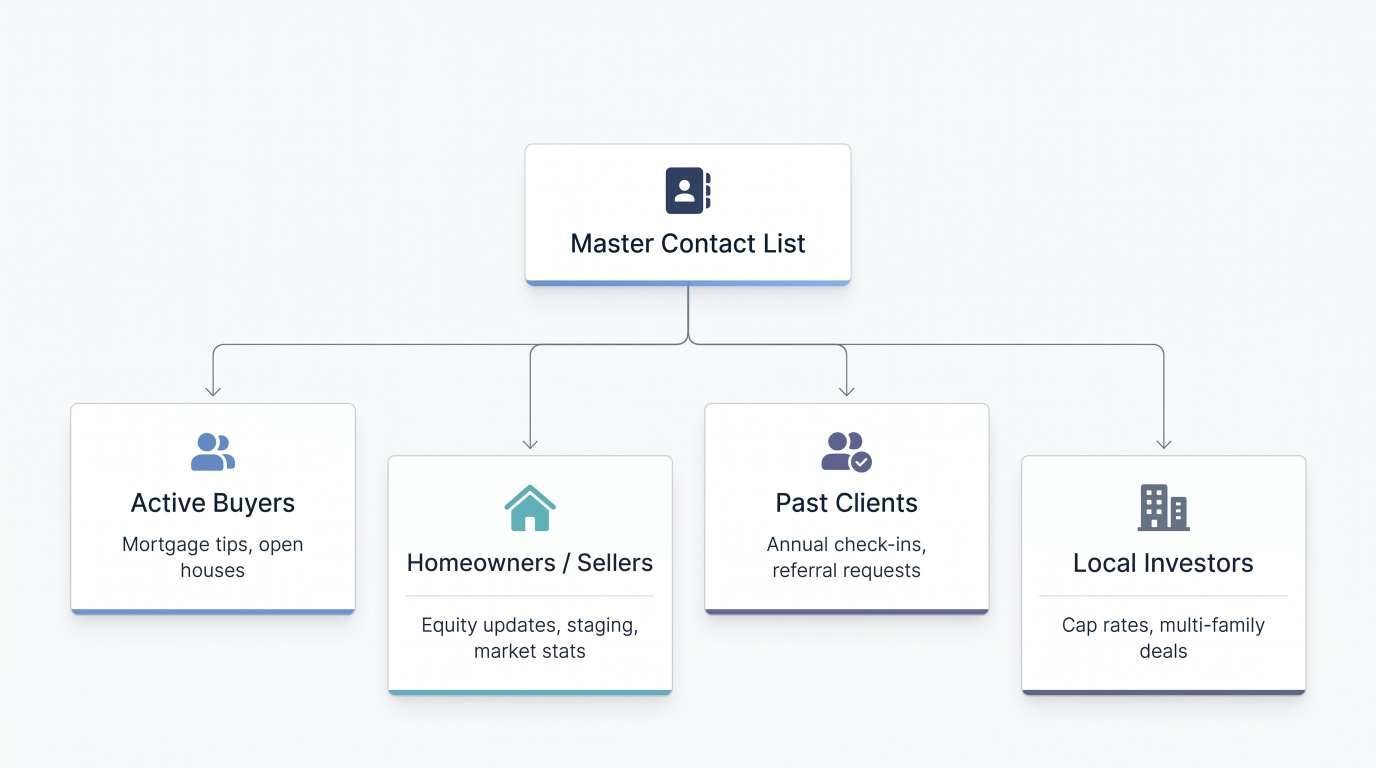
Active Buyers: People searching for a home right now. They want to see price drops, new listings, and interest rate updates.
Current Homeowners / Future Sellers: People who already own a home in your town. They want to know home values, property tax trends, and home improvement ideas.
Past Clients (Your Referral Goldmine): People who bought or sold with you already. They need relationship maintenance, holiday greetings, and local community updates so they refer their friends to you.
Real Estate Investors: People looking for rental properties, flips, or commercial spaces. They care about numbers: cap rates, cash-on-cash return, and zoning changes.
When you send an email tailored specifically to that group's immediate goals, your open rates jump from 20% to over 45%.
Step 4: Write Emails People Actually Enjoy Reading
Real estate emails fail when they sound like a corporate robot wrote them.
Nobody wakes up in the morning excited to read a corporate press release. People read emails that feel like a personal note from a helpful neighbor who happens to know a lot about houses.
The 80/20 Rule of Content
Follow the 80/20 rule:
80% Value and Education: Local news, market breakdowns, cost-saving tips, and community highlights.
20% Direct Promotion: "Here is my new listing," or "I have three open consultation slots this Thursday."
If every email you send is a sales pitch saying "Hire me, I'm the top agent in town," people will tune you out. But if you consistently teach them how to save money on their property taxes, choose the right contractor, or understand where mortgage rates are heading, they will open every message you send.
Use the "One Friend" Writing Style
When you sit down to draft an email, picture one specific client you worked with recently. Write the email as if you are sending a quick message directly to them.
Use short sentences.
Keep paragraphs to two or three lines maximum.
Skip the fancy industry jargon. Instead of saying "residential inventory absorption rate," say "homes are selling twice as fast this month compared to last month."
Ask simple questions to encourage replies. (Every time a subscriber hits "Reply" to your email, email providers like Gmail see you as an authentic sender, which keeps you out of the spam folder.)
Step 5: Master the Art of Subject Lines
Your email content does not matter if nobody opens the message. Your subject line is the door handle.
Good subject lines are short, honest, and create genuine curiosity without using sleazy clickbait.
High-Converting Subject Line Formulas
Here are real-world subject line templates you can adapt for your local market:
For Local Buyers
"Quick question about your home search in [City Name]"
"3 homes in [Neighborhood] that just cut their price"
"What $450k actually buys you in [City Name] right now"
"Before you tour that house this weekend, check this..."
For Homeowners and Potential Sellers
"What happened to home prices in [Neighborhood] last month?"
"3 simple home fixes that pay off big when you sell"
"Is your home assessment too high this year?"
"A quick update on property values on your street"
For Past Clients
"Thinking of you! How is the kitchen holding up?"
"My 4 favorite weekend events happening in [City Name]"
"A trusted plumber recommendation (just in case)"
Pro Tip: Avoid all-caps text, excessive exclamation points, and hype words like "FREE CASH GUARANTEED NOW!!!" Those trigger spam filters before your email ever reaches the inbox.
Step 6: Set Up Simple Automated Drip Campaigns
The real magic of email marketing happens when you set up automated sequences (often called "drip campaigns").
An automation is a series of pre-written emails that go out on a schedule whenever someone takes a specific action, like downloading your buyer guide. You write these emails once, and they work for you 24 hours a day, 7 days a week.
[ Lead Downloads Buyer Guide on Website ]
                  │
                  ▼
         [ Immediately: Email 1 ]
   Deliver Guide + Short Friendly Welcome
                  │
                  ▼ (Wait 2 Days)
         [ Day 2: Email 2 ]
   "The 3 Biggest Mistakes First-Time Buyers Make"
                  │
                  ▼ (Wait 3 Days)
         [ Day 5: Email 3 ]
   "How Pre-Approval Really Works (and local lender recommendations)"
                  │
                  ▼ (Wait 4 Days)
         [ Day 9: Email 4 ]
   "My Favorite Hidden-Gem Neighborhoods in [City]"
                  │
                  ▼ (Wait 5 Days)
         [ Day 14: Email 5 ]
   Direct Offer: "Want to tour 2-3 homes this Saturday?"
The 5-Part Welcome Sequence for New Leads
Here is a simple 5-email sequence you can put together this week:
Email 1 (Sent Immediately): Deliver the Goods. Send the PDF they requested. Introduce yourself in two sentences and tell them what to expect from your emails.
Email 2 (2 Days Later): The Common Mistake. Share a short story about a common mistake buyers or sellers make in your local market and how to avoid it.
Email 3 (5 Days Later): Local Knowledge Drop. Highlight your favorite hidden-gem neighborhood, local park, or upcoming community development that will impact property values.
Email 4 (9 Days Later): Social Proof / Case Study. Tell a brief story about how you helped a real family navigate a tough inspection or win a home against multiple offers.
Email 5 (14 Days Later): The Soft Ask. Ask if they have any quick questions about the market or if they want to grab a quick 10-minute phone call to talk through their timeline.
After this initial sequence finishes, move that contact into your regular weekly or bi-weekly community newsletter list.
Step 7: How to Format Your Weekly Real Estate Newsletter
Consistency beats intensity. Sending an email once every week or every two weeks keeps your name top-of-mind.
A great real estate newsletter does not need to be long. In fact, shorter is often better. Here is a proven three-part layout that takes less than an hour to write each week:
1. The Local Real Estate Pulse (2–3 Sentences)
Give a quick snapshot of the local market in plain English:
"This week in North Austin, we saw 14 new homes hit the market and 9 go under contract. Average days on market dropped slightly to 28 days. If you're buying, you have a bit more room to negotiate inspection repairs right now than you did last spring."
2. The Community Spotlight (1 Short Paragraph)
Talk about something happening in town that is not about real estate. Mention a new coffee shop opening downtown, an annual fall festival, or a park renovation. This proves you are an active part of the community, not just a salesperson trying to collect a commission check.
3. The Featured Home or Deal of the Week (With Photos)
Highlight one standout property. It could be your own listing, an office listing, or simply an interesting property on the MLS (make sure you follow your local board's rules on advertising MLS listings).
Write a quick note on why it stands out:
"Check out this 3-bed mid-century home in Oak Forest. It has an incredible backyard with mature oak trees, and it just had a $15,000 price adjustment. [Link to full photo gallery and details]."
4. A Clear Call-to-Action (CTA)
Wrap up with a simple way to get in touch:
"Have questions about what your home is worth before summer? Hit reply to this email, and I'll send you a custom market report for your neighborhood."
Step 8: Stay Legal and Follow US Email Regulations
Real estate is a heavily regulated industry in the United States, and email marketing has its own set of federal rules. You do not need a law degree to stay safe, but you must follow the basics.
The CAN-SPAM Act Requirements
The Federal Trade Commission (FTC) enforces the CAN-SPAM Act. To stay compliant:
Include a Physical Address: Every email you send must clearly display your valid physical postal address (this can be your brokerage office address or a registered P.O. Box).
Provide an Easy Unsubscribe Link: Every marketing email must include an obvious, working unsubscribe link. If someone clicks it, your system must honor that request promptly without charging fees or asking for complicated steps.
Use Accurate Header Information: Your "From," "To," and "Reply-To" fields must accurately identify who you are.
Do Not Use Deceptive Subject Lines: Never use misleading subject lines like "RE: Your mortgage refund check" just to trick someone into opening an email.
Fair Housing Guidelines in Email
Remember that the Fair Housing Act applies to all your marketing materials, including digital newsletters.
Never write copy that expresses a preference, limitation, or discrimination based on race, color, national origin, religion, sex, familial status, or disability. Stick to describing the physical features of the property, the structure, and verified public data rather than describing the "type of people" living in an area.
Key Metrics to Track (and What Good Numbers Look Like)
Do not get overwhelmed by deep analytics. Keep an eye on these four basic numbers in your dashboard:
Metric | What It Means | Healthy Real Estate Benchmark | How to Improve It |
Open Rate | Percentage of people who opened your email. | 35% – 45% | Test shorter subject lines and clean out inactive subscribers every 6 months. |
Click-Through Rate (CTR) | Percentage of people who clicked a link inside. | 2.5% – 5% | Use clear buttons and link directly to helpful resources or photo galleries. |
Unsubscribe Rate | Percentage who opt out after an email. | Under 0.4% | Ensure content stays relevant to their specific segment (buyers vs. sellers). |
Direct Replies | Real replies to your inbox. | 1 to 3 per send | End your emails with simple, open-ended questions like "What neighborhood are you eyeing?" |
Putting It All Together: Your 30-Day Action Plan
You do not need to do everything at once. Here is a simple, realistic roadmap to launch your email marketing system over the next 30 days:
[ Week 1: Foundation ] ──> Set up email platform, import existing contacts, add footer address.
[ Week 2: Lead Magnet ] ──> Build 1 simple PDF guide (e.g., Relocation or Buyer Checklist).
[ Week 3: Automation ]  ──> Write and schedule a 3-part welcome email sequence.
[ Week 4: First Send ]   ──> Write your first local newsletter and hit "Send" to your network.
Week 1: Choose an email tool (like MailerLite or your brokerage CRM). Export your past contacts, family, friends, and sphere of influence. Clean up duplicates and upload them.
Week 2: Create one solid lead magnet. A simple 2-page PDF on Canva about buying a home in your town is plenty. Connect it to a signup form on your website or social media.
Week 3: Write a 3-email welcome sequence that introduces who you are, shares one local tip, and offers an open door for questions.
Week 4: Write your very first local community newsletter and send it out to your list. Keep it brief, friendly, and helpful.
Once that rhythm is established, stick to it. Email marketing is a compounding asset.
A list of 500 local homeowners and qualified buyers who know, like, and trust you is worth more to your real estate business than 50,000 random social media followers anywhere in the world. Start building your list today, stay consistent, and watch your transaction volume grow.
Looking for a simpler way to manage buyers and send local newsletters? Check out our custom real estate CRM, built with automated email tools and zero recurring monthly fees. See How It Works Here
Ready to grow your business?
Contact us today to find out how our strategies can scale your operations to the next level.
Contact Us