How to Use Social Media to Grow Your Startup Business
Hey there! If you just launched a startup, congratulations. Building something from scratch is exciting, scary, and a lot of work.
Now comes the hard part: getting customers.
You might look at your bank account and think, "I do not have thousands of dollars for Facebook ads or marketing agencies."
The good news? You do not need big money. You only need the right playbook.
Today, we are going to break down how to use social media to grow your startup business from zero. We will keep things simple, real, and actionable. No fancy buzzwords, no confusing technical talk. Think of this guide like having a coffee chat with a founder who has already built a brand from scratch.
Grab a notepad, and let’s dive in.
Why Social Media Is Crucial for Startup Growth
When you run a new company, you face one giant enemy: obscurity. Nobody knows your product exists.
Social media is the only place on earth where a brand-new business with $0 can reach millions of people in a single afternoon.
Free Attention and Equal Opportunity
Old-school advertising required massive budgets for billboards, TV slots, or radio ads. Big corporations always won because they had deeper pockets.
Social media flipped the rules. Today, algorithms reward interesting content, not big bank accounts. If your post helps someone, makes them smile, or solves a real problem, the platform pushes it for free.
Direct Feedback from Real People
Social media is not just a megaphone to shout your promotions. It is a telephone.
When you share your ideas on social platforms, people leave comments. They tell you:
What features they love.
What confuses them.
What price they are willing to pay.
You get free market research every single day.
Step 1: Pick the Right Social Media Platform for Your Startup
A huge mistake many new founders make is trying to be everywhere at once.
They make an account on Instagram, TikTok, LinkedIn, YouTube, X, Pinterest, and Threads on day one. Two weeks later, they burn out, stop posting, and quit.
Do not do that. Choose one primary platform where your audience hangs out, and master it before moving to the next.
Platform | Best For | Content Style |
B2B, SaaS, Professional | Text stories, case studies | |
TikTok / Reels | E-commerce, B2C, Lifestyle | Short-form relatable videos |
YouTube | Education, Software, Tech | Deep tutorials & teardowns |
X (Twitter) | Tech, Web3, Indie Founders | Short insights, threads |
Visual products, Food, Art | Photos, carousels, stories |
Where Does Your Customer Actually Spend Time?
Ask yourself: Who buys my product?
If you sell enterprise software or professional services, go straight to LinkedIn.
If you sell cool backpacks, skincare products, or home goods, go to Instagram and TikTok.
If you build software for developers or creators, X and YouTube are your best friends.
Go where your customers already are. Never try to force your customers to come to a platform they do not use.
Step 2: Set Up a Profile That Converts Visitors into Customers
When someone sees an interesting post from you, they tap your profile name.
You have about three seconds to convince them to follow you or visit your website. Your profile page is your digital storefront.
[  Clean Profile Photo / Brand Icon  ]
  Your Name / Startup Name

  Line 1: Who you help + What problem you solve
  Line 2: The proof or result (Numbers, social proof)
  Line 3: Clear Call to Action -> [ Free Tool / Website Link ]
Profile Photo and Username
Keep it simple:
Use a crisp, high-resolution logo or a clean, smiling photo of the founder.
Keep your username short, memorable, and identical across all platforms if possible.
The 3-Line Bio Formula
Do not write poetry in your bio. Write clarity:
Line 1 (The Hook): What do you do, and who is it for? (Example: "We help remote teams track work without boring meetings.")
Line 2 (The Proof): Why should they trust you? (Example: "Used by 10,000+ happy team leads.")
Line 3 (The Action): Tell them what to do next. (Example: "Grab your free 14-day trial below 👇")
The Link in Bio
Do not just paste a home page link with no explanation. Send visitors to a specific landing page, a free guide, a newsletter signup, or a simple discount offer.
Step 3: Master the "Build in Public" Strategy
If you are a startup founder with no brand name, your biggest advantage is your story.
People rarely care about faceless corporations. But people love watching a scrappy underdog build something meaningful. This is called Building in Public.
Share the Ups and the Downs
Do not only post when you succeed. Share the lessons from your failures:
"We tried this launch tactic, and it made $0. Here is what we learned."
"Here is how we fixed our biggest customer complaint this week."
"How we built our initial MVP in 30 days."
Transparency creates deep trust. When people watch you build your startup brick by brick, they cheer for you. When you launch a paid product, they become your first paying customers because they feel like part of the journey.
Show Behind the Scenes
Film short clips on your phone:
Show your desk setup.
Show the box packing process.
Show your team brainstorming on a whiteboard.
Show your reaction when you get your first customer review.
Simple, unpolished videos consistently beat expensive, shiny studio ads because they feel authentic and human.
Step 4: The 70-20-10 Content Rule
What should you actually post each week? If you only post: "Buy my product! Buy my product!", people will unfollow you immediately.
To keep your audience engaged and grow steadily, use the 70-20-10 Content Rule:
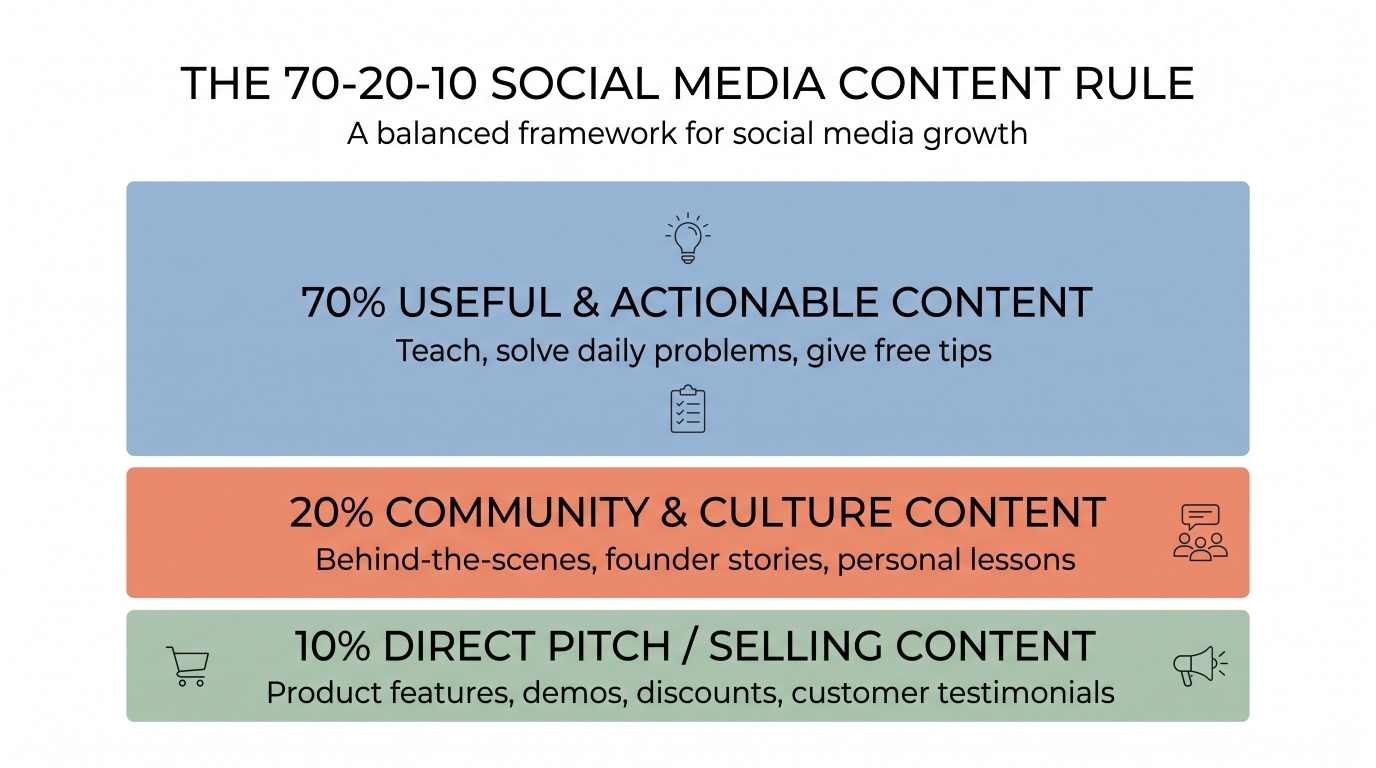
1. 70% Value-First Content (Educate and Help)
Solve real problems for free.
If you sell accounting software for freelancers, post tips on how to save taxes easily.
If you sell running shoes, post stretching guides and 5K training routines.
When you give away helpful advice without asking for money, you position your startup as the go-to expert in your field.
2. 20% Culture and Founder Stories (Build Connection)
Share your personal perspective:
Why did you quit your job to start this company?
What books or podcasts changed how you think?
A mistake you made early on and how you resolved it.
This turns casual followers into true fans who care about you as a person.
3. 10% Direct Promotion (Make Sales)
Now that you have earned attention and trust, you can ask for the sale:
Show customer case studies and screenshots of real results.
Announce product updates and special discounts.
Walk through a 30-second screen recording showing how easy your tool is to use.
Because you gave 90% free value, your audience will gladly listen to your 10% sales pitches.
Step 5: How to Write Posts That Stop the Scroll
Every platform moves fast. People scroll on their phones with their thumbs at lightning speed. If your first sentence or visual is boring, your post is invisible.
Here is how to create content that hooks attention naturally.
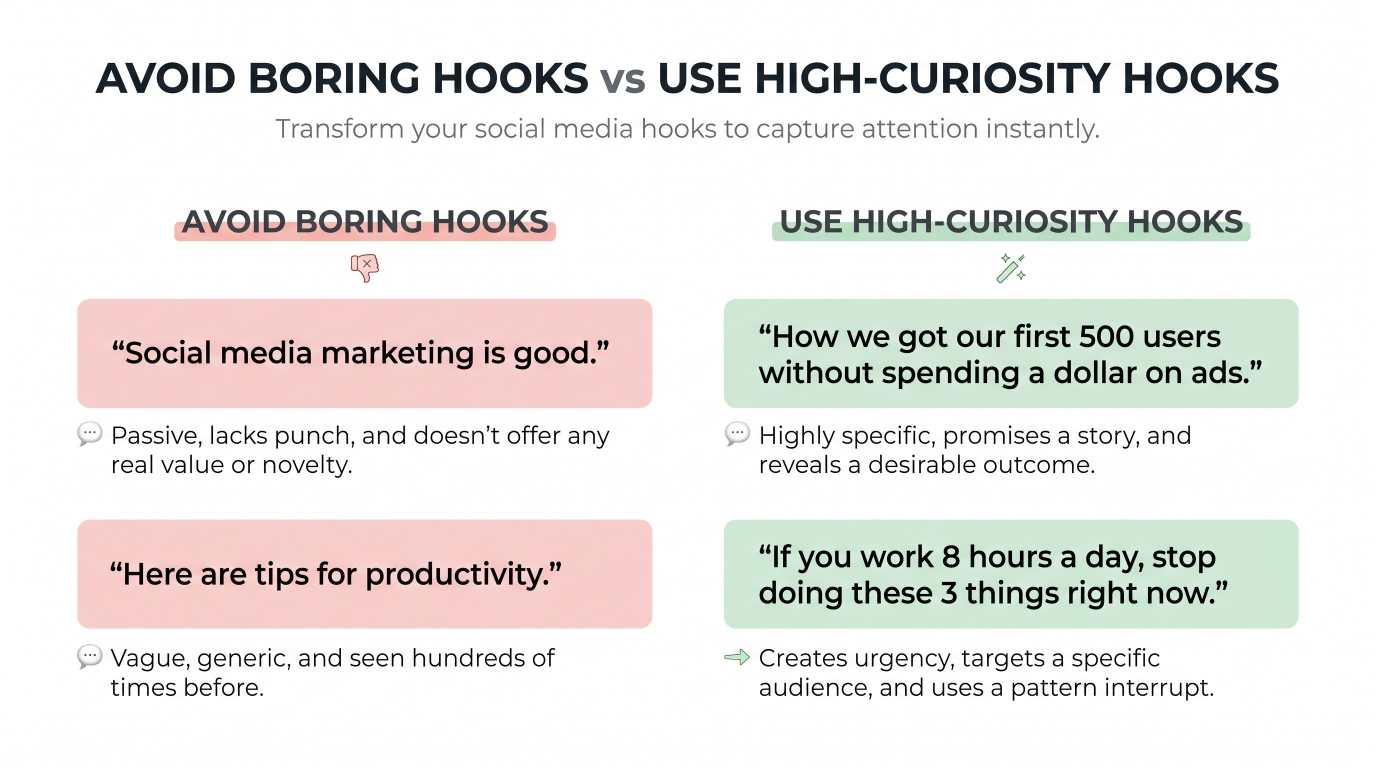
Nail the First 2 Seconds (The Hook)
The first line of your text post, or the first two seconds of your short video, is 80% of your success.
Keep Sentences Short and Punchy
Look at this page. Notice how short the paragraphs are?
Big walls of text scare people away.
Write one or two sentences per paragraph.
Use bullet points to break down complex lists.
Leave plenty of white space so the text breathes on a mobile screen.
Talk Like You Talk to a Friend
Read your post out loud before hitting publish.
If you sound like a textbook or a legal contract, delete it and rewrite it.
Use words like "you", "me", "we", and "let's".
Write the exact way you talk in real life.
Step 6: The Daily 30-Minute Engagement Routine
Social media is not a one-way street. You cannot simply post your content, close the app, and wait for magic to happen. The algorithms favor accounts that interact with other human beings.
Spend 30 minutes every day executing this simple routine:
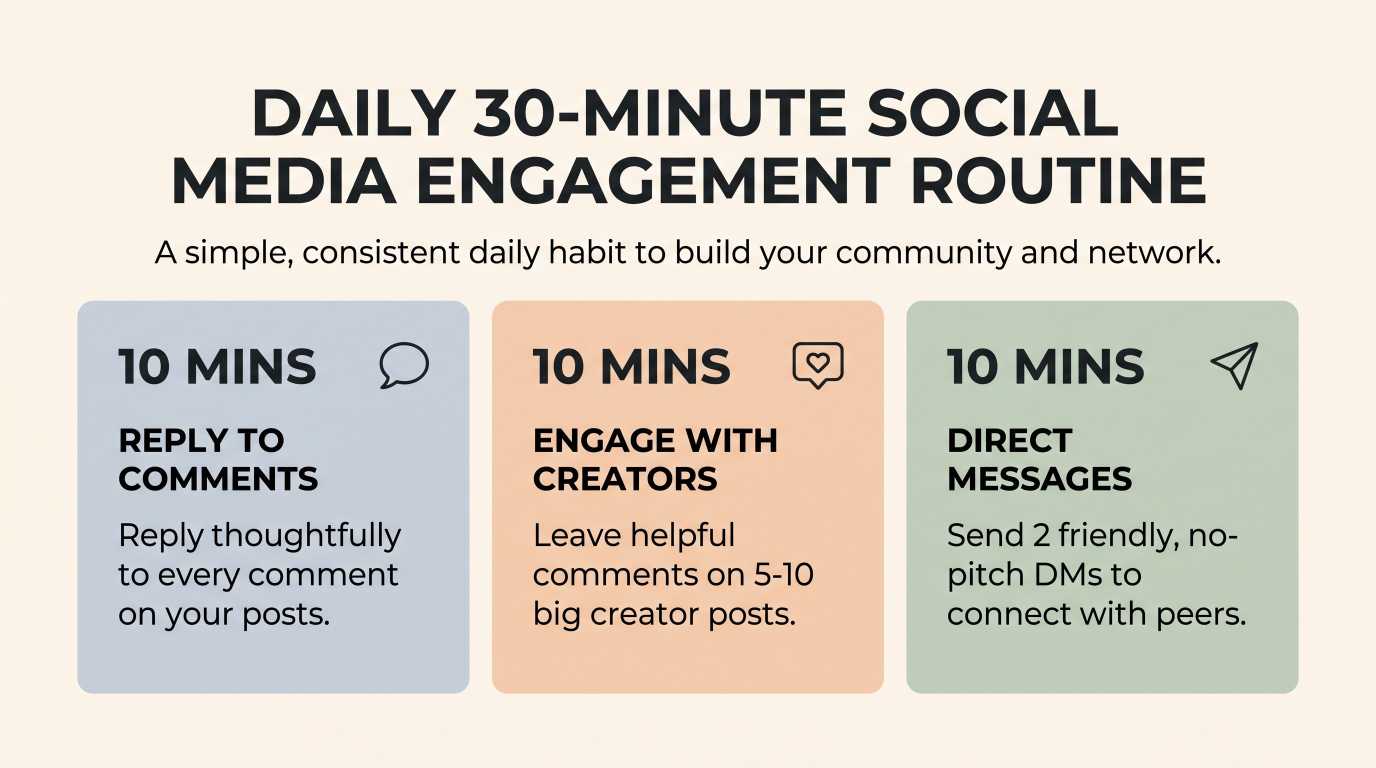
Step-by-Step Daily Checklist:
First 10 Minutes: Reply to every single comment left on your recent posts. Ask a follow-up question to keep the conversation going.
Next 10 Minutes: Find 5 to 10 popular creators or industry leaders in your niche. Read their posts and leave thoughtful, insightful comments. Don't spam: "Great post!" Add something useful to the conversation. Their followers will notice your comment, find it smart, click your profile, and follow you.
Last 10 Minutes: Reach out to 2 people in your space via direct message. Welcome new followers or tell another creator that you loved their recent post. Make friends. Do not pitch your product. Relationships build business.
Step 7: Leverage Short-Form Video (Reels, TikTok, and Shorts)
If you want fast organic reach today, short-form vertical video is unmatched.
Platforms like YouTube Shorts, Instagram Reels, and TikTok actively distribute content to non-followers. You can post your very first video and get 5,000 views in 24 hours if the topic hits a nerve.
You Do Not Need Fancy Video Gear
Do not waste $1,000 on camera equipment:
Use the smartphone already in your pocket.
Sit facing a window so natural daylight hits your face.
Put in wired headphones or an inexpensive lapel mic for clear audio (good sound matters more than 4K video).
3 Simple Short Video Templates for Startups
Template 1: "The Problem vs. Solution"
0:00 - 0:03 : Show the painful, frustrating old way of doing a task.
0:03 - 0:15 : Show how your startup makes it take 5 seconds.
0:15 - 0:20 : Clear call to action to test it out.

Template 2: "3 Tools You Didn't Know Existed"
0:00 - 0:03 : "3 websites that feel illegal to know for small businesses."
0:03 - 0:20 : Mention two popular tools, and slip your startup in as tool #2.
0:20 - 0:25 : Ask the viewer what tools they use in the comments.

Template 3: "Behind the Scenes Story"
0:00 - 0:03 : "What happened when our website crashed on launch day."
0:03 - 0:30 : Tell the quick story, what went wrong, and how you fixed it.
0:30 - 0:40 : Share the key takeaway for other founders.
Step 8: Micro-Influencer Collaborations on a Shoestring Budget
Paying a celebrity or giant influencer $20,000 for a post is risky and usually delivers poor return on investment for an early-stage startup.
Instead, collaborate with micro-influencers (creators with 2,000 to 25,000 followers).
Influencer Type | Follower Count | Engagement Level |
Mega / Celebrity | 500,000+ | Low (1% - 2%) |
Mid-Tier | 50,000 - 200,000 | Moderate (2% - 3%) |
Micro-Influencer | 2,000 - 25,000 | High (5% - 10%+) |
Why Micro-Influencers Win:
High Trust: Their followers often know them personally or view them as honest peers.
Affordable: Many micro-creators will gladly review your product in exchange for a free subscription, sample product, or a small affiliate commission.
Targeted Audiences: A creator with 4,000 dedicated indie game developers is worth far more to a game engine startup than a general lifestyle influencer with 200,000 followers.
How to Reach Out Without Being Annoying
Send a brief, polite direct message or email:
"Hey [Name], love your recent video on [Topic]. We built [Startup Name] to help people solve [specific problem], and we thought it would save you a ton of time. Would love to gift you a free lifetime account—no strings attached. Let me know if you want the login!"
Notice there is zero pressure to post. When your product is genuinely good, they will often talk about it on their own.
Step 9: Turn Social Followers into Email Subscribers
Never forget this golden rule of internet business: You do not own your social media followers.
An algorithm change can drop your organic reach overnight. An account suspension can erase years of hard work in seconds.
The entire goal of learning how to use social media to grow your startup business is to move those followers off rented land and onto land you own: your email list.
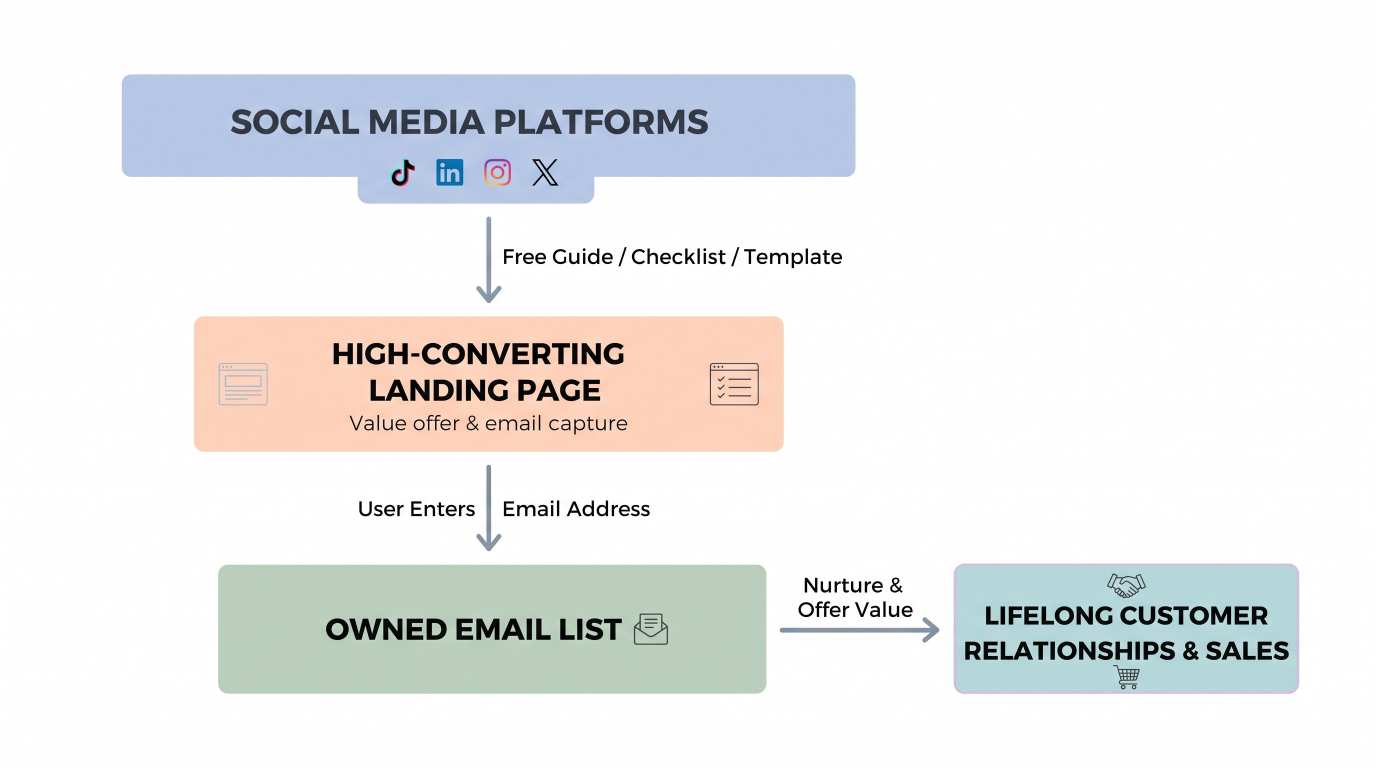
Use a Simple "Lead Magnet"
Give people a compelling reason to join your email list. Offer a free resource:
A one-page checklist.
A spreadsheet template.
A mini video workshop.
An exclusive discount code.
Whenever you share a great tip on social media, add a reminder at the end: "Want my free template? Grab the link in my bio." This turns social views into permanent business assets.
Step 10: Track the Metrics That Actually Matter
Many founders obsess over vanity metrics: follower counts and likes.
While likes feel good, they do not pay rent or salaries. Focus on numbers that signal real business health:
Metric | Why It Matters |
Profile Visits | Shows how many people found your post interesting |
Click-Through Rate | Measures how many people actually visit your site |
Saves and Shares | Algorithms prioritize content people save & share |
Conversions | Signups, email subscribers, and paying customers |
How to Adjust Your Strategy Every Month
Set a calendar reminder on the last Sunday of every month:
Open your social media analytics.
Identify your top 3 performing posts. Ask: Why did these work? Can I create more content on this exact topic?
Identify your 3 worst-performing posts. Ask: Was the hook boring? Was the topic unhelpful?
Double down on what worked and discard what failed. Repeat this month after month.
Common Social Media Pitfalls to Avoid
As you execute your social media roadmap, avoid these four common traps:
Buying Fake Followers: Buying bot followers destroys your organic engagement rate. Social media algorithms test your post on a small sample of followers first. If your bot followers do not engage, the algorithm kills the post instantly.
Posting Inconsistently: Posting 5 times in one day and then disappearing for three weeks confuses your audience and trains the algorithm to ignore your page. It is far better to post 3 times a week consistently every week.
Sounding Like a Corporate Robot: People connect with human stories, jokes, vulnerability, and honest opinions. Avoid stiff corporate announcements. Speak naturally.
Giving Up Too Early: Organic social growth is a compound curve. You might post for 60 days and see modest results. Then, one post catches fire, leads to press coverage, brings in 5,000 email subscribers, and launches your business. Stay the course.
Final Thoughts: Start Today
Learning how to use social media to grow your startup business is not about complicated software tricks or spending thousands of dollars on advertisements.
It comes down to simple fundamentals:
Pick one platform.
Optimize your profile.
Teach your audience something useful every single day.
Build genuine friendships in the comments.
Move followers to your email list.
You do not need to be famous to get customers. You just need to show up, be helpful, and share your journey consistently.
Pick your platform, post your first story today, and let the compounding begin!
Do You need Social Media Automation? Then you can check it out here now
Frequently Asked Questions (FAQ)
How often should a startup post on social media?
For most platforms like LinkedIn, Instagram, or X, posting 3 to 5 times per week is ideal. Quality and consistency matter much more than flooding feeds with low-value content.
Can I grow my startup on social media without showing my face?
Yes! Many successful software and e-commerce companies grow by sharing screen tutorials, product demonstrations, customer case studies, and visual infographics without ever showing a founder's face.
How long does it take to see sales from organic social media?
Most startups begin seeing meaningful traction, inbound leads, and consistent signups within 60 to 90 days of posting high-value, problem-solving content regularly.
Ready to grow your business?
Contact us today to find out how our strategies can scale your operations to the next level.
Contact Us