How to Raise Money for a Startup: Funding Stages, Investors, and Strategies
Raising money for a brand-new business can feel like trying to solve a puzzle in the dark. You have a great idea. You have the passion. You might even have a working prototype or a few excited users. But when it comes to getting real cash into your bank account, everything suddenly feels complicated, formal, and confusing.
If you have ever wondered:
Where do I even begin?
What is the difference between pre-seed, seed, and Series A?
How do I talk to investors without sounding foolish?
You are in the right place. Think of this guide as a friendly, step-by-step masterclass over coffee. We will break down every single part of raising capital in plain English, with zero corporate fluff and zero confusing buzzwords.
Here is everything you need to know about how to raise money for a startup: funding stages, investors, and strategies.
You can also check: How to Build a Business Model for a Startup in 7 Simple Steps
What Does Raising Money for a Startup Actually Mean?
Let us start with the basics.
When you start a company, you need cash to build your product, pay team members, run servers, and market to customers. If you do not have enough money in your own pocket, you have two main choices:
Debt financing: You borrow money from a bank or lender and pay it back with interest.
Equity financing: You sell a small slice of ownership (shares) in your company to someone else in exchange for cash.
In the startup world, almost everyone talks about equity financing. Investors give you cash today because they believe your tiny company will grow into a massive company tomorrow. If you succeed, their small slice of the pie becomes worth millions. If your startup fails, they usually lose their money.
Because the risk is very high, investors look for companies with huge potential.
Step 1: Are You Truly Ready to Raise Money?
Before you start emailing investors, pause and ask yourself an honest question: Do you actually need to raise money right now?
Raising money is not a badge of honor. It is a tool. Once you take someone else's money, you are on a clock. Investors expect rapid growth, regular updates, and eventually, an exit (like selling the company or going public on the stock market).
The Reality Check: Bootstrapping vs. Fundraising
Bootstrapping means you fund the business yourself from savings or from early sales revenue. You keep 100% control, you answer to nobody, and you can grow at your own pace.
Fundraising means bringing in outside capital. You give up part of your company, but you get fuel to move fast and capture a market before competitors do.
If you can build a small version of your product and get paying customers without outside investment, do that first! Showing that people already pay for what you built makes raising money ten times easier later.
Startup Funding Stages Explained: From Napkin Idea to Growth Machine
Fundraising does not happen all at once. Startups raise money in rounds or stages. Each stage matches a specific milestone in your company's life.
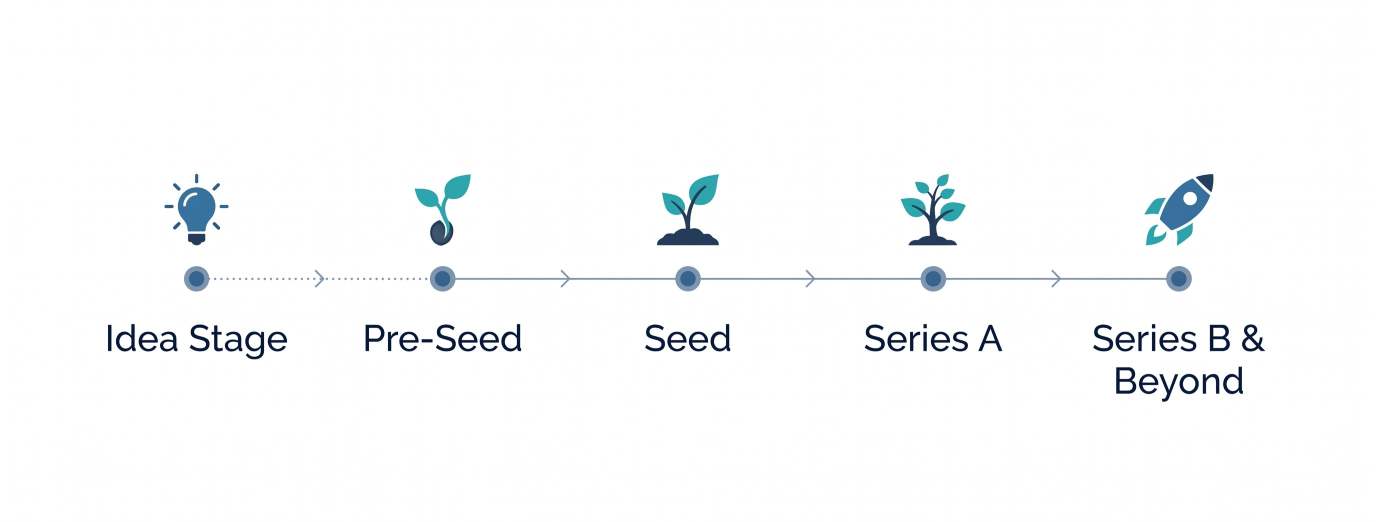
Let us look at each stage one by one.
1. Bootstrapping and The Pre-Seed Stage
What it is: The very beginning. Often, you only have an idea, a pitch deck, and maybe a rough prototype.
Typical check size: $25,000 to $250,000.
What it pays for: Basic legal setup, building the minimum viable product (MVP), and preliminary user interviews.
Who invests: You, your friends and family, and early angel investors.
At this stage, you do not have financial charts or revenue numbers. People are not investing in the business yet; they are investing in you, your work ethic, and your insight into a specific problem.
2. The Seed Stage
What it is: Your product is live. You have real people using it, and you are starting to see early traction.
Typical check size: $500,000 to $3 million.
What it pays for: Hiring your first core engineers or marketers, refining your product based on user feedback, and finding Product-Market Fit.
Who invests: Angel investors, early-stage venture capital micro-funds, and startup accelerators (such as Y Combinator or Techstars).
At the seed stage, you need to prove one main thing: people actually want what you built. Even if you are not profitable, you need to show consistent user growth, engagement, or early recurring revenue.
3. Series A: Proving the Business Model
What it is: You have found product-market fit. Customers love your product, they stick around, and now you want to scale up.
Typical check size: $3 million to $15 million.
What it pays for: Scaling the sales and marketing engine, expanding into new markets, and building out a full management team.
Who invests: Traditional venture capital firms.
Series A is where data takes over. Investors look closely at hard numbers:
Customer Acquisition Cost (CAC): How much does it cost to get one new customer?
Lifetime Value (LTV): How much money does that customer pay you over time?
Churn Rate: How many customers cancel each month?
If your unit economics make sense (for example, if you spend $1 to get $4 back), Series A investors will give you millions to pour fuel on that fire.
4. Series B, C, and Beyond: Scaling and Expansion
What it is: You are no longer an experiment. You are a recognized company building a dominant market position.
Typical check size: $15 million to $100+ million.
What it pays for: Global expansion, acquiring competitors, developing brand-new product lines, and preparing for an IPO (Initial Public Offering).
Who invests: Late-stage VCs, growth equity funds, private equity firms, and sovereign wealth funds.
Meet the Investors: Who Has the Money?
Not all money is the same. Different types of investors look for different things, write different check sizes, and offer different levels of support.
1. Friends and Family
These are people who already love and trust you. They invest because of their personal relationship with you, not because they analyzed your balance sheet.
Pros: Fast decisions, very friendly terms, patient.
Cons: Mixing family and business is risky. If the startup fails, relationships can suffer. Always use clear legal contracts so everyone understands the risk.
2. Angel Investors
Angels are wealthy individuals (often successful entrepreneurs, doctors, lawyers, or senior tech executives) who invest their own personal money into early startups.
Pros: They move quickly, do not need board seats, and often provide valuable mentorship and industry introductions.
Cons: Check sizes are smaller than VC funds, and their level of experience varies wildly.
3. Venture Capital (VC) Firms
VC firms are professional investment companies. They raise large pools of money from big institutions (pension funds, university endowments) and invest that money into fast-growing startups.
Pros: They write massive checks, bring powerful brand credibility, and offer deep operational networks.
Cons: High pressure. VCs need huge returns to satisfy their own investors. If you want to grow a calm, steady, profitable business, traditional VCs are usually the wrong match.
4. Accelerators and Incubators
Programs like Y Combinator, Techstars, and 500 Global offer small amounts of capital (such as $100k to $500k) alongside intense 3-month mentoring programs that finish with a Demo Day in front of hundreds of investors.
Pros: World-class networking, instant credibility, and hands-on guidance.
Cons: They take a fixed percentage of equity (often 7% to 10%) right out of the gate.
5. Alternative Funding: Grants and Crowdfunding
Government and Innovation Grants: Non-dilutive capital (money you do not pay back and give zero equity for), common in clean energy, biotech, and deep tech.
Equity Crowdfunding: Platforms like Wefunder or Republic allow hundreds of everyday fans to invest small amounts ($100 each) in exchange for shares.
Core Strategies to Win Over Investors
Getting a check is not about having the fanciest slides or using big vocabulary. It comes down to four fundamental pillars: story, traction, team, and numbers.
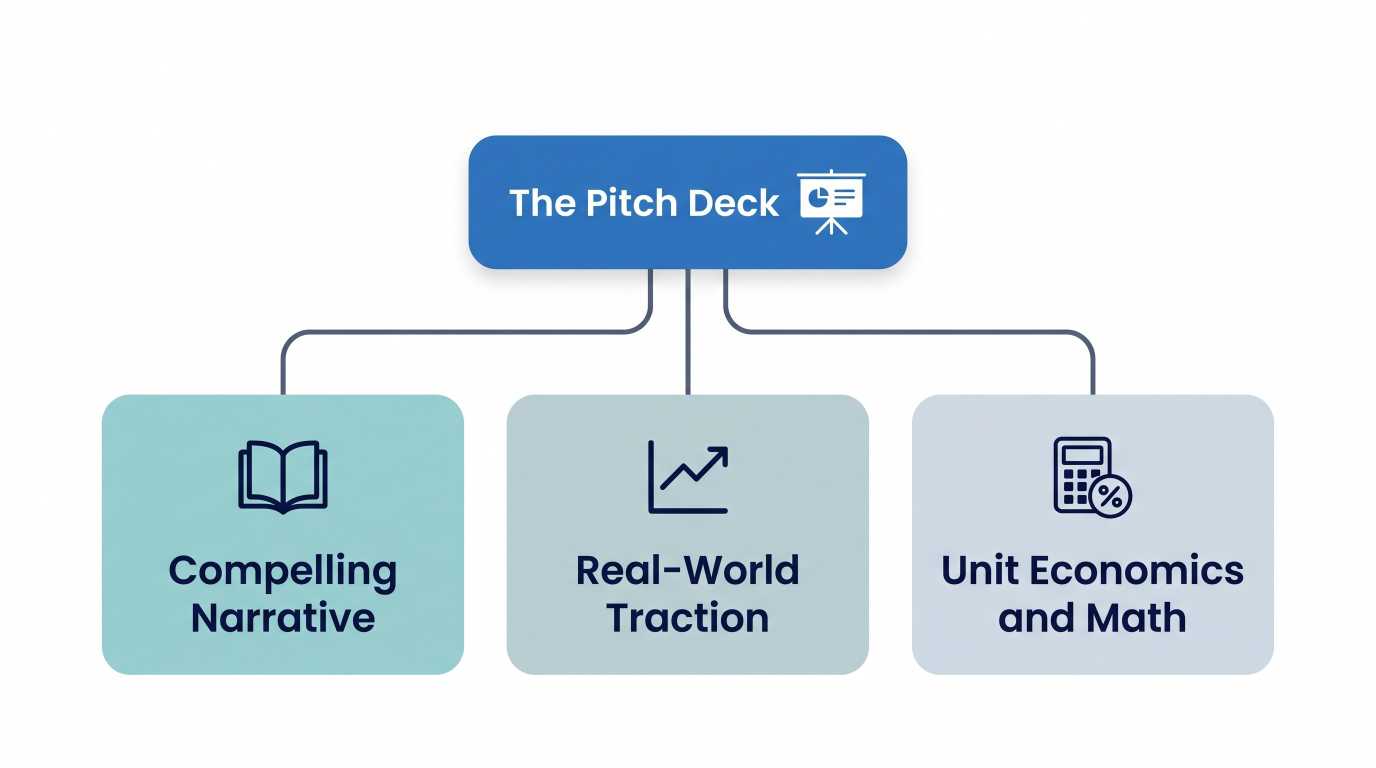
1. Master the 10-Slide Pitch Deck
Your pitch deck is your visual resume. Keep it simple, clean, and no longer than 10 to 12 slides:
Title: Company name, logo, and a one-sentence summary of what you do.
The Problem: What painful, expensive problem exists right now?
The Solution: How your product solves this problem simply and directly.
Market Size (TAM): How many people or businesses have this problem, and how big is the total market?
Product / Demo: Screenshots or a quick overview showing how it works.
Traction: Your proudest numbers, such as active users, revenue, and growth percentage month-over-month.
Business Model: How do you make money? (Subscription, marketplace fee, transaction cuts).
Competition: Who else is doing this, and why are you uniquely better or different?
The Team: Why are you and your co-founders the exact right people to solve this?
The Ask: How much money are you raising, and what specific milestones will it help you achieve over the next 18 months?
2. Focus on Traction Above Everything Else
Nothing speaks louder than traction. If you have two founders pitching the same idea, the investor will always choose the founder who already has 500 active users over the founder who only has pretty slides.
Traction can mean:
Monthly recurring revenue (MRR)
Daily active users (DAU)
A waitlist with thousands of verified email sign-ups
Letters of Intent (LOIs) from corporate buyers stating they will purchase your software once launched
If your traction graph goes up and to the right, fundraising becomes a conversation where investors pitch you, rather than you begging them.
3. Build Real Relationships Before You Need Cash
The famous startup quote says: "Ask for money, and you will get advice. Ask for advice, and you will get money twice."
Start talking to investors 3 to 6 months before you actually start your funding round. Send short, polite messages:
"Hi Sarah, I love your writing on supply chain tech. I am building a tool that helps local warehouses track inventory faster. We are not raising money yet, but I would love to share our monthly progress update as we build towards our launch."
When you send regular updates showing consistent progress month after month, you prove that you execute on your promises. By the time you open your round, Sarah already knows, likes, and trusts you.
Understanding Startup Valuation and Investment Documents
When an investor agrees to fund your startup, how does the deal actually work legally? You do not need a law degree to understand the basics.
Priced Rounds vs. Convertible Instruments
In the early days, valuing a company is almost impossible. How much is an idea and two laptops worth? $1 million? $5 million?
To avoid arguing over exact valuations, most early-stage startups use convertible instruments:
SAFE (Simple Agreement for Future Equity): Created by Y Combinator, this is a simple 5-page legal document. The investor gives you money today, and that money converts into actual shares later when you raise a priced round (like a Series A).
Convertible Note: Similar to a SAFE, but structured as a short-term loan that earns interest and converts into equity later.
Valuation Caps and Discounts
When investors sign a SAFE, they usually ask for two terms to reward them for taking an early risk:
Valuation Cap: A ceiling on the company valuation at which their money converts into shares. If your cap is $5 million and your Series A is valued at $20 million, the early investor gets their shares calculated at the favorable $5 million rate.
Discount Rate: A percentage discount (often 15% to 20%) compared to what new investors pay in the next round.
5 Common Mistakes First-Time Founders Make (And How to Avoid Them)
Avoiding common traps will immediately put you ahead of 90% of other founders:
1. Giving Away Too Much Equity Too Early
Never give away 40% or 50% of your company in your first angel round. If you sell too much early on, you will not have enough equity left to motivate yourself and your future executive team in later rounds. Try to keep dilution between 10% and 20% per funding round.
2. Pitching the Wrong Investors
Do your research. Do not pitch an enterprise healthcare VC if you are building a consumer mobile game. Look for investors who have already backed companies in your sector or adjacent spaces.
3. Hiding Weaknesses or Making Up Answers
Smart investors will spot falsehoods immediately. If an investor asks a technical or financial question you do not know the answer to, never guess. Simply say: "That is a great question. I do not have that exact number in front of me, but I will pull the data and email it to you by 5 PM today." Then make sure you actually send it.
4. Running Out of Runway
Fundraising almost always takes longer than you expect, often 3 to 6 months of full-time effort. Do not wait until you have two weeks of cash left in your bank account to start pitching. Start when you still have at least 6 months of cash runway left.
5. Forgetting About the Customer
Fundraising can become an addiction. Some founders spend all their energy meeting investors, attending parties, and tweaking pitch decks, while completely neglecting their product and users. Never forget: customers pay the bills; investors only buy tickets to the show.
Summary Checklist: Your Action Plan to Raise Capital
To raise startup money successfully, follow this simple roadmap:
Talk to users: Validate your idea and build a simple MVP.
Get early traction: Prove that someone wants your solution.
Build a clean pitch deck: 10 slides focusing on problem, solution, market, traction, and team.
Create a target list: Find 50 to 100 angels or funds that actively invest in your niche.
Get warm introductions: Connect through mutual founders, mentors, or advisors whenever possible.
Use standard agreements: Stick to simple, founder-friendly contracts like the Y Combinator SAFE.
Keep building: Never pause product development or user sales just because you are pitching.
Raising money is a marathon of hearing "no" until you finally hear the right "yes." Stay focused on your core mission, keep your numbers clear and honest, and remember that building a truly valuable business is the fastest way to get investors knocking on your door.
Launch Your Startup’s App in Weeks, Not Months
Don’t let technical roadblocks delay your fundraising. [Your Agency Name] crafts modern, scalable web and mobile applications designed to attract users and win over investors.
Ready to grow your business?
Contact us today to find out how our strategies can scale your operations to the next level.
Contact Us