Building a Modern Website for a Real Estate Company to Get More Leads and Sales
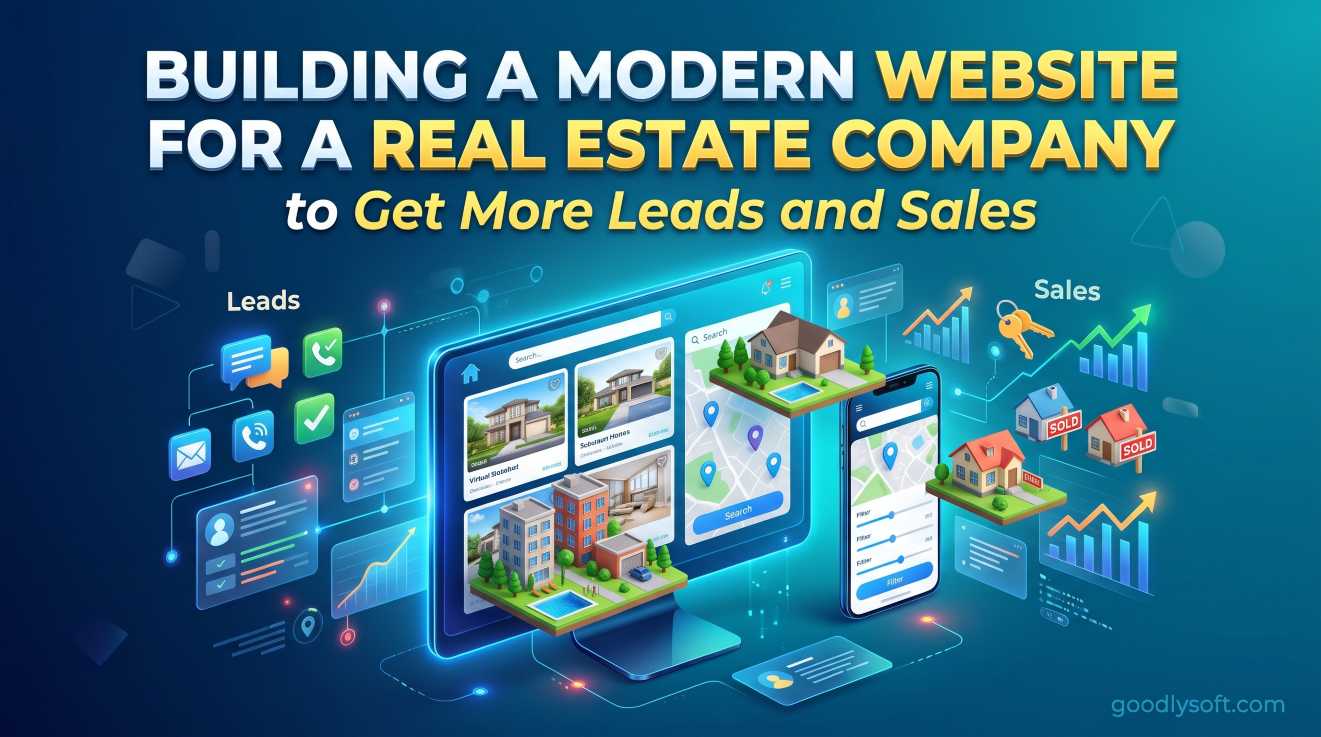
If you run a real estate agency today, your website is your actual front door. Ten or fifteen years ago, people used to walk into a local office, look at brochures on a coffee table, or check printed ads in the weekend paper.
Today, that entire habit has changed.
Almost every home buyer, renter, and property investor starts on a phone or laptop. They browse living rooms while drinking morning coffee, check floor plans on their lunch break, and share virtual home tours with family late at night.
If your website feels slow, hard to use, or outdated, those people will not call your office. They will hit the back button and go to your competitor.
Building a modern website for a real estate company is not just about making something that looks clean and shiny. It is about building a lead generation engine that runs 24 hours a day, 7 days a week. It must help visitors find what they want in seconds, show them clear photos and prices, and give them an easy way to contact your agents.
In this practical guide, we will walk through every step required to build a high-performing real estate website. We will look at design, features, speed, search engine optimization (SEO), and how to turn casual visitors into paying clients.
Why a Generic Website No Longer Works for Real Estate
Many property brokers make a simple mistake when setting up their online presence. They purchase a generic corporate web template, paste a few static pictures of houses, put up an "About Us" page, and wait for the phone to ring.
Then weeks pass, and nothing happens.
Real estate is a unique industry. Buyers do not browse property websites the way they browse standard blogs or simple service company pages. They are preparing to make one of the largest financial investments of their entire life. Because of that, their expectations are very high:
They demand real-time information: If a property has already sold or the price dropped yesterday, the website needs to reflect that immediately.
They need fast visual clarity: Low-resolution pictures, tiny gallery previews, or missing neighborhood details make buyers lose trust immediately.
They search with strict filters: No one wants to scroll through three-bedroom family houses when they are looking for a one-bedroom downtown apartment.
They expect instant mobile speed: More than 70 percent of initial real estate searches happen on mobile devices.
A modern real estate website must act like an interactive software tool, not a static digital flyer.
Core Features Every Modern Real Estate Website Must Have
When you plan your build, focus first on utility. What tools does a buyer or seller actually need to make a decision? Here are the non-negotiable features you need to include.
1. Fast, Intuitive Property Search and Filtering
The search bar should be the star of your homepage. Do not hide it behind multiple menus. Place it right in the main hero section above the fold so visitors can start searching within two seconds of landing on your site.
Make sure your search filters allow users to narrow listings down by:
Location (city, neighborhood, postal code, or school district)
Property type (single-family home, condo, townhome, commercial space, land)
Price range (minimum and maximum sliders)
Bedrooms and bathrooms
Square footage or lot size
Specialized amenities (garage, swimming pool, pet-friendly policy, waterfront view)
Keep your search simple on the surface, with an "Advanced Filters" dropdown for users who know exactly what they want.
2. High-Quality Property Listing Pages
Your listing detail page is where the sale actually starts. When a user clicks on an interesting property, this page must give them everything they need without feeling cluttered.
High-Definition Photo Galleries: Use full-width, clean galleries with fast thumbnail navigation. Allow visitors to click and expand images in full-screen mode on both mobile and desktop.
Video Walkthroughs and 3D Virtual Tours: Embedded 3D virtual tours (such as Matterport) and smooth video walkthroughs keep users on your page significantly longer, which also signals to search engines that your content is valuable.
Key Details at a Glance: Place the price, property status (Active, Pending, Price Reduced), bedroom count, bathroom count, and total area in bold right at the top.
Downloadable Property Flyers: Give buyers and investors a one-click button to download a clean PDF summary with all specs and your agent contact info.
3. MLS and IDX Integration for Live Updates
If you operate in a market supported by an MLS (Multiple Listing Service), an IDX (Internet Data Exchange) integration is crucial.
IDX feeds listings directly from the regional database straight onto your website automatically. That means whenever a new listing hits the market or a price changes, your website updates on its own without manual data entry.
For modern custom platforms, using a direct API connection (like the RESO Web API) is much faster and cleaner than old iframe embeds. It ensures every listing lives on its own clean URL on your domain, which is a major advantage for your organic search rankings.
4. Interactive Neighborhood and Community Guides
People do not just buy a house; they buy a location. They want to know what life feels like in that specific area before they ever schedule a viewing.
Include detailed neighborhood profile pages on your website that highlight:
Local school ratings and public transit links
Average commute times to business districts
Walkability scores and nearby grocery stores
Local parks, restaurants, and shopping spots
Market trends, such as average price per square foot in that neighborhood
When you write helpful, original local community guides, you establish strong local authority, which both home buyers and search engines reward.
5. Clear, Transparent Agent Profiles
Real estate remains a people business built on personal trust. A modern website needs an engaging "Our Team" directory where each agent has their own dedicated profile page.
Each agent profile should showcase:
A professional, warm photo and a short, relatable bio
Direct phone numbers, email addresses, and WhatsApp click-to-chat links
Current active listings managed by that agent
Recent sales history and verified client reviews or testimonials
Spoken languages, which is very helpful for international or multicultural markets
Technical Architecture: Building for Speed, Security, and Reliability
A beautiful design will not help your business if pages take seven seconds to open or the system crashes during high traffic spikes. Here is what you need under the hood.
Modern Frontend and Backend Frameworks
Many businesses start with basic website builders, but as their property inventory and visitor numbers grow, those basic builders often slow down to a crawl.
For modern real estate platforms, combining a solid backend framework like Laravel or Node.js with a snappy frontend like React or Vue delivers an app-like experience. Pages change instantly, filters update the listings without full page reloads, and the user interface feels smooth.
Mobile-First Responsive Design
Do not design your website on a 27-inch desktop monitor and then treat the mobile version as an afterthought. Most of your clients are looking at homes on their smartphones while waiting in line, sitting on the couch, or driving through prospective neighborhoods.
Make sure your buttons are large enough for thumbs to tap comfortably, search input fields do not trigger awkward screen zooms, and image carousels swipe naturally.
Image Optimization and Content Delivery Networks (CDN)
Real estate websites are naturally heavy because of hundreds of high-resolution property photos. If you upload full-size images directly from a camera, your site speed will suffer badly.
To keep your website lightning-fast:
Convert all images to modern formats like WebP or AVIF.
Implement lazy loading so images only load when a user scrolls down to them.
Use a Content Delivery Network (CDN) like Cloudflare to serve images from servers located closest to your visitor.
Looking to build a custom real estate platform that drives real client inquiries?
If you want a fast, custom-built website with live property search, seamless mobile experience, and modern CRM integration, the engineering team at GoodlySoft can help you design and deploy a solution tailored directly to your business goals.
On-Page and Local SEO Strategies for Real Estate
Search Engine Optimization (SEO) is the most sustainable way to attract high-intent home buyers and property sellers without paying constantly for digital ads.
To score at the very top of SEO audits and bring in organic search traffic, your site must be structured carefully around user search intent and Google's E-E-A-T (Experience, Expertise, Authoritativeness, and Trustworthiness) standards.
1. Structuring Your URL Hierarchy
Keep your website structure organized and logical. Both search engines and everyday users appreciate clean, predictable URLs:
Good:
[yourdomain.com/homes-for-sale/downtown/modern-2-bed-condo](https://yourdomain.com/homes-for-sale/downtown/modern-2-bed-condo)Bad:
[yourdomain.com/?p=4821&cat=12](https://yourdomain.com/?p=4821&cat=12)
When URLs contain clear location and property-type keywords, users know what they are clicking on before the page even opens.
2. Title Tags and Meta Descriptions That Win Clicks
Your page title and meta description are your organic advertisement in search results. Make sure they are descriptive, honest, and include your primary focus keywords naturally.
Homepage Title Example: Modern Real Estate Company in [City Name] | Homes & Condos for Sale
Listing Page Title Example: 4 Bedroom Family Home for Sale in [Neighborhood, City] | [Agency Name]
Meta Description Example: Explore this renovated 4-bedroom home for sale in Oakridge. Features a modern kitchen, private backyard, and top school access. Schedule a private tour today.
3. Adding Real Estate Structured Data (Schema Markup)
Schema markup is code that helps search engines understand the exact data points on your pages. When you add structured data to your listings, search engines can display rich snippets directly in search results, showing the price, availability status, review ratings, and address right under your page link.
Important schema types to include:
RealEstateAgentorRealEstateListingSingleFamilyResidenceorApartmentOffer(with price, priceCurrency, and availability)PlaceandPostalAddress
4. Demonstrating Strong E-E-A-T Standards
Google places heavy weight on trust when it comes to financial and property topics. You can clearly demonstrate your agency's real-world authority through simple, transparent additions:
Real experience: Include original commentary from your agents on listings, such as "Why our team loves this layout" or "What makes this street special."
Verified credentials: Clearly display state or national real estate license numbers, brokerage affiliations, and professional association badges in your footer and agent pages.
Customer reviews: Showcase authentic, verified reviews from past buyers and sellers with their permission.
Accurate contact info: Have a clear "Contact" page showing a physical street address, local phone numbers, working business hours, and an embedded map.
Step-by-Step Workflow: How to Build Your Platform
Building a modern website for a real estate company is a structured journey. Taking shortcuts during planning usually leads to expensive redesigns later on. Here is a proven step-by-step roadmap.
Step 1: Define Your Target Audience and Niche
Before touching any code or design tool, decide who your primary clients are.
Are you serving luxury home buyers who want minimalist, high-end aesthetics and private video tours? Are you focusing on commercial leasing for small businesses? Or are you serving first-time home buyers who need step-by-step mortgage calculators and buying guides?
Your target audience determines your design style, page layouts, and the specific tools you need to build.
Step 2: Plan Your Site Architecture and Wireframes
Sketch out every primary screen on paper or in a collaborative design tool like Figma. Plan the path a visitor takes from the homepage to a search page, then to a listing page, and finally to booking an in-person tour.
Keep user friction as low as possible. If a visitor has to click more than three times to reach a property inquiry form, your layout needs simplification.
Step 3: Connect Your MLS / Property Database and Build Core Templates
Set up your database schema to handle all property attributes: addresses, price changes, multiple image sizes, agent associations, and neighborhood tags.
If you are pulling listings via an API, build scheduled background jobs to sync listing updates regularly without slowing down the live user-facing pages.
Step 4: Add High-Conversion Lead Capture Touchpoints
Do not just put a plain contact form on a distant contact page. Integrate convenient lead capture points throughout the site:
Schedule a Tour Widget: An interactive calendar box right on each listing page where a user selects a date and time to see the property in person or via video call.
Instant Valuation Tool: A simple form where homeowners type their address and property details to receive a free, estimated home value report. This is one of the most effective ways to generate listing leads from sellers.
Save Listing and Email Alerts: Allow users to save their favorite properties and get automatic email updates whenever similar homes enter the market or prices change.
Step 5: Test Across Devices, Speeds, and Browsers
Before launching, test your new website rigorously. Open it on budget Android phones, iPhones, tablets, and older laptops. Test it on slow 4G cellular connections to verify that photos load smoothly and buttons respond immediately.
Check your pages on Google PageSpeed Insights and accessibility testing tools to catch any contrast or performance bottlenecks early.
Comparison: Custom Real Estate Development vs. Generic Templates
When launching or upgrading your website, you will generally choose between a generic pre-made template or a custom-developed web application. Here is how they compare across key factors:
Feature / Factor | Generic Pre-Made Template | Custom Modern Web Platform |
Initial Cost | Lower upfront expense | Moderate to higher investment |
Loading Speed | Often slow due to heavy unused scripts | Highly optimized and lightweight |
Search Engine Optimization | Basic metadata settings only | Full control over schema, URLs, and clean code |
MLS / IDX Integration | Often relies on slow iframe widgets | Direct API sync with native, indexable listing pages |
Custom Features | Restricted to available plugins | Built specifically for your agency workflows |
Brand Identity | Looks identical to many other sites | Unique, memorable design built for your brand |
Long-Term Scalability | Can break under heavy traffic or big inventory | Easily scales to thousands of listings and users |
While pre-made templates can work for solo agents just starting out on a tight budget, growing agencies and brokerages quickly outgrow their limitations. A custom build offers far better speed, cleaner SEO performance, and a smoother experience for your buyers.
Helpful Tools to Integrate into Your Real Estate Website
A modern real estate website does not live in isolation. It should talk directly to the digital tools you and your team use daily to run your business:
Customer Relationship Management (CRM): Integrate your lead capture forms directly with systems like HubSpot, Follow Up Boss, or Salesforce. When a user requests a home tour, your agents should get an instant notification on their phone.
Mortgage Calculators: Include a simple, easy-to-use mortgage payment calculator on listing pages. Let buyers adjust down payments, interest rates, and loan terms so they can understand their monthly numbers without leaving your page.
Automated Email Marketing: Connect your user signups to an email marketing platform so you can automatically send weekly neighborhood digests, newly listed properties, and seasonal real estate market reports.
Live Chat or WhatsApp Floating Button: Many buyers prefer quick messaging over sending formal emails or making phone calls. A direct WhatsApp click-to-chat button can double your direct inquiries overnight.
Common Mistakes to Avoid When Building Your Real Estate Site
Over the years, we have seen many agencies spend considerable time and money on a website, only to miss out on results because of simple design and technical mistakes. Keep an eye out for these common traps:
Forcing visitors to register before seeing photos: While capturing lead info is important, demanding an email address before a visitor can even look at a home's pictures frustrates users and drives them straight to competitors. Let them explore first, and offer value in exchange for their contact info.
Neglecting image compression: Uploading 10MB camera files directly to your gallery will destroy your mobile loading speed. Always compress and resize images properly before publishing.
Leaving out old or sold listings without a strategy: When a property sells, do not simply delete the page if it already receives organic traffic from Google. Update the status clearly to "Sold," show the final selling price if local laws allow, and showcase similar active listings right below it.
Ignoring accessibility standards: Make sure your text has high contrast against backgrounds, images have descriptive alt text, and the site can be easily navigated using a keyboard. Good accessibility helps all visitors and supports solid SEO rankings.
Ready to turn your real estate website into a lead-generating machine?
Whether you need a brand-new website built from scratch or want to upgrade your current platform with lightning-fast search and custom tools, the team at GoodlySoft is ready to help. Reach out to discuss your project and discover what modern web engineering can do for your property agency.
Frequently Asked Questions (FAQ)
What is the most important feature of a modern real estate website?
The search and filtering system is the single most critical feature. If visitors cannot quickly filter properties by location, price, and type on their mobile phones, they will leave your website within seconds.
How does an IDX integration help my real estate company?
An IDX (Internet Data Exchange) integration connects your website directly to your regional MLS database. It keeps your property inventory updated automatically in real time, so you never have to manually add or remove listings as they change status.
How long does it take to build a modern real estate website?
A simple real estate site using pre-made tools can take a few weeks, while a custom-engineered platform with direct MLS integration, custom property search, agent portals, and CRM synchronization typically takes between 6 to 12 weeks to design, develop, test, and launch.
Why is website speed so important for real estate SEO?
Real estate pages are naturally rich with photos and maps. If a website takes more than three seconds to load, visitors bounce back to Google search results. Search engines track this behavior, and slow loading times can significantly lower your search engine rankings.
Can a real estate website generate seller leads as well as buyer leads?
Yes. By adding high-value tools for homeowners, such as instant home valuation estimators, recent neighborhood sales reports, and seller guides, your website can attract property owners who are thinking about listing their homes.
Final Thoughts: Treat Your Website as an Ongoing Investment
Building a modern website for a real estate company is not a one-time project that you finish and forget about. The real estate market changes daily, technology evolves, and buyer expectations continue to rise.
Treat your website as an active digital branch of your agency. Regularly publish fresh neighborhood guides, update client success stories, monitor your site speed, and refine your search filters based on what your clients are actually looking for.
When you combine clean design, fast technology, helpful local content, and easy communication tools, your real estate website will become your most reliable source of new business for years to come.
Ready to grow your business?
Contact us today to find out how our strategies can scale your operations to the next level.
Contact Us