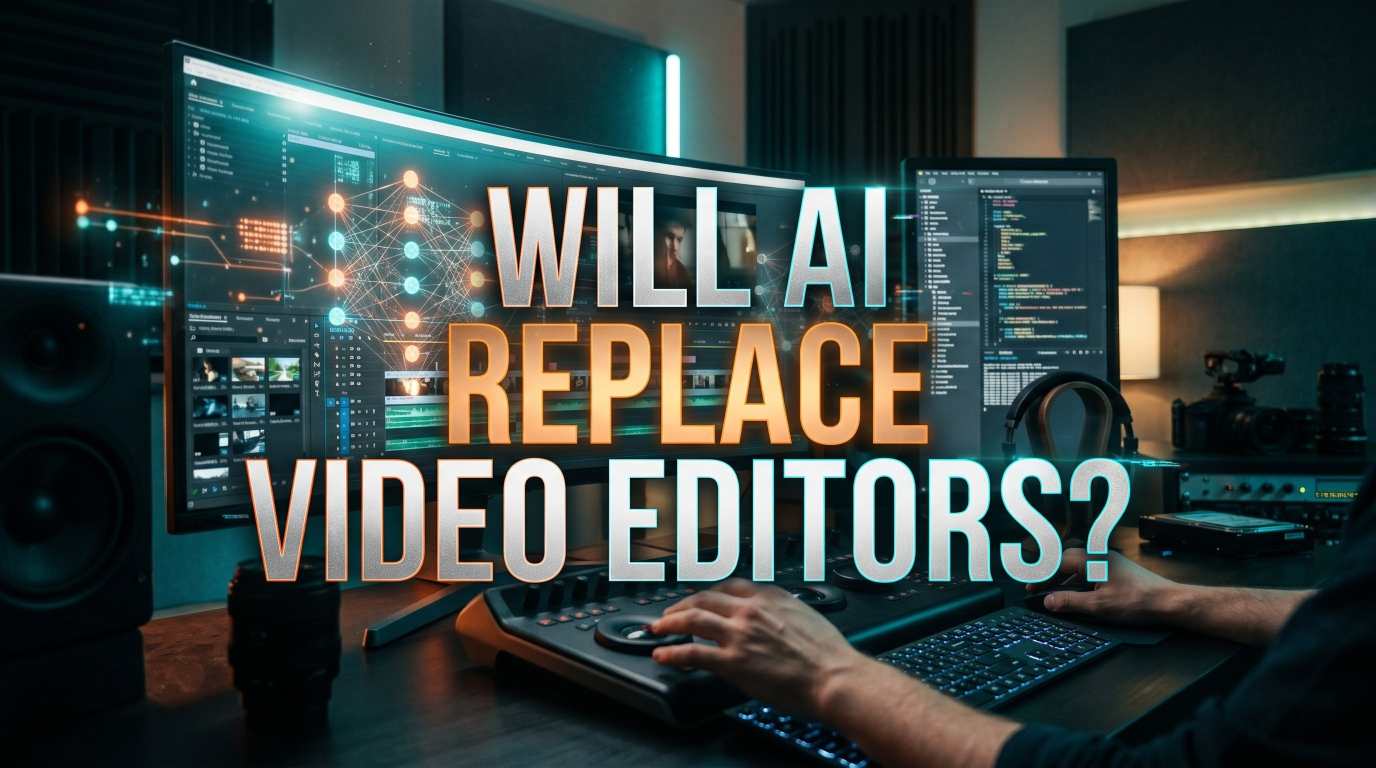
Will AI Replace Video Editors in 2026? The Future of Video Editing Jobs
Have you opened YouTube, TikTok, or LinkedIn lately and felt a small pit in your stomach?
Every single week, a new software comes out. One app promises to turn a text prompt into a full cinematic movie in seconds. Another app automatically cuts silence, creates captions, adds sound effects, color grades footage, and exports thirty viral clips while you sleep.
It feels crazy. It feels overwhelming.
If you edit video for a living, or if you are thinking about learning video editing right now, you probably have one big question on your mind:
Will AI replace video editors in 2026? What is the real future of video editing jobs? Are we all going to be replaced by algorithms, or is something else actually happening?
Grab a cup of coffee. Let’s sit down and talk about this honestly, without technical jargon, without hype, and without panic.
The Short Answer: Will AI Replace Video Editors in 2026?
Let’s cut right to the point:
No, AI will not completely replace video editors in 2026.
However, AI will replace video editors who refuse to use AI.
Even more directly: AI is already destroying robotic, low-skill editing tasks. If your daily routine as a video editor is only chopping pauses, lining up auto-captions, or dragging standard transitions onto a timeline, your job is in serious trouble.
But if you are someone who understands storytelling, pacing, emotional impact, client communication, and creative vision, 2026 is actually going to be one of the most profitable times in history to work with video.
To understand why, we need to look at what video editing truly is.
What Video Editing Actually Means (Hint: It’s Not Just Clicking Buttons)
A lot of software developers and tech executives think video editing is purely mechanical. They believe an editor just takes bad footage, cuts out the mistakes, syncs the audio, and saves the file.
If that were all video editing was, software could have replaced us ten years ago!
Real video editing is not mechanical. Real video editing is human psychology.
When you watch a great film, a great documentary, or even a 60-second YouTube Short that gives you goosebumps, you are not reacting to cuts and keyframes. You are reacting to:
Timing: Waiting an extra half-second before cutting to let a facial reaction land.
Emotion: Knowing when silence speaks louder than an energetic background track.
Context: Understanding cultural jokes, human sarcasm, and unspoken tension.
Empathy: Knowing how an audience feels right now, and leading them where you want them to go next.
Can a machine detect a pause? Yes.
Can a machine remove filler words like "um" and "uh"? Yes, absolutely.
Can a machine feel goosebumps? No.
Can an algorithm understand why a specific sigh from an actor breaks your heart? Not at all.
That distinction is the entire reason the future of video editing jobs is safe for true creative thinkers.
What AI Video Editing Tools Can Already Do in 2026
To understand your place in the market, you must know what the competition looks like. Today's AI tools are genuinely incredible, and pretending they are useless is a big mistake.
Here is what modern video AI handles effortlessly today:
1. Rough Cuts and Silence Removal
In the past, an editor spent three hours listening to an interview, cutting dead air, and taking out repeated takes. Today, tools do this in 20 seconds. You upload an hour of raw video, click a button, and the timeline is clean.
2. Auto-Captions and Dynamic Subtitles
Writing subtitles manually used to be torture. Now, speech-to-text algorithms transcribe audio with 99% accuracy, add styling, apply brand colors, and add emojis automatically.
3. Smart B-Roll Placement
Some new programs analyze your voice script, figure out the subject matter, search an internal library of stock footage, and automatically drop matching B-roll onto your timeline.
4. Audio Cleaning and Voice Cloning
Bad microphone? Wind noise? Echo in a large room? AI audio repair cleans noisy tracks into studio-quality voiceovers in one click. Voice synthesis models can even generate realistic narration from written text.
5. Color Matching and Scene Extension
AI can match the color profile of two completely different cameras with a single click. Generative tools can even paint beyond the borders of your video frame to turn a vertical video into a widescreen landscape.
When you look at this list, it looks terrifying at first glance. But notice a common pattern: Every single one of these tasks is technical labor. None of them are creative decisions.
The Big Shift: From "Button Pusher" to "Creative Director"
Think about the history of other jobs.
When Photoshop was invented in 1988, traditional illustrators and darkroom technicians panicked. They said, "Computers will kill photography and graphic design!"
Did graphic designers disappear? No. Graphic design exploded into a multi-billion-dollar global industry. What disappeared was the physical labor of cutting paper, mixing chemicals in darkrooms, and hand-setting metal typography.
The software did not replace the designer; it simply removed the boring, slow parts of the job.
The exact same thing is happening to video editing in 2026.
Before AI, an editor spent:
70% of their time on boring admin work (organizing files, syncing audio, cutting dead space, searching for stock assets, fixing export settings).
30% of their time on real storytelling, pacing, and creative vision.
With AI tools handling the grunt work, those numbers flip:
10% of your time goes to automated technical setup.
90% of your time goes to creative direction, pacing, emotion, and client strategy.
You are no longer just a technician who moves clips around on a timeline. You are becoming a Director of Post-Production, even if you work as a solo freelancer from your bedroom.
Why Cheap AI Videos Are Flooding the Internet (And Why That Helps You)
Have you noticed how many weird, cheap, fully AI-generated videos are floating around social media right now?
Robotic voices reading stolen Reddit stories. Strange, plastic-looking faces speaking in monotone cadences. Endless generic motivational quotes matched with random slow-motion nature clips.
At first, people watched them because the technology was novel and surprising.
Now? Audiences scroll past them immediately. People are developing an instant filter against synthetic content.
Here is a simple rule of economics: When something becomes cheap and easy to produce, its value drops to zero.
Because anyone can push a button and make a generic 30-second clip in ten seconds, generic clips are now worth nothing. Businesses cannot build real brands or loyal communities on lazy, robotic spam.
What is rare now?
Authenticity.
Genuine personality.
Thoughtful pacing.
Original stories.
The more the internet fills up with automated noise, the more valuable a skilled human video editor becomes. High-paying clients do not want content that looks like an algorithm made it; they want content that makes humans stop, feel, and buy.
Which Video Editing Jobs Are Disappearing in 2026?
Let’s be completely transparent. Not every video job is safe. Some roles are shrinking rapidly or disappearing altogether.
If your income depends heavily on the following categories, you need to adjust your approach immediately:
1. Basic Content Choppers
If your main service on Fiverr or Upwork is simply taking long podcast recordings, cutting them into 5 clips, and adding animated subtitles, software can now do that faster and for a fraction of the cost. Clients will not keep paying $50 an hour for simple transcript cutting.
2. Basic Stock-Footage Compilers
Channels that string together random royalty-free clips over an AI voiceover are being automated out of existence. Script-to-video engines can build those in minutes.
3. Entry-Level Data Wranglers
Jobs that strictly involve file management, basic transcoding, manual sync, and simple naming conventions are rapidly shrinking as camera-to-cloud workflows and automated ingest tools take over.
Which Video Editing Jobs Are Thriving in 2026?
On the other side of the coin, several sectors of the industry are booming like never before. Demand for high-tier video has never been higher, because every company on Earth is now forced to be a media company.
Here is where the real money and career security live in 2026:
1. Narrative and Documentary Editors
Long-form storytelling requires understanding human drama, pacing, suspense, and empathy. An AI cannot interview a subject, discover an unexpected emotional moment, and restructure a 40-minute story around an unscripted revelation.
2. High-End Commercial and Brand Editors
Brands spend hundreds of thousands of dollars on advertising campaigns. They have strict brand guidelines, nuanced humor, and precise marketing goals. They will never trust an automated prompt box with their entire public reputation. They need professional editors who understand consumer psychology.
3. YouTube Creators and Retention Strategists
Top-tier YouTube creators (like MrBeast, Ali Abdaal, or Colin & Samir) do not hire editors just to cut video. They hire editors who understand viewer retention. They hire editors who know how to design an intro that prevents click-aways, how to construct a visual payoff, and how to hold an audience's attention across a 20-minute video. That is strategy, not technical clipping.
4. Hybrid AI Post-Production Specialists
There is a massive new category of editors who master these new tools. Instead of taking three weeks to deliver a complex VFX-heavy video, a hybrid editor uses generative tools, neural filters, and automated pipelines to deliver mind-blowing results in four days. These editors charge premium rates because they work at lightning speed without sacrificing quality.
5 Practical Steps to Future-Proof Your Video Editing Career
If you want to make sure your career grows over the next 5 to 10 years, do not fight the technology. Adopt it, master it, and lean into your unique human strengths.
Here is your step-by-step game plan:
Step 1: Adopt AI Tools as Your Personal Assistants
Stop spending hours manually masking objects, cleaning background hum, or building subtitle animations frame-by-frame.
Find the best tools in your editing software, whether you use Premiere Pro, DaVinci Resolve, Final Cut Pro, or CapCut, and master their intelligent features. Treat AI like a fast, eager intern who works for you. Let the intern do the boring work so you can focus on the art.
Step 2: Learn the Psychology of Storytelling
Read books on screenwriting and dramatic structure. Study classics like In the Blink of an Eye by Walter Murch. Learn why certain cuts feel natural and why others feel jarring.
When you can explain to a client, "We should cut to this angle here because it highlights the speaker's hesitation," you immediately separate yourself from 99% of budget editors. You are no longer an order-taker; you are a trusted advisor.
Step 3: Master Sound Design
Here is an industry secret: Sound is more than 50% of how people perceive video quality.
A viewer will forgive mediocre video resolution, but they will click away instantly if the audio is harsh, flat, or poorly balanced. Learn how to layer ambient noise, choose impactful audio risers, use subtle foley effects, and carve out space for dialogue with EQ. Great sound design is pure emotional artistry, and automated tools still struggle to get it right.
Step 4: Become a Creative Problem Solver
Clients do not actually buy video editing. They buy solutions to business problems:
A YouTuber wants higher watch time and more subscribers.
A real estate agent wants to sell homes faster.
A SaaS company wants more sign-ups from their product demo.
A course creator wants students to finish their lessons.
When you speak to clients, stop talking about frame rates, codecs, and software shortcuts. Talk about their business goals. When you tie your editing directly to a client's revenue or growth, you will never lack work.
Step 5: Build a Strong Personal Brand
Do not hide behind an anonymous logo or an empty portfolio page. Post breakdowns of your edits on social media. Show your timeline. Explain why you made a specific cut. Share your workflow tips.
When clients feel a personal connection to you and trust your expertise, they do not shop around for automated software replacements. They want you.
The Verdict: Will AI Replace Video Editors in 2026?
Let’s bring everything together.
Will AI replace video editors in 2026?
The answer is a confident No.
The technology is powerful, exciting, and moving fast, but video editing has never been about pushing buttons. It has always been about communication, emotion, and connection.
AI can create pictures, but it cannot create meaning.
AI can generate audio, but it cannot understand heartbreak or triumph.
AI can make a cut, but it does not know why that cut matters to a human heart.
The year 2026 will not be the death of the video editor. It will be the death of the boring, repetitive parts of editing. It will free you up to do what humans do best: tell stories that move people.
Stop worrying about software stealing your seat at the table. Learn the tools, master your craft, focus on the human story, and build your future. There has never been a better time to create.
Frequently Asked Questions (FAQ)
Will AI replace beginner video editors?
AI will replace beginners who only learn how to make basic cuts and add automated text. However, beginners who focus on storytelling principles, pacing, and learning modern hybrid tools will learn faster and advance more quickly than any generation before them.
Which editing software is best to learn in 2026?
DaVinci Resolve and Adobe Premiere Pro remain industry-leading powerhouses for professional work, both featuring deep integrations for intelligent workflow tools. For quick-turnaround social media content, CapCut remains widely used. The key is mastering core editing theory, which transfers across any software.
Will freelance video editing pay less because of AI?
Low-end freelance gigs that involve basic trimming and simple assembly are seeing fee compression. However, high-end editors who offer creative direction, retention strategy, and polished sound design are charging higher rates than ever because businesses need standout content to rise above automated web noise.
Ready to grow your business?
Contact us today to find out how our strategies can scale your operations to the next level.
Contact Us