How AI Is Transforming Digital Advertising in 2026
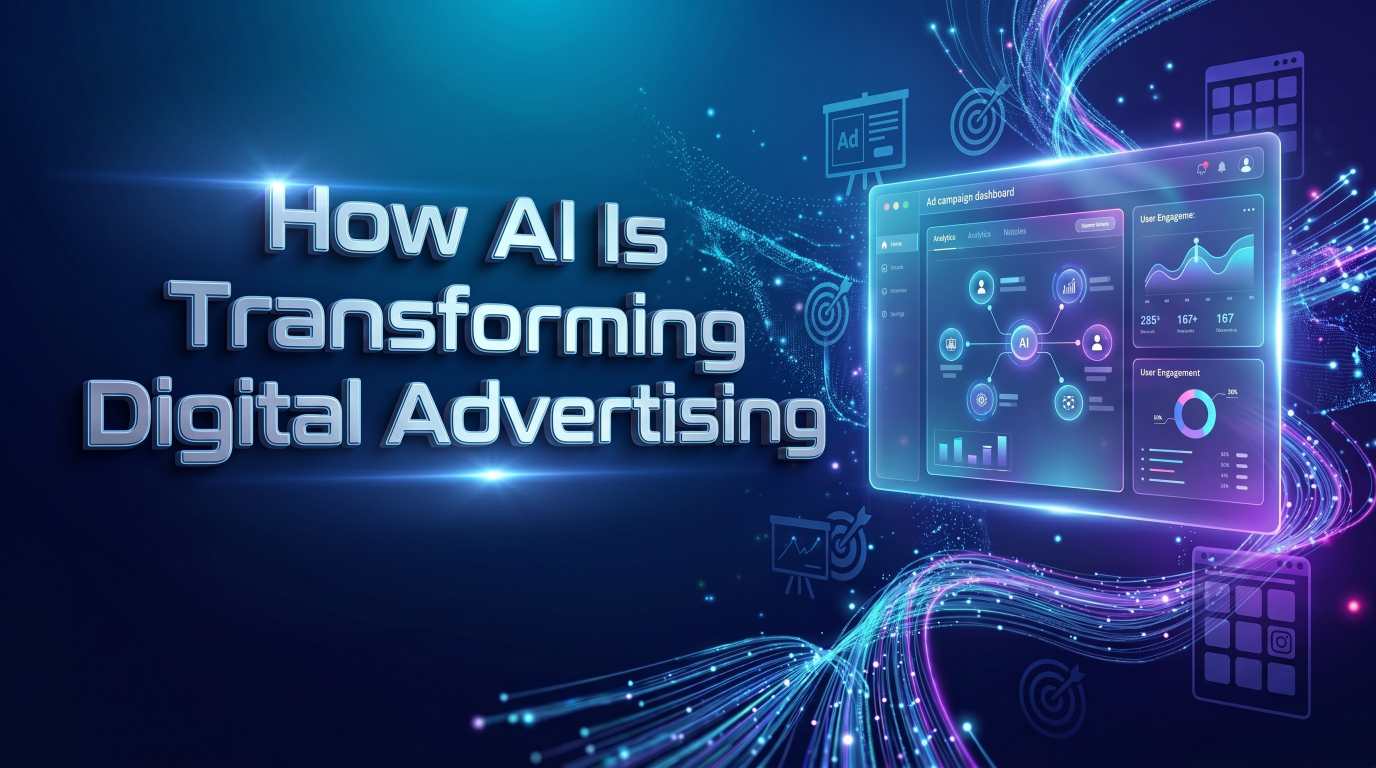
If you have spent any money on online ads recently, you already know the truth: digital advertising does not look like it used to.
Just a few years ago, running an ad campaign felt like sitting in the cockpit of an old airplane. You had fifty different dials to watch. You had to choose your target age group, pick specific zip codes, type in dozens of interests, design six different image sizes, write catchy headlines, test button colors, and constantly check your budget every four hours so you did not waste your hard-earned money.
Today, in 2026, the game has completely flipped.
You no longer have to manually test twenty different versions of a photo to see if people prefer blue or green backgrounds. You do not need to spend three days writing sixty variations of an ad headline. Algorithms now handle the heavy lifting in seconds.
So, what does that mean for you as a business owner, a creator, a marketer, or a student?
In this comprehensive guide, we are going to break down how AI is transforming digital advertising in 2026. We will keep it simple, honest, and practical—just like sitting down over a cup of coffee and talking about what is actually working right now.
Tired of Wasting Ad Spend on Campaigns That Go Nowhere?
Setting up modern, AI-driven campaigns does not have to feel like guesswork. If you want better results without spending hours tweaking dials and testing bid caps, we can handle it for you.
Let our team build and manage high-performing, smart ad campaigns that turn your budget into real revenue.
Claim Your Free 20-Minute Ad Strategy Call →
1. What Is Happening Right Now? The Big Shift in 2026
To understand where we are today, let’s take a quick look back.
In 2022 and 2023, artificial intelligence was mostly a fun assistant. Marketers used it to brainstorm social media captions or generate funny illustrations. Then in 2024 and 2025, tools became smarter and started predicting which users might buy a product based on their past browsing habits.
Now, in 2026, we have moved into what experts call autonomous advertising.
What does "autonomous" mean in plain English? It means smart systems can now run, test, and adjust your ad campaigns automatically from start to finish. You tell the software your goal—for example, "I want to sell 100 pairs of running shoes this week for under $40 per sale"—and the system builds the creative, finds the right audience, shows them the ad at the right time, and tweaks everything in real-time.
Why This Shift Happened So Fast
Three major things came together to make 2026 the breakout year for AI-powered advertising:
Computers Got Much Faster at Processing Data: Modern AI models can look at millions of data signals in less than a second.
Online Privacy Rules Changed: Third-party tracking cookies are essentially gone. Advertisers had to find newer, smarter ways to understand what customers want without invading their privacy.
Generative Media Became Seamless: In the past, AI-generated images or voiceovers looked robotic and unnatural. Today, high-quality audio, video, and text can be produced instantly with incredible quality.
When you put these three things together, you get an advertising ecosystem that moves faster than human hands ever could.
2. Creative on Autopilot: Making Ads That Actually Connect
Let’s talk about the hardest part of advertising: making the ads.
If you have ever hired a creative agency or tried to make ads yourself, you know the struggle. You have to hire a graphic designer, shoot product photos, write copy, edit video clips, and export everything into twenty different screen sizes for Instagram, TikTok, YouTube, and search engines.
By the time you finish creating the ads, the trend has passed, or your budget is already half gone.
In 2026, generative tools have solved this creative bottleneck.
Real-Time Creative Generation
Imagine you run an online coffee shop.
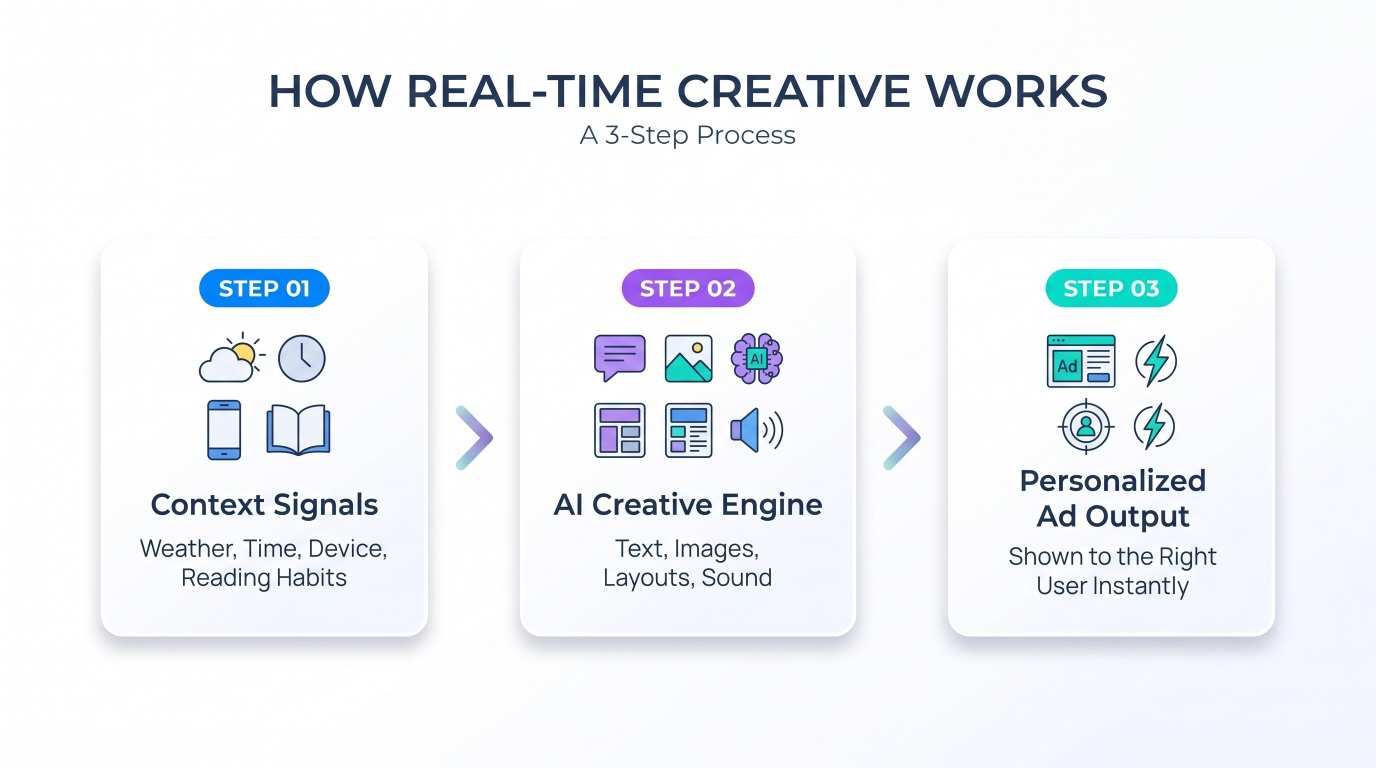
A user named Sarah opens her phone on a rainy Tuesday morning in London. The ad system knows two things: it is raining outside, and it is 7:30 AM.
Instead of showing Sarah a generic photo of a bag of coffee beans, the platform creates an ad on the spot:
It displays a warm ceramic mug sitting next to a rain-streaked window.
The headline reads: "A warm, smooth roast to brighten up a rainy Tuesday."
A cozy acoustic guitar track plays in the background.
Thirty minutes later, Marco in sunny Madrid sees an ad for the exact same coffee company. But Marco’s ad shows an iced latte with cubes clinking in a tall glass, with the headline: "Stay cool this afternoon with a crisp cold brew."
The advertiser did not sit at a desk and design those two ads. The AI generated both variations instantly to fit the customer's exact context and mood.
Video and Audio That Sound Natural
Short-form video is still the king of content in 2026. But creating fresh videos every single day used to cause massive burnout for creators and marketing teams.
Today, AI video tools can take one single product recording and transform it into 50 unique video hooks. The system can swap the opening three seconds, test different background voices, change the captions, and translate the spoken language into Spanish, French, or Japanese while matching the speaker's original voice tone.
This allows a small neighborhood business to advertise globally without spending tens of thousands of dollars on translation studios.
3. Smarter Targeting Without Invading Privacy
For years, digital marketing relied on tracking people across the internet. If you looked at a pair of headphones on one website, those exact headphones would follow you around the web for the next two weeks.
People got tired of feeling watched. Governments introduced stricter privacy regulations, and web browsers blocked tracking cookies.
Many marketers panicked. They asked: "How can we find our ideal customers if we cannot track them across the web?"
The answer in 2026 is contextual intelligence and predictive modeling.
Context Is King Again
Instead of tracking who you are across ten different apps, modern AI looks at what you are doing right now.
If you are reading an article about marathon training tips, the algorithm knows you might be interested in high-protein snacks, hydration packs, or running socks.
If you are watching a video about how to repair a leaky sink, you probably need plumbing tools or quick-dry sealant.
AI reads and understands the full meaning of articles, podcasts, and videos in milliseconds. It does not just look for single keywords; it understands the theme, the tone, and the user's intent.
As a result, ads feel helpful rather than creepy. You see ads that match what your mind is already focused on at that exact moment.
First-Party Data Clean Rooms
Big brands in 2026 keep their own customer data safe inside private, secure storage environments often called "data clean rooms."
Smart algorithms analyze this data without exposing any personal names, email addresses, or phone numbers. The system simply spots patterns:
"Customers who buy product A usually buy product B after three weeks."
"Users who watch educational tutorials are four times more likely to sign up for a subscription."
By learning from these patterns, brands can show helpful suggestions to existing customers while keeping everyone's personal identity 100% private and protected.
4. Hyper-Personalization: The End of "One Size Fits All"
Think about the ads you saw five years ago. Most of them were shouty billboards on a small phone screen: "BUY THIS NOW! 50% OFF TODAY ONLY!"
In 2026, ads do not feel like shouting anymore. They feel like direct conversations.
Conversational Ads You Can Talk To
Have you noticed how search bars and display banners look different today?
Instead of clicking a static banner that takes you to a confusing website landing page, many ads in 2026 are interactive micro-apps.
You can literally talk or type directly to the ad:
User: "I need a birthday gift for my 12-year-old nephew who loves space and building things. My budget is $30."
The Ad System: "Here are three top-rated building kits under $30 with two-day shipping. Kit #1 includes an astronaut model, Kit #2 is a solar-powered rover. Which one do you prefer?"
In less than twenty seconds, the shopper finds the exact product they want, confirms their purchase, and continues browsing their favorite content without leaving the page.
This saves the customer time and dramatically cuts down abandoned shopping carts for merchants.
5. Bidding and Budgeting: Zero Wasted Money
If you have ever managed an ad account on Google, Meta, or Amazon, you know the painful feeling of waking up in the morning, checking your dashboard, and realizing you spent $200 with zero sales to show for it.
Manual bidding has always been tricky:
Bid too low, and nobody sees your ad.
Bid too high, and you lose all your profit.
Bid at the wrong hour, and bots click your link instead of real people.
Autonomous Bidding Engines
In 2026, manual bidding is practically a thing of the past. Autonomous bidding engines manage spending in real time with laser precision.
Here is how modern budgeting systems work:
Old Way (Manual / Semi-Automated) | The 2026 Way (Fully AI-Optimized) |
Set a fixed daily budget (e.g., $50 every day). | Budget floats dynamically based on market demand and buying signals. |
Pick broad time windows (e.g., run ads 9 AM to 5 PM). | Bids increase during exact minutes when purchase conversion rates spike. |
Manually pause losing ads after reviewing weekly reports. | System detects low-performing ads in minutes and moves budget to winners. |
Guess which audience demographic will convert best. | System tests small variations across diverse groups and scales automatically. |
Because the software can analyze performance indicators instantly, small businesses no longer need a full-time media buyer just to watch over daily campaigns. Even a local bakery with a $15-a-day budget can run campaigns that are as mathematically efficient as those of global brands.
6. How Small Businesses Can Win Big in 2026
There is a common worry among solo creators, freelancers, and small business owners:
"If big corporations have access to advanced AI, won't they crush smaller businesses?"
The reality is actually the exact opposite.
AI is the great equalizer. Ten years ago, a Fortune 500 company had a huge advantage because they could afford a team of twenty copywriters, five video editors, and three data analysts. A small shop owner had to do all of that alone at midnight after closing the store.
Today, a single person with an internet connection has access to tools that match the speed of an entire agency.
Practical Steps for Small Business Owners
If you run a small business or work as an independent marketer, here is how you can use AI in digital advertising right now without feeling overwhelmed:
Focus on Your Unique Story: AI can write headlines and edit video clips, but it cannot invent your personal life experiences. Share real behind-the-scenes moments, your struggles, customer reviews, and your genuine passion. Use AI to format and distribute that story, not to fake it.
Feed the Machine High-Quality Inputs: If you give an AI system poor product photos or vague descriptions, your ads will look generic. Spend time taking clear, well-lit photos and writing honest descriptions of what makes your product special. The better your initial input, the better the final ad.
Set Clear Guardrails: Never hand an algorithm your credit card without setting strict spending limits. Always set daily caps, target return-on-ad-spend (ROAS) goals, and review your search queries regularly.
Test One Channel First: Don’t try to master six ad platforms at once. Pick the one platform where your customers spend the most time—whether that is search, short video feeds, or niche community forums—and master AI tools on that single platform first.
7. The Human Touch: Why E-E-A-T Matters More Than Ever
You might be asking: "If AI can create images, write text, pick targets, and manage budgets, what is left for humans to do?"
The answer is simple: Experience, Expertise, Authoritativeness, and Trustworthiness (E-E-A-T).
Because creating content has become so easy, the internet is flooded with generic, computer-generated fluff. Consumers in 2026 have developed an instinct for spotting robotic, soulless content. When an ad feels completely fake, people scroll past it immediately.
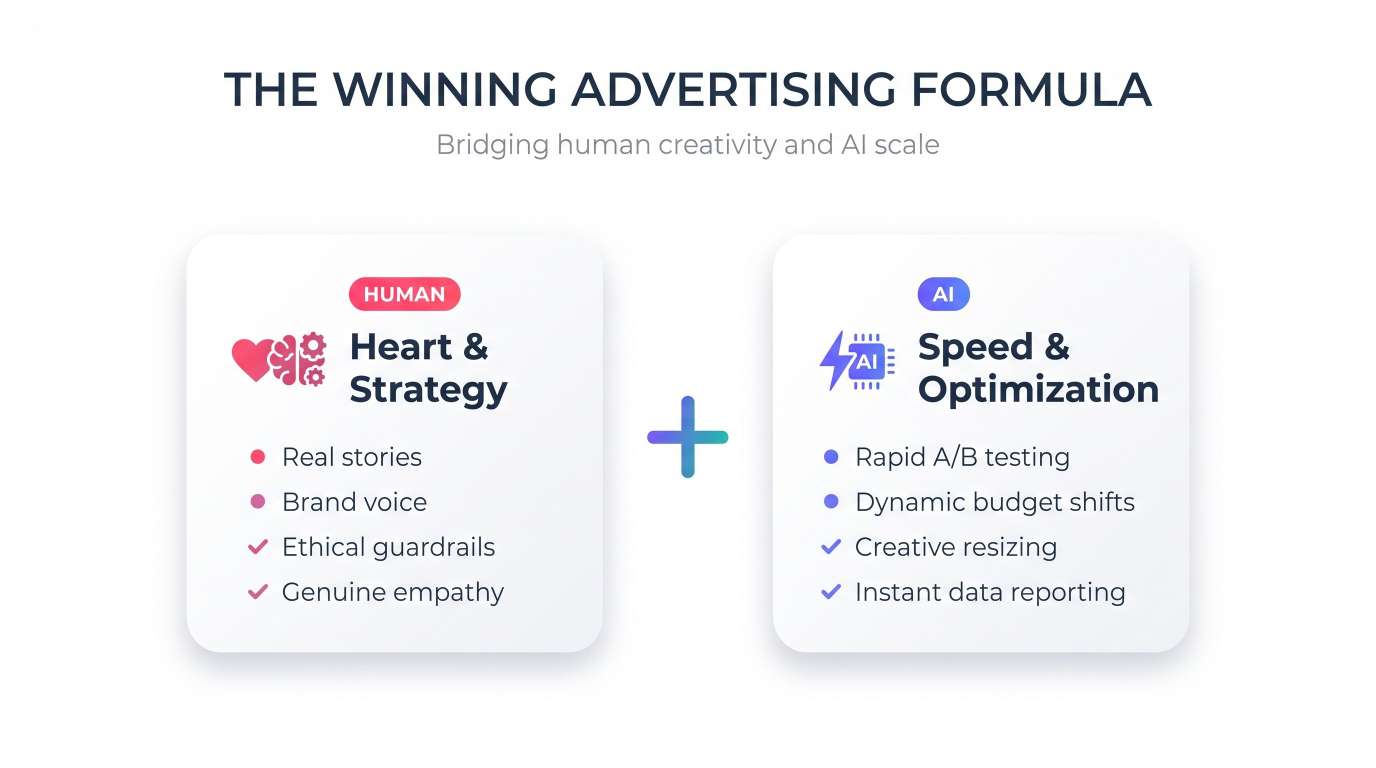
Here is what humans do that algorithms cannot replicate:
1. Real Human Experience
An algorithm has never felt the pain of a sore back after a long workday. It has never tasted a homemade recipe or felt the joy of taking a warm shower after a long hike. Real human reviews, unscripted reactions, and honest demonstrations build trust that synthetic ads simply cannot match.
2. Ethical Judgment and Brand Safety
Computers do not understand cultural nuances, sensitive news events, or humor the way people do. A human eye must always inspect campaigns to make sure ads do not appear in inappropriate contexts or sound tone-deaf during serious global moments.
3. Big Strategic Vision
AI is great at answering questions and optimizing numbers, but it cannot decide what your company should stand for. Humans decide which products to build, which communities to support, and what mission to pursue.
The winning formula in 2026 is not AI instead of humans. It is humans powered by AI.
8. Common Myths About AI in Advertising (Debunked)
Let’s clear up a few common misunderstandings people have about modern digital ads.
Myth 1: "AI Advertising Is Too Expensive for Normal People"
Reality: Most advertising platforms have built these tools directly into their standard dashboards for free. You do not need a million-dollar enterprise contract. If you have $10 to run an ad, you are already using AI tools behind the scenes.
Myth 2: "Ads Will Soon Replace All Content Creators"
Reality: People follow people, not algorithms. Creators who build genuine relationships with their audience are more valuable than ever in 2026. Brands partner with real creators and then use AI tools to boost those creator videos to the right audiences.
Myth 3: "You Can Just Press a Button and Make Millions Overnight"
Reality: AI is an amplifier. If your product is broken, or if your customer service is slow, showing your ad to more people will only help you fail faster. You still need a great product, good pricing, and honest customer support.
9. What the Future Holds: Looking Beyond 2026
As we look ahead, the line between digital advertising, everyday search, and smart home assistance will continue to blur.
We are already seeing ads designed for voice search on wearable devices, augmented reality mirrors in clothing stores, and smart car assistants that suggest nearby local diners when you are on a road trip.
The advertisers who thrive in the coming years will not be the ones who try to fight technological change, nor will they be the ones who let computers run everything without supervision.
The winners will be the smart, practical creators who use these new tools to save time on boring tasks—so they can spend more time connecting with their customers, telling meaningful stories, and building businesses that last.
Quick Summary: Key Takeaways to Remember
AI Runs on Intent: Ads in 2026 match the user's immediate context and intent, rather than tracking them invasively across the web.
Creative Variety Is Instant: Dynamic text, audio, and video are generated to fit the viewer's exact language, device, and setting.
Budgets Are Self-Balancing: Smart bidding moves money automatically toward ads that generate genuine results, cutting wasted spend.
Humans Provide the Soul: Real human stories, ethical oversight, and personal trust are the secret ingredients that make modern ads actually convert.
The tools are ready and waiting. How will you use them to grow your brand this year?
Frequently Asked Questions (FAQ)
How is AI transforming digital advertising in 2026 for small businesses?
AI allows small businesses to create high-quality video and image ads without hiring expensive agencies. It also automates bidding and audience discovery, ensuring every dollar of your ad budget is spent effectively.
Will AI replace human marketing jobs completely?
No. While routine tasks like resizing graphics and adjusting bid prices are now automated, human creativity, empathy, brand strategy, and ethical decision-making remain essential for successful campaigns.
Are AI-targeted ads safe for user privacy?
Yes. Advertising in 2026 relies heavily on contextual targeting and secure data clean rooms, allowing brands to show relevant ads without tracking individuals' private identities across websites.
Ready to Put AI Advertising to Work for Your Business?
The tools to scale your business are already here, but having an experienced partner to guide your strategy makes all the difference. We combine human creativity with cutting-edge ad automation to help brands grow faster, smarter, and with zero wasted ad spend.
Whether you need a full ad audit or end-to-end campaign management, we're here to help you win in 2026.
Ready to grow your business?
Contact us today to find out how our strategies can scale your operations to the next level.
Contact Us