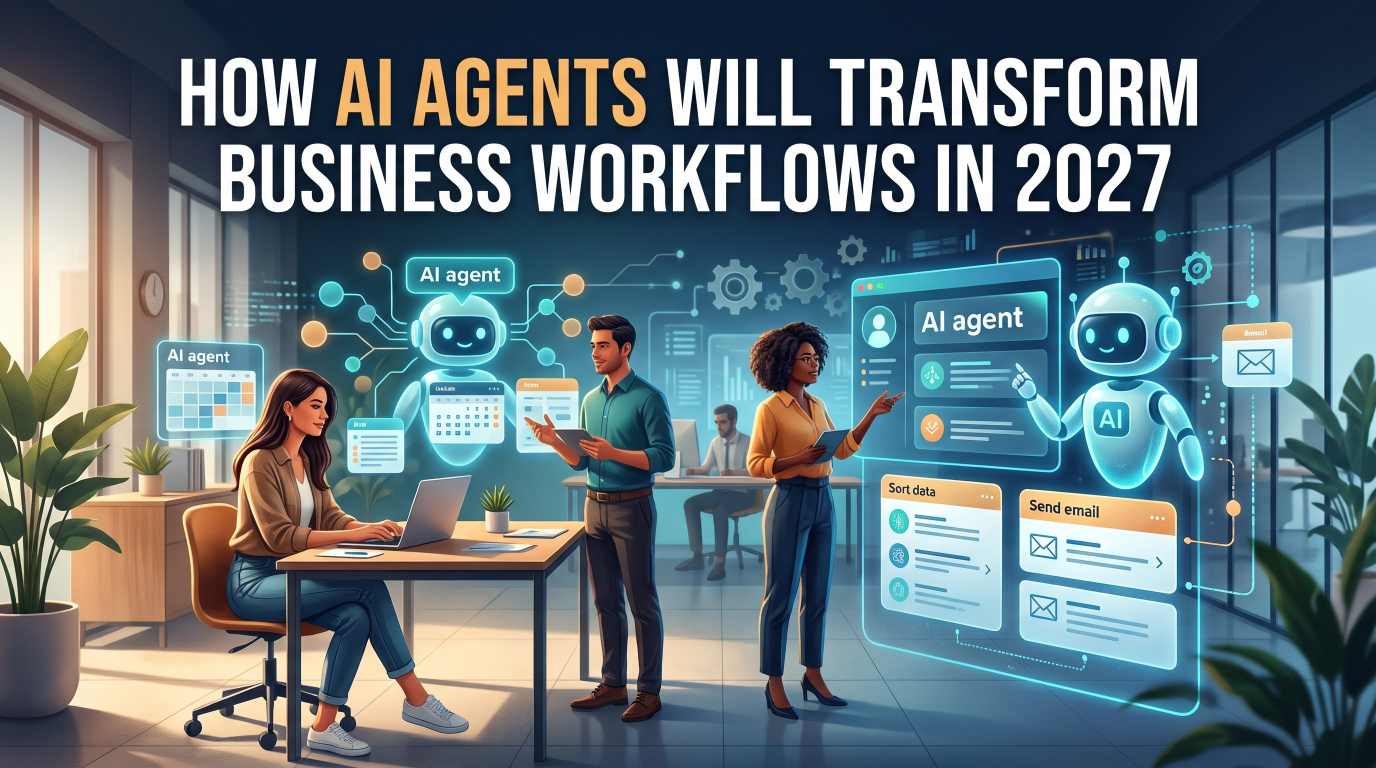
How AI Agents Will Transform Business Workflows in 2027
Introduction: Let's Talk About Your Typical Monday
Grab your coffee, sit back, and think about your typical Monday morning at work.
What actually drains your energy before lunch?
It is almost never the big, creative work. It is the boring stuff. You spend an hour copying numbers from your sales dashboard into an Excel sheet. You spend thirty minutes chasing an unpaid invoice. You answer the exact same customer question for the twelfth time. You click around in your calendar trying to book three simple meetings.
By noon, you feel tired, but you have not even touched your primary goals yet.
Here is the good news: this entire daily grind is about to change.
By the year 2027, everyday work will look completely different. We are moving away from simple chatbots that just spit out text. We are entering the era of AI agents.
In this post, we will break down what this shift means for you, your team, and your bottom line. No fancy computer science degrees required. Let us look at exactly how AI agents will transform business workflows in 2027 and why you should care right now.
What Is an AI Agent? (Think Digital Co-Worker, Not Chatbot)
Most people today are familiar with tools like ChatGPT. You type a prompt, it gives you an answer, and then you have to do all the actual work with that answer.
Let us use a simple kitchen analogy.
A standard chatbot is like a cooking recipe book. You ask it, "How do I make pasta?" It prints out the ingredients and the steps. That is helpful, but you still have to go buy the groceries, boil the water, cook the sauce, and clean the dishes yourself.
An AI agent is like an actual chef in your kitchen.
You tell the agent: "I want pasta ready at 7:00 PM." The agent checks your fridge, orders missing groceries through an app, turns on the stove, cooks the meal, sets the dining table, and lets you know when dinner is served.
In business, an AI agent does not just give you advice. It takes action.
It has four clear capabilities:
A Goal: You give it a target (for example, "Collect past-due payments").
Tools: It has permission to use your email, your CRM database, your billing software, and your calendar.
Memory: It remembers company rules, past client chats, and team preferences.
Action Steps: It plans the sequence, executes each click, fixes small errors along the way, and only bugs you when it genuinely needs your approval.
Chatbots vs. AI Agents: The Big Difference
To see why this is a massive upgrade, look at how both tools handle normal, everyday office problems:
Daily Office Task | How a 2024 Chatbot Helps | How a 2027 AI Agent Handles It |
A customer wants a refund | Gives your support rep a polite email template to copy and paste. | Looks up the customer in your database, checks the delivery tracking, verifies store policy, issues the refund to Stripe, and emails the customer confirmation. |
Weekly sales summary | Tells you what formulas to write in Excel to build a chart. | Pulls raw numbers directly from Shopify, calculates your profit margins, creates a clean PDF report, and drops it into your team chat every Friday at 9:00 AM. |
Hiring a new team member | Writes a generic checklist of onboarding tasks for HR. | Sets up their company email, creates logins for all company apps, sends the welcome kit, and books their first week of training on the calendar. |
Reviewing a supplier contract | Summarizes the text into bullet points on your screen. | Reads the terms, checks them against your company legal rules, highlights risky payment clauses, and sends an edit request back to the supplier. |
5 Ways AI Agents Will Transform Business Workflows in 2027
Now let us look at the actual departments inside a company. Here is where the biggest changes will happen over the next few years.
Ready to Automate Your Repetitive Tasks?
You do not have to wait until 2027 to eliminate operational bottlenecks. At GoodlySoft, we build custom web platforms, mobile applications, and intelligent workflow automations that save your team dozens of hours every week.
Schedule a Free Workflow Consultation
1. Operations: No More Endless Admin Work
Running an office or an online business means managing dozens of small administrative tasks every single day.
Think about what happens when you sign a new client today. Someone has to make a new folder in Google Drive. Someone has to create a project board in Trello or Asana. Someone has to send an intake form, invoice the client, and assign tasks to designers or writers.
In 2027, an operations agent handles that whole chain automatically.
The minute a client signs your digital proposal, the agent creates the project folders, invites the client to your portal, assigns tasks to team members based on their current workload, and schedules the kickoff call.
Human project managers stop wasting time on data entry. Instead, they focus on keeping clients happy, solving tricky problems, and leading their teams.
2. Customer Support: Instant Solutions, Zero Wait Times
Nobody likes waiting on hold or dealing with robotic phone menus that do not understand simple questions.
Customers want fast answers from someone who knows their history.
By 2027, customer support agents will solve problems directly instead of just handing out canned answers:
A buyer writes: "I received the wrong shirt size in my order yesterday."
The agent instantly pulls up the order number, confirms the stock in the warehouse, creates a free return shipping label, and places a replacement order for the correct size.
The entire issue is resolved in 45 seconds, with zero wait time.
If a customer is angry or has a rare, complicated dispute, the agent passes the conversation to a human manager. Even better, it gives the manager a three-sentence summary of the problem so the customer never has to repeat themselves.
3. Marketing: Content and Ads That Run Smoothly
Marketing today can feel overwhelming. You have to write blog posts, format social media updates, design images, track clicks, and manage ad spending.
In 2027, marketing teams use groups of specialized agents that work together like a mini-agency:
The Research Agent: Scans the internet to see what questions your audience is asking right now.
The Writer Agent: Drafts helpful guides, social posts, and email newsletters matching your company voice.
The Design Agent: Formats the content into clean carousels, infographics, and blog layouts.
The Analytics Agent: Monitors which posts bring in real leads, pauses ads that waste money, and increases the budget on ads that bring in sales.
Instead of burning out while trying to post every single day, you act as the creative director. You choose the message, and your digital team takes care of the distribution.
4. Finance: Bookkeeping on Autopilot
Ask any business owner what task they dislike most, and many will tell you: bookkeeping and chasing invoices.
By 2027, financial workflows will run in real time:
When you take a photo of a business lunch receipt, the agent matches it to the bank transaction instantly.
Invoices go out automatically the moment a job is completed.
If a client forgets to pay, the agent sends gentle, polite email reminders on days 3, 7, and 14.
The agent alerts you before you run into trouble: "Notice: You have two major software renewals next week. Delaying invoice payment X by three days will keep your bank balance safe."
You never have to spend an entire weekend sorting through shoe boxes of receipts or messy spreadsheets again.
5. Sales: Booking Calls While You Sleep
Sales reps spend a lot of time doing detective work. They search LinkedIn, verify email addresses, and send dozens of cold messages just to get one phone call.
In 2027, sales agents handle the setup:
A prospective client visits your website and asks a question.
The agent looks up the visitor's public company background to see if they are a good match for your services.
It answers their initial questions clearly and offers a link to book a discovery call.
It sends a one-page briefing note to your sales rep before the call starts, explaining what the client wants and how much they can spend.
Your sales team spends their time having real conversations with qualified buyers, not digging through contact lists.
A Day in the Life: Working in 2024 vs. Working in 2027
To understand what this feels like in practice, let us follow Sarah. She runs a local graphic design and web studio with six employees.
Sarah's Workday in 2024
8:30 AM: Sarah opens her inbox. She has 38 unread emails. Three clients want price estimates, two are asking for status updates, and one contractor needs an updated file link.
10:00 AM: She is still searching for project files and emailing clients back.
11:30 AM: She manually builds two project proposals by copying old documents and updating the prices.
2:00 PM: She spends an hour reminding clients to pay late invoices.
5:30 PM: Sarah packs up her bag. She spent the entire day answering messages and shuffling files. She did not work on a single creative project, and she feels exhausted.
Sarah's Workday in 2027
8:30 AM: Sarah opens her studio dashboard. Her AI operations agent worked through the night.
What Happened Overnight:
Routine client status requests were answered with live links to completed design files.
Two standard client quotes were generated, verified against studio pricing, and sent out.
Three late invoices received polite follow-up notices, and one payment was collected and marked in the ledger.
9:00 AM: Sarah drinks her coffee and reviews two major design briefs for a high-paying brand.
1:00 PM: She spends the afternoon mentoring her junior designers and talking directly with her top clients.
5:00 PM: Sarah leaves the office on time. Her business is growing, her clients are happy, and she actually enjoyed her day.
Why Is 2027 the Big Year for This Shift?
You might wonder: if AI is already here, why will it take until 2027 for this to become normal?
Three clear pieces of the puzzle are coming together right now:
Software Connecting to Software: Right now, getting an AI to talk to your bank, your email, and your CRM requires custom code. By 2027, simple plug-and-play standards will let any business connect tools in just a few clicks.
Reliable Memory: Older AI models forgot what you told them after a few hours. Modern agent systems have long-term memory. They remember your company rules, your preferred tone, and past project details without getting confused.
Safety and Guardrails: Businesses cannot risk an AI making unauthorized bank transfers or sending wild emails to clients. By 2027, built-in safety controls will give companies total control over what an agent can do alone and what requires human sign-off.
The Golden Rule: Keeping Humans in Control
A lot of people worry when they hear about autonomous agents. They ask: "Will these tools take away all our jobs? Will an AI make an expensive mistake that ruins my company?"
The most successful companies will not use AI agents to fire their staff. They will use them to remove dull, repetitive busywork so their people can do better work.
Think of it like the "Human in the Loop" system:
Level 1 Tasks (No human needed): Sorting receipts, tagging support tickets, setting calendar dates, copying data between tools.
Level 2 Tasks (AI drafts, human approves): Sending large price proposals, answering delicate client emails, publishing public articles.
Level 3 Tasks (Humans only): Company strategy, hiring decisions, personal relationship building, resolving big client conflicts.
When you treat an AI agent like a smart junior assistant, you win. You give it clear instructions, set spending limits, check its work, and give it more freedom only after it proves it is reliable.
4 Simple Steps to Prepare Your Business Today
You do not need to wait until 2027 to start getting ready. Here is a simple, practical checklist you can start using this week:
Step 1: Write Down Your Standard Operating Procedures (SOPs)
An AI agent cannot follow your rules if your rules only exist in your head. Start writing down simple step-by-step instructions for your common tasks. How do you welcome a new client? How do you issue a refund? Clear, written steps are the exact instructions an AI agent needs.
Step 2: Clean Up Your Business Data
Organize your digital files. Put your client information into a proper CRM instead of scattered sticky notes or random phone contacts. Keep your pricing sheets up to date. The cleaner your data is today, the easier an agent will plug into it tomorrow.
Step 3: Find Your Biggest Time-Wasters
Sit down with your team for fifteen minutes. Ask everyone one simple question: "What is the most boring task you have to repeat every single week?" Write down the answers. That list is your roadmap for what to automate first.
Step 4: Test One Small Automation Tool
Do not try to change your entire company overnight. Pick one small, safe project. Set up a simple automated tool to sort incoming customer support emails, or try an agent that drafts your weekly sales summary. Learn how it works, see where it saves time, and build from there.
Frequently Asked Questions (FAQ)
Will AI agents make everyday workers obsolete?
No. Throughout history, new tools change the type of work we do, but they do not eliminate the need for people. When spreadsheets were invented, accountants did not disappear. They stopped doing math with pencils and started doing higher-level financial planning. AI agents will do the same thing: handle the manual busywork so you can focus on creative, strategic work.
Are AI agents safe to use with sensitive company data?
Yes, provided you choose professional business tools with clear privacy rules. Enterprise AI agents are designed to keep your business data private, meaning your internal numbers and client details are not shared with the public or used to train public models.
Can a small business afford this technology?
Yes. Just like cloud storage and email platforms, AI agents will be available as affordable monthly software services. You do not need to hire a software engineer to build one from scratch. Small businesses will be able to turn on digital assistants for a modest monthly fee.
Final Thoughts: Getting Your Time Back
The big change coming in 2027 is not about replacing humans with cold robots. It is about giving you your time back.
When software handles the data entry, the scheduling headaches, and the receipt chasing, you get to spend your energy on the things that actually matter. You get to connect with your customers, build better products, and grow your business without burning out.
The companies that succeed over the next five years will not be the ones that ignore AI, nor the ones that turn everything over to machines without thinking. The winners will be the businesses that pair smart, caring humans with fast, tireless digital teammates.
Start organizing your daily processes today. The future of work is arriving quickly, and it is going to make your workday a whole lot lighter.
Want to turn manual business tasks into automated workflows? Check out how our custom development solutions at GoodlySoft help businesses scale without extra overhead.
Ready to grow your business?
Contact us today to find out how our strategies can scale your operations to the next level.
Contact Us