Email Marketing vs Cold Email Marketing: Which Is Better for Business?
If you run a business, you probably ask yourself this question every single week: “How do I get more clients and sales without wasting all my money?”
Someone told you to start an email newsletter. Then, someone else on LinkedIn or YouTube said you should send 200 cold emails a day.
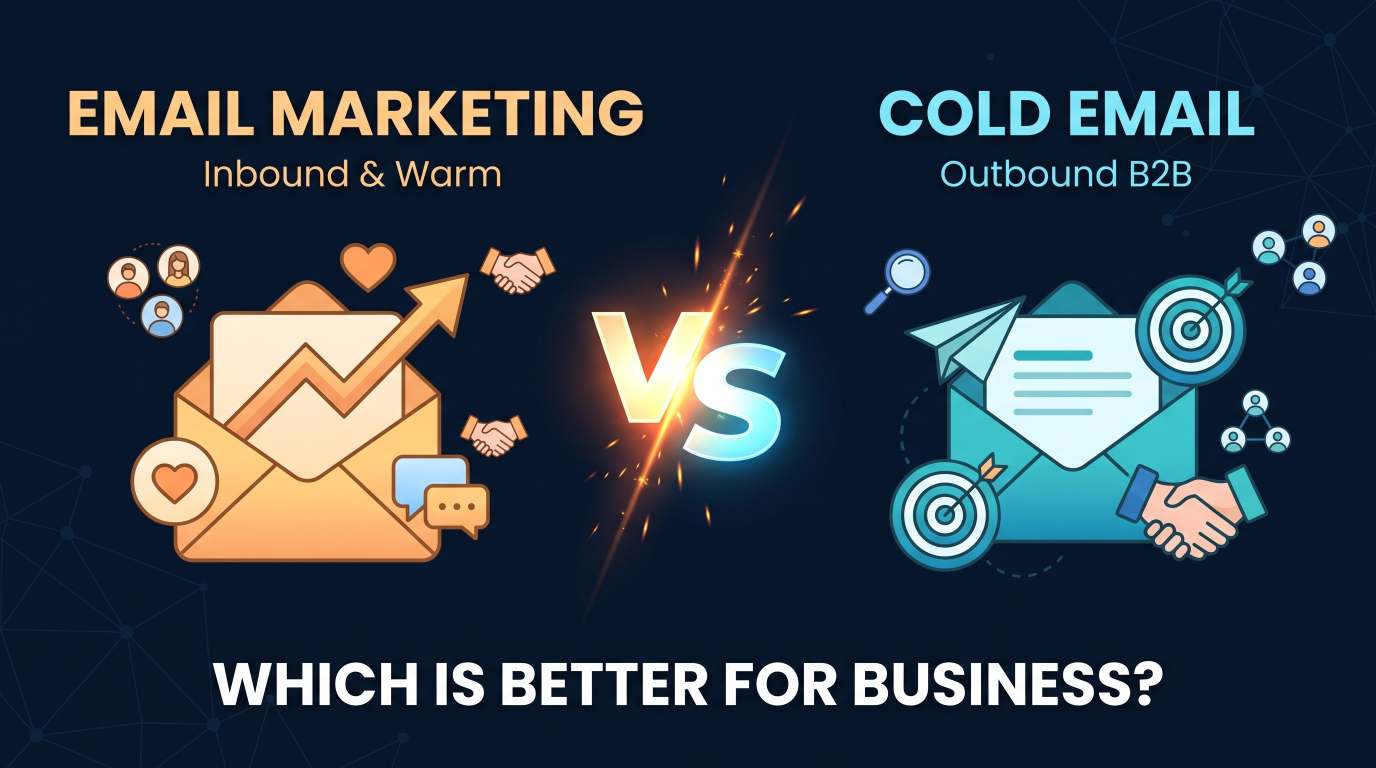
Now you are sitting at your desk wondering: Email marketing vs cold email marketing: which is better for business?
Let’s cut through the buzzwords and fancy talk. Think of this article like a cup of coffee with a friend who has tested both methods for years. We will look at how each one works, how much they cost, the exact rules you need to follow, and which one will actually bring money into your bank account.
Quick Summary: The Difference in Plain English
Before we dive deep, let's look at the basic difference:
Inbound Email Marketing: You send messages to people who already know you. They visited your website, signed up for a discount code, downloaded a free guide, and said, "Yes, please send me your updates."
Cold Email Marketing: You send messages to people who have never heard of you before. You found their work email on LinkedIn or a directory, and you reached out to start a business conversation.
Think of inbound email marketing like texting someone who saved your phone number. Cold email is like walking up to someone at a business conference, shaking hands, and introducing yourself. Both can bring you massive success, but they play completely different roles.
What Is Email Marketing? (Inbound Email Marketing Explained)
Traditional email marketing—often called inbound email marketing—is all about nurturing a relationship.
People come to your digital storefront or blog. They like what you do. They type their email address into your box and click "Subscribe."
Because they gave you permission, you can send them helpful advice, product discounts, stories, and company updates over months or even years.
How Inbound Email Marketing Works in Real Life
The Lead Magnet: You offer something helpful for free. It could be a 10% coupon, a simple checklist, a free template, or a weekly educational newsletter.
The Opt-In: The person gives you their name and email address to get that free item.
The Welcome Email: You deliver what you promised instantly.
The Nurture Sequence: Over the next few weeks, you send emails that teach them something useful, share customer stories, and solve common problems.
The Offer: When they are ready to buy, you send an email with a clear offer or link to your shop.
Why Businesses Love Inbound Email Marketing
People actually want to hear from you: They asked for your emails, so they are much happier to see your name in their inbox.
Massive scale: With platforms like Mailchimp, ConvertKit, or Klaviyo, you can click one button and send an email to 10,000 or 100,000 subscribers at the same exact second.
Predictable revenue: Every time you launch a sale or announce a new product, you can email your list and see orders roll in within an hour.
Long-term trust: It keeps your brand in front of their eyes. Even if they do not buy today, they will remember you six months from now when they finally need your service.
Where Inbound Email Marketing Struggles
It takes time to build a list: You cannot launch a website today and have 5,000 subscribers tomorrow morning. Building a high-quality list takes weeks and months of content creation, social media posting, or paid ads.
People stop opening emails: Over time, people change jobs, change email addresses, or simply lose interest. You have to clean your list constantly.
What Is Cold Email Marketing? (Outbound Email Explained)
Cold email marketing is an outbound sales strategy.
You do not wait for people to find you. Instead, you research your ideal client, find their professional contact details, and send them a short, personal message.
It is not spam. Spam is sending a million emails selling cheap products to random people who do not care. A true cold email is a targeted, professional conversation between two business people.
How Cold Email Marketing Works in Real Life
Target List Building: You find 100 or 200 specific businesses that have a problem you know how to fix. For example, local accounting firms that have slow websites.
Finding the Right Person: You find the exact person who makes decisions (like the owner, founder, or marketing manager).
The Short Message: You write a 3 to 4 sentence email explaining who you are, what problem you noticed, and ask if they are open to a quick chat.
The Follow-Up: Business owners are busy. If they do not reply in three days, you send a polite, short follow-up note.
The Sales Call: When they say, "Sure, tell me more," you move the conversation to a 15-minute phone or video call.
Why Businesses Love Cold Email Marketing
Immediate speed: You do not need a famous brand, a fancy website, or months of blogging. You can send 20 tailored cold emails today and book a client meeting by tomorrow afternoon.
You pick your clients: Instead of hoping the right people find your website, you hand-pick the exact companies you want to work with.
Extremely cheap to start: All you need is a professional email address, an internet connection, and good research.
Where Cold Email Marketing Struggles
You cannot do massive volume easily: You cannot blast 50,000 cold emails from your everyday Gmail account. Your email will get flagged as junk, and your domain will get banned.
Thick skin required: Most people will ignore you. Some might say, "Not interested." You need patience and emotional resilience to handle the silence.
Technical setup: You have to set up your DNS records (SPF, DKIM, DMARC) properly and warm up your inbox so your emails actually land in the primary inbox.
Email Marketing vs Cold Email Marketing: Head-to-Head Comparison
To see which path fits your current business stage, let’s compare them across seven key categories:
Feature | Regular Email Marketing (Inbound) | Cold Email Marketing (Outbound) |
Audience Relationship | Warm (they know and trust you) | Cold (strangers) |
Primary Goal | Retention, education, repeated sales | Booking meetings, opening new doors |
Time to First Result | Slow to medium (weeks to months) | Fast (days to weeks) |
Design Style | Pretty HTML templates, logos, images | Plain text, looks like a note from a friend |
Sending Volume | Send to thousands at once | Sent slowly in small batches |
Software Used | Mailchimp, Klaviyo, ConvertKit, ActiveCampaign | Instantly, Lemlist, Woodpecker, Google Workspace |
Best For | E-commerce, bloggers, creators, SaaS | B2B services, agencies, freelancers, consulting |
Deliverability and Legal Rules: Don't Skip This Part!
This is where many business owners make huge mistakes. The rules for inbound newsletters and outbound cold emails are completely different.
1. Inbound Email Rules (CAN-SPAM, GDPR, CASL)
When sending to a subscriber list:
You must have an obvious "Unsubscribe" link at the bottom of every email.
You must include your physical business address in the footer.
You cannot buy a random list of 50,000 consumer emails and drop them into Mailchimp. If you do, your account will be shut down immediately because those people never opted in.
2. Cold Email Rules
When sending cold business emails:
Stick strictly to B2B (Business to Business). In most countries, sending cold emails to private consumer addresses (like someone's personal
@gmail.comor@yahoo.com) violates privacy laws.Give them an easy way to opt out. A simple sentence like: "If you are not the right person for this, just let me know and I won't reach out again" works well.
Use a separate secondary domain. If your real website is
mycompany.com, buygetmycompany.comfor your cold emails. That way, if anything goes wrong with your email reputation, your main business website is completely safe.
Real-World Examples: What Each Email Actually Looks Like
Let's look at real examples so you can see the difference with your own eyes.
Example 1: Inbound Email Marketing (Sent to 5,000 subscribers)
Subject: Quick tip: How to cut your weekly grocery bill by 20%
From: Alex at Smart Kitchen
Hey Sarah,
Have you noticed how expensive food has become lately?
Last Tuesday, I tried a simple batch-cooking method that cut our grocery bill down significantly without eating boring meals.
Here are the 3 simple steps you can take this weekend:
Plan around seasonal greens
Buy your dry grains in bulk
Prep your sauces on Sunday evening
Want our full printable recipe planner? We just launched our Spring Pack with 30 quick dinner ideas.
[Click here to grab your copy at 25% off this week only]
Cheers,
Alex
Unsubscribe | 123 Main Street, Suite 400
Notice how friendly, helpful, and value-packed this is. It has an unsubscribe link, talks about a common struggle, and sells a product at the bottom.
Example 2: Cold Email Marketing (Sent to one specific marketing director)
Subject: Quick idea for the Acme Corp blog
From: David Miller
Hi Marcus,
I was reading your recent article on cloud security trends and loved the breakdown on data compliance.
I noticed you don't have custom infographic summaries at the top of your long guides. On our clients' sites, adding quick visual summaries boosted average time-on-page by 42%.
I put together a quick 60-second mockup for your latest post. Would it be okay if I sent that short clip over for you to see?
Best,
David
P.S. If you are not the right person to look at this, please let me know!
Notice how short this is. No logos, no colorful banners, no links to click, and no hard sales pitch. It just offers genuine value and asks for permission to continue the conversation.
Ready to Grow Your Business with Smarter Email Marketing?
Whether you are sending targeted outreach to prospective clients or building a loyal subscriber list, you need a system that organizes your leads and ensures your messages actually land in the inbox.
With GoodlyCRM, you get:
All-in-One CRM: Capture, organize, and manage every qualified lead in one visual dashboard.
Effortless Automation: Set up automated email workflows that follow up on autopilot.
Built-in Deliverability: Protect your sender reputation and drive higher open rates.
Stop juggling multiple subscriptions and start closing more deals today.
Get Started with Custom Marketing Tools
Which One Is Better for Your Specific Business?
Here is the truth: Neither one is "better" in the abstract. It completely depends on what you sell and who your customers are.
Choose Cold Email Marketing If:
You sell high-ticket services: If a single client pays you $1,000, $5,000, or $20,000 (like web design, video production, bookkeeping, recruiting, or consulting), cold email is unbeatable. You only need 2 or 3 positive replies each month to make great money.
You are starting from zero: If you launched your company this week and have zero website visitors, cold email gives you immediate direct access to decision-makers.
You sell exclusively B2B: Your target audience works at specific companies with publicly listed roles.
Choose Inbound Email Marketing If:
You sell physical products or low-cost digital goods: If you sell $30 t-shirts, coffee beans, or a $15 software subscription, you cannot afford to spend 20 minutes researching one person to send a cold email. You need volume.
You create regular content: If you run a YouTube channel, a podcast, or a blog, an email list is your biggest asset because algorithms cannot take it away from you.
You want repeat sales from existing customers: It costs five times more to find a brand new customer than to keep an old one. Regular newsletters turn one-time shoppers into lifelong fans.
The Hybrid Model: How the Smartest Businesses Use Both
You do not have to pick just one forever. In fact, the fastest-growing businesses use both in a simple two-step growth engine:
Step 1: Use Cold Email to get your first 10-20 high-paying clients today.
                       ↓
Step 2: Take the cash flow from those clients and invest it into content and ads.
                       ↓
Step 3: Build an Inbound Email List to nurture thousands of leads on autopilot.
                       ↓
Step 4: Result: Fast cash flow now + long-term brand equity later.
When you combine both, you never worry about dry spells. If your inbound lead flow slows down this month, you can always send a batch of targeted cold emails to fill your calendar. And as your inbound newsletter grows, you will slowly rely less on cold outreach over time.
Five Golden Rules for Cold Email Success
If you decide to try cold email, follow these rules to avoid getting flagged as spam:
Keep it under 100 words: Busy executives read emails on their phones between meetings. If your email looks like an essay, they will delete it immediately.
Make the subject line look normal: Avoid clickbait like "INCREDIBLE OPPORTUNITY FOR YOU!!!" Instead, use natural, lowercase subject lines like "quick question about your hiring" or "idea for your website."
Never sell on the first email: Your goal is not to close a sale in an inbox. Your goal is simply to get a reply and start a friendly dialogue.
Always ask a low-friction question: Instead of asking, "Can we jump on a 45-minute phone call tomorrow at 9 AM?", ask, "Are you open to checking out a quick 2-minute video about this?"
Set up proper email records: Before sending cold messages, make sure your domain has SPF, DKIM, and DMARC records active. Warm up your new inbox for at least two weeks before sending outreach.
Five Golden Rules for Inbound Email Success
If you decide to build your subscriber newsletter, stick to these core principles:
Never buy an email list: Buying a list of email addresses is the fastest way to get your domain blacklisted and destroy your sender score. Build your list person by person.
Deliver value before you ask for money: For every sales email you send, send two or three emails that simply educate, entertain, or help your reader solve a problem for free.
Write like you talk: Write in short sentences. Use simple words. Break up your paragraphs so they are easy to scan on a smartphone screen.
Clean your list regularly: Every three months, remove people who haven't opened your emails in the last 90 days. A smaller list of active, engaged readers is much healthier than a huge list of ghost accounts.
Be consistent: Decide on a realistic schedule—whether it is once a week or twice a month—and stick to it so your audience knows when to expect your insights.
Frequently Asked Questions (FAQ)
Can I send cold emails to Gmail addresses?
No. You should not send cold outreach to personal @gmail.com addresses. Stick to professional corporate email addresses (like [email protected]) to stay compliant with commercial email guidelines.
Which tools are best for regular email marketing?
Popular, reliable options include ConvertKit (great for creators), Klaviyo (the standard for online stores), Mailchimp (friendly for beginners), and ActiveCampaign (great for advanced automations).
Which tools are best for cold email marketing?
Specialized platforms like Instantly, Lemlist, and Woodpecker are built specifically for cold outreach. They manage inbox rotation, automated follow-ups, and deliverability protection.
How many cold emails should I send per day?
To keep your sending reputation safe, limit each individual email address to 30–50 cold emails per day. If you need to send 200 a day, use multiple domains and accounts.
What is a good open rate for email marketing?
For an inbound newsletter with opted-in subscribers, a healthy open rate is usually between 25% and 40%. For targeted cold B2B emails, open rates often reach 50% to 70% if your subject lines are natural and your deliverability setup is clean.
Final Thoughts: Which Should You Start Today?
So, when we look at email marketing vs cold email marketing: which is better for business, the answer comes down to your current resources:
If you need sales right now and offer high-ticket B2B services, open a new browser tab, research 25 ideal prospects, and send thoughtful, helpful cold emails.
If you want to build a valuable brand asset that generates compounding income over the next five years, set up an opt-in box on your website and start your inbound email marketing list today.
The best businesses don't fight over which method is better. They use cold email to build early momentum and inbound email to keep their customers for life. Pick the one your business needs right now, take action, and watch your business grow!
Ready to grow your business?
Contact us today to find out how our strategies can scale your operations to the next level.
Contact Us