How to Validate a Startup Idea: The Ultimate Step-by-Step Guide for Beginners
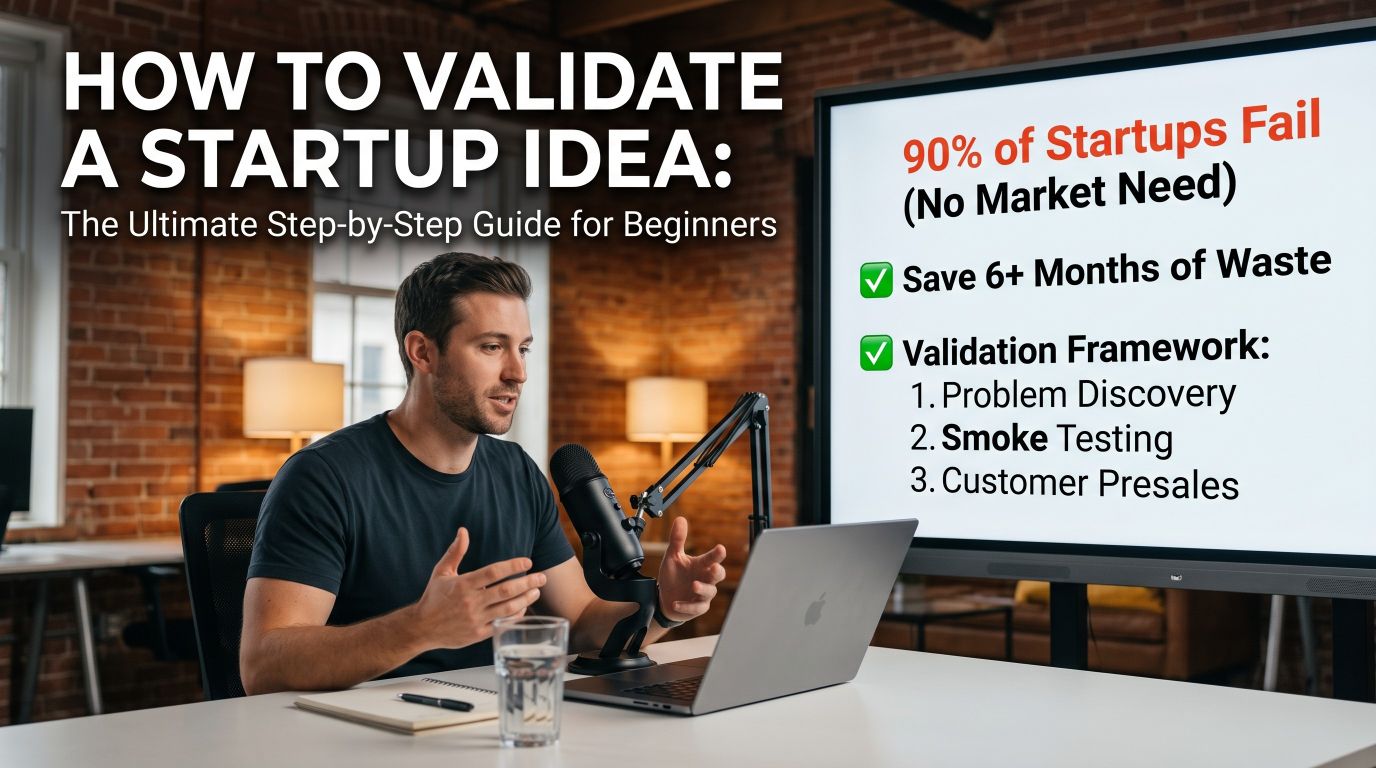
Most people think startups fail because they build bad products.
That is actually not true. Most startups fail because they build something that nobody actually wants.
Imagine spending six months writing code, designing logos, and staying up until 3:00 AM every night. You finally launch your project to the world. You post on social media, open your dashboard, and wait for notifications.
Silence. Zero sales. Nobody signs up.
It is a heartbreaking feeling, and it happens to thousands of founders every single day. But here is the good news: you do not have to guess. Before you spend a single dollar, write one line of code, or quit your job, you can find out if your business will work.
In this comprehensive guide, you will learn how to validate a startup idea quickly, affordably, and safely. We will break down the entire validation process into simple steps that anyone can follow, even if you have never built a company before.
What Does Startup Idea Validation Actually Mean?
Let us keep things simple. Validation means getting real proof that real people want what you are building and are willing to give you their time or money for it.
Notice the key word there: proof.
Validation is not asking your mom, your best friend, or your partner, "Hey, do you think this is a cool idea?"
Why? Because they love you. They will smile and say, "Wow, that sounds amazing!" They do not want to hurt your feelings. But your friends and family are rarely your target customers.
Real validation answers three simple questions:
Does this problem really hurt people enough that they want to fix it?
Does my idea solve that problem in a way they like?
Will they actually pay money for it?
If you get a clear "Yes" to all three questions, you have a green light. If you get a "No," you just saved six months of your life and thousands of dollars. That is a massive win either way.
Why You Must Validate Your Startup Idea Before Building
Building a product before talking to users is like cooking a five-course dinner for a stranger without asking what food they like or if they have allergies. You might make a wonderful meal, but if they cannot eat it, all your work goes straight into the trash.
Here are the main reasons why learning how to validate a startup idea is your most important superpower as an entrepreneur:
1. You Save Massive Amounts of Money
Hiring developers, buying software tools, and running paid ads costs a lot of cash. When you validate first, you can test demand using free tools, landing pages, and direct conversations.
2. You Save Valuable Time
Time is the only resource you can never get back. Validating an idea takes a few days or a couple of weeks. Building a full product takes months. Which would you rather risk?
3. You Build What People Actually Want
When you talk to customers early, they tell you exactly what features they need. You do not have to guess what buttons to put on your app or what services to offer in your business. Your future customers hand you the roadmap.
4. You Gain Unshakable Confidence
Starting a business is scary. Doubts will creep into your mind. But when you have a list of fifty people waiting to buy your product, all that fear disappears. You know you are building something real.
Step 1: Write Down Your Core Problem and Assumptions
Every great business starts with a problem, not a solution. Uber did not start because someone loved building mobile apps; it started because finding a taxi in San Francisco in the rain was a nightmare.
Before you test anything, grab a notebook or open a blank document. Answer these simple questions:
What specific problem am I solving? Be very precise. Instead of saying "People waste time grocery shopping," say "Busy working parents spend two hours every weekend waiting in grocery lines."
Who has this problem the most? Not "everyone." Everyone is not a target market. Pick a specific group: college students, freelance designers, small gym owners, or real estate agents.
How are these people solving this problem right now? Are they using messy spreadsheets? Are they using sticky notes? Are they using an expensive tool that is too complicated? If they are doing nothing to solve it today, the problem might not hurt enough for them to pay for your fix.
What is my risky assumption? What is the one thing that must be true for this business to succeed? For example: "Small gym owners are willing to pay $49 a month for simple class scheduling software."
Once you have these answers written down, you are ready to find out if your assumptions are true.
Step 2: Study the Market and Existing Competitors
A common beginner mistake is saying: "Nobody else is doing this! I have zero competitors!"
If nobody is doing it, one of two things is happening:
You discovered a brand-new market (this is very rare).
Many people tried before you, realized nobody wants to pay for it, and went out of business.
Competition is not bad news. Competition is proof that money is already changing hands in that industry.
Where to Find Market Clues for Free
You do not need expensive market research reports. You just need curiosity and an internet connection.
Check Online Communities (Reddit, Facebook Groups, Quora)
Find the forums where your ideal buyers hang out. If you want to build a tool for freelance writers, visit subreddits like r/freelance or r/freelanceWriters.
Search for words like:
"I hate when..."
"Is there a tool that..."
"Why is it so hard to..."
"How do you handle..."
Read the comments. You will see people pouring out their frustrations for free. If twenty people are complaining about the exact same issue every single week, you just found a real problem.
Read Negative Reviews on Existing Products
Go to websites like Trustpilot, G2, Capterra, or the Amazon reviews section for competing products. Filter specifically for 2-star and 3-star reviews.
Why 2-star and 3-star reviews? Because 1-star reviews are often just angry rants, but 2-star and 3-star reviews usually give honest, detailed feedback: "I like this app, but it lacks this one feature," or "The customer service is terrible," or "It is way too complicated for a small team."
Those reviews tell you exactly what the market is missing. That gap is your business opportunity.
Step 3: Talk Directly to Potential Customers
Now comes the part that makes many people nervous: talking to strangers.
You do not need to do high-pressure sales calls. In fact, you should not sell anything during these conversations. You are simply doing detective work.
The Golden Rule of Customer Interviews
Never ask people about the future. Ask them about their past behavior.
If you ask: "Would you buy an app that organizes your receipts?"
People will say: "Sure, that sounds cool!" (Future talk is cheap and unreliable).
Instead, ask:
"When was the last time you organized your business receipts?"
"How did you do it?"
"What was the most frustrating part of that process?"
"Have you tried paying for any software or tools to fix that? If so, what happened?"
If the person says: "Oh, I haven't tracked my receipts in three years, I just throw them in a shoebox and forget about it," they do not care enough about the problem. They will not buy your software.
If they say: "Last Friday I spent six hours crying over a spreadsheet, and last month I paid an accountant $500 to sort it out," then bingo! You found someone with genuine pain and a proven willingness to spend money.
How to Reach Out to People Without Being Annoying
Send short, friendly, direct messages on LinkedIn, Twitter, or email. Keep it brief:
"Hi [Name], I noticed you run a boutique fitness studio in [City]. I am researching how local gym owners manage their weekly class bookings and the headaches that come with it. I am not selling anything at all—just trying to learn from people in the trenches. Would you be open to a quick 10-minute chat over the phone or Zoom this week? Either way, thank you for your time!"
Reach out to 30 people. If you get 10 conversations, you will learn more about your market in one week than most people learn in a year of building in isolation.
Step 4: Build a Smoke Test with a Simple Landing Page
Talking to people is great, but actions speak louder than words. The next level of learning how to validate a startup idea is running what marketers call a Smoke Test.
A smoke test is a simple one-page website that looks like your product already exists (or is launching soon), designed to measure whether visitors take action.
The Ingredients of a High-Converting Landing Page
You do not need to hire a web developer. You can build this in an afternoon using no-code website builders like Carrd, Webflow, Framer, or WordPress.
Keep your page focused and simple:
A Clear Headline: State what problem you solve and for whom in plain language. (Example: "The simple invoice tool for freelance photographers. Get paid on time, every time.")
A Supporting Subheadline: Add one or two sentences explaining how it works.
Three Core Benefits: Use bullet points with short explanations highlighting how your product makes their life easier, saves them time, or earns them money.
Social Proof or Context: Even if you are brand new, explain why you are building it or showcase early feedback from your interviews.
A Single Call-to-Action (CTA): A clean button saying "Join the Early Access Waitlist" or "Get 50% Off at Launch."
What to Track on Your Page
Set up free analytics to monitor your visitors. Watch two simple numbers:
Unique Visitors: How many people visited your page?
Conversion Rate: What percentage of those people entered their email address to join the waitlist?
If 100 people visit your page and 15 to 20 people happily give you their email address, you have strong initial interest! If 500 people visit and only 2 people sign up, your message is either unclear or people simply do not want what you are offering.
Step 5: Drive Targeted Traffic to Test Your Page
A landing page does not validate anything if nobody sees it. You need to put your page in front of the exact people who face the problem you are solving.
Here are three simple, low-cost ways to get visitors to your test page:
Method 1: Organic Community Sharing
Go back to the communities where you did your research. Share your project honestly and transparently.
Do not post spam like: "Check out my new startup at mywebsite.com!" Communities will ban you immediately.
Instead, share your story:
"Hey everyone! Last month I asked this group how you manage client contracts, and 40 of you said it was your biggest headache. I put together a simple prototype to automate this workflow. I would love your honest feedback on whether this actually solves the issue. Here is the link..."
When you are humble and focus on solving their problem, people are happy to check out your work and give feedback.
Method 2: Micro-Budget Search and Social Ads
You do not need a huge marketing budget. Spending just $30 to $50 on targeted ads can give you clear answers within 48 hours.
Search Ads (Google Ads): Target people actively searching for solutions. For example, if someone types "best scheduling app for barbers," they already have intent to find a tool. An ad showing your landing page will quickly prove if they are interested.
Social Ads (Meta, LinkedIn, or TikTok): Target people based on their job title or interests.
If your ad gets clicks and those clicks turn into email signups at a reasonable cost, you have proof of real market demand.
Method 3: Direct Personal Outreach
If your business is for other companies (B2B), direct outreach is often the fastest route.
Find 50 people on LinkedIn who match your buyer persona. Send them a polite note showing your landing page and asking if the concept fits their current workflow. Direct outreach costs zero dollars and gives you high-quality feedback.
Step 6: Create a Minimum Viable Product (MVP) Without Code
Once your landing page gets signups, do not jump straight into building a complex, expensive app. Build a Minimum Viable Product (MVP).
An MVP is the simplest possible version of your idea that still delivers real value to the customer.
Think of it like transportation: if your ultimate vision is to build a sports car, your MVP is not a car engine sitting on the floor. Your MVP is a skateboard. A skateboard is simple, cheap to make, and it still gets a person from point A to point B.
WRONG MVP PATH:   Wheel  ---> Axle  ---> Car Body  ---> Working Car
RIGHT MVP PATH:   Skateboard ---> Scooter ---> Bicycle ---> Working Car
Three Simple Ways to Build an MVP Today
1. The Concierge MVP (Do It Manually)
Instead of building software to automate a service, do the work by hand behind the scenes.
Famous Example: Food delivery apps often started with founders taking orders via text messages, running to restaurants themselves, and delivering the food by hand. The customers thought it was a high-tech service, but the founders were testing if people actually wanted meals delivered before spending money on custom driver apps.
2. The "Wizard of Oz" MVP
Your product looks completely automated on the front end, but everything behind the scenes is powered by human effort.
Famous Example: The founder of Zappos (the massive online shoe store) did not buy warehouse inventory. He walked down to local shoe stores, took photos of shoes, and put them on a simple website. When someone placed an order, he walked back to the store, bought the shoes at full price, and mailed them out. He lost a little money on shipping, but he proved that people were willing to buy shoes online.
3. The No-Code Stack
Today, you can build full web applications using drag-and-drop tools. You do not need to write code.
Use Airtable or Google Sheets for your database.
Use Make or Zapier to connect apps and send automated emails.
Use Softr, Glide, or Bubble to create customer dashboards and mobile interfaces.
You can assemble a working, usable product in a weekend for under $50.
Step 7: The Ultimate Test — Pre-Sales and Real Money
Here is the absolute truth about business:
Compliments are nice, email signups are promising, but paying customers are the only true validation.
Until someone opens their wallet and pays you, your idea is still an unverified guess.
Many founders are terrified to ask for money early. They think: "My product isn't perfect yet. How can I charge people?"
If your solution solves a painful problem, people will gladly pay for early access, discounts, or a basic version that solves their core issue today.
How to Collect Pre-Orders Ethically
Be honest and upfront. Never lie and pretend your finished product is already shipping tomorrow if it is not.
Here is how you frame a pre-sale:
Offer a Founder Discount: Tell your early supporters: "The regular price will be $200 per year, but if you join our early founder batch today, you get lifetime access for a one-time payment of $79."
Offer a 100% Money-Back Guarantee: Remove all risk for the buyer. Tell them: "If we launch and it does not solve your problem, or if you change your mind for any reason, email us for an instant, full refund. No questions asked."
Set Up a Simple Checkout: Connect a Stripe payment link, PayPal button, or Lemon Squeezy checkout directly to your page.
If five or ten total strangers pull out their credit cards and buy your pre-order, congratulations! You have validated your startup idea at the highest level possible. You now have paying customers waiting for you to build the product.
What Should You Do If Your Idea Fails Validation?
What happens if you run your tests, talk to users, launch your landing page, and nobody signs up or pays?
First: celebrate.
Seriously! You just saved yourself months of exhausting work and thousands of dollars. You did not fail—your experiment gave you clear data.
When an idea does not validate, you have three clear choices:
Option A: Pivot the Audience
Maybe your product solves a real problem, but you targeted the wrong group of people.
Example: College students did not want to pay for a daily planner app because they have limited budgets, but busy corporate executives might pay $15 a month for the exact same tool without thinking twice.
Option B: Pivot the Problem
During your customer interviews, did people keep bringing up a different headache?
Example: You tried to sell them an email newsletter tool, but everyone kept complaining about how difficult it is to format images for social media. Drop the newsletter idea and look into the image problem instead! Follow where the customer's pain actually leads you.
Option C: Drop the Idea Completely and Move to the Next One
Entrepreneurs have lots of ideas. Not every idea is a winner, and that is completely normal. Shelve the concept, review your notes, pick your next favorite idea, and run the validation playbook again from Step 1.
Common Startup Validation Mistakes to Avoid
To make sure your validation results are accurate, watch out for these common traps:
Common Mistake | Why It Hurts You | What to Do Instead |
Asking friends and family | They will tell you what you want to hear to be supportive. | Talk exclusively to strangers who match your target customer profile. |
Pitching before listening | You spend the whole call selling your dream instead of learning their real issues. | Ask open-ended questions about their past struggles and listen 80% of the time. |
Falling in love with the solution | You become obsessed with your features instead of fixing the user's pain. | Fall in love with the problem. Be flexible with how you solve it. |
Relying only on verbal promises | People say "I would totally buy that," but disappear when it is time to pay. | Ask for an email signup, a deposit, or a pre-order to test true intent. |
Spending months perfecting an MVP | You delay user feedback and waste resources on unnecessary features. | Launch a basic version in days using no-code tools or manual workflows. |
Your 7-Day Action Plan: Validate Your Startup Idea This Week
You do not need months of planning. You can validate your next project in seven days by following this simple schedule:
Day 1: Define the Core Problem. Write down who your customer is, what specific problem they face, and your primary risky assumption.
Day 2: Research Communities. Browse Reddit, Facebook groups, and product reviews. Save direct quotes from people complaining about the problem.
Day 3: Reach Out to 20 Prospects. Send short, polite messages asking for 10-minute discovery calls. No sales pitches.
Day 4: Conduct User Interviews. Ask open-ended questions about their daily workflows, past solutions, and current spending habits.
Day 5: Build a 1-Page Landing Page. Set up a simple Carrd or Webflow page with your core headline, key benefits, and an email signup box.
Day 6: Drive Your First 100 Visitors. Share your story in relevant communities, message your interviewees, or run a small $20 search ad test.
Day 7: Review the Proof and Decide. Check your conversion rates. If interest is high, offer a discounted pre-order. If interest is low, pivot or move on to the next idea.
Frequently Asked Questions About Startup Idea Validation
How much money does it cost to validate a startup idea?
You can validate most ideas for less than $50. Using free site builders, social media communities, and direct outreach, your primary investment is time, not money.
How long should startup validation take?
For most software, digital products, and service businesses, validation takes between one and three weeks. If you spend more than a month validating without clear answers, your offer is likely too complicated or your target market is too broad.
What if someone steals my startup idea during validation?
Ideas are cheap; execution is everything. Most people are too busy working on their own lives to steal your concept. Furthermore, without talking to customers publicly, you cannot build a product people want anyway. Secrecy hurts early founders far more than openness ever will.
How many customer interviews do I need?
Speaking with 10 to 15 people who fit your exact target profile is usually enough to spot repeating patterns and validate core problems.
Final Thoughts: Start Validating Today
The biggest difference between successful founders and people who only dream about entrepreneurship is not intelligence or funding. It is how fast they test their ideas in the real world.
Do not spend the next six months building something in the dark. Step into the light, talk to future customers, test demand with simple tools, and let real market data guide your journey.
Now that you know how to validate a startup idea, pick your best concept, open a blank page, and take your first step today!
Ready to grow your business?
Contact us today to find out how our strategies can scale your operations to the next level.
Contact Us