AI Layoffs Explained: Why Companies Are Firing Workers for Algorithms
Have you opened LinkedIn or checked the morning news lately and felt a knot in your stomach?
Every single week, there is another headline:
“Tech giant cuts 5,000 jobs.”
“Customer support team replaced by automated bots.”
“Company restructures around artificial intelligence.”
It feels like a wild movie plot, but it is happening right in front of us. Welcome to the era of artificial intelligence restructuring.
Today, we are going to break down AI layoffs explained: why companies are firing workers for algorithms.
Think of this post as a friendly coffee chat or a candid podcast episode. We will skip the dry business talk, avoid robotic buzzwords, and look directly at what is really going on behind closed boardroom doors.
1. What Are AI Layoffs? (The Simple Explanation)
Let us start with the basics so everyone is on the same page.
When a company goes through a traditional layoff, it usually happens because money is tight. Sales went down, profits dropped, or a terrible economy forced executives to cut spending to keep the business afloat.
AI layoffs work differently.
In many cases, the companies cutting staff right now are not broke. Some are reporting record quarterly revenues. Yet, they are letting go of hundreds or thousands of loyal team members.
Why? Because leadership believes software code, machine learning systems, and generative tools can do the exact same daily tasks faster, cheaper, and without needing a break.
When we talk about why companies are firing workers for algorithms, we are looking at a quiet shift from paying monthly human salaries to paying cloud software subscriptions.
An algorithm does not get sick. It does not ask for health insurance, vacation time, parental leave, or a bonus. And to a corporate executive focused solely on profit margins, that sounds like an easy trade.
2. Why Companies Are Firing Workers for Algorithms: The 5 Big Drivers
To understand this wave of job cuts, we have to look at the motives driving corporate leaders. It is not just about the technology itself; it is about money, investor expectations, and business efficiency.
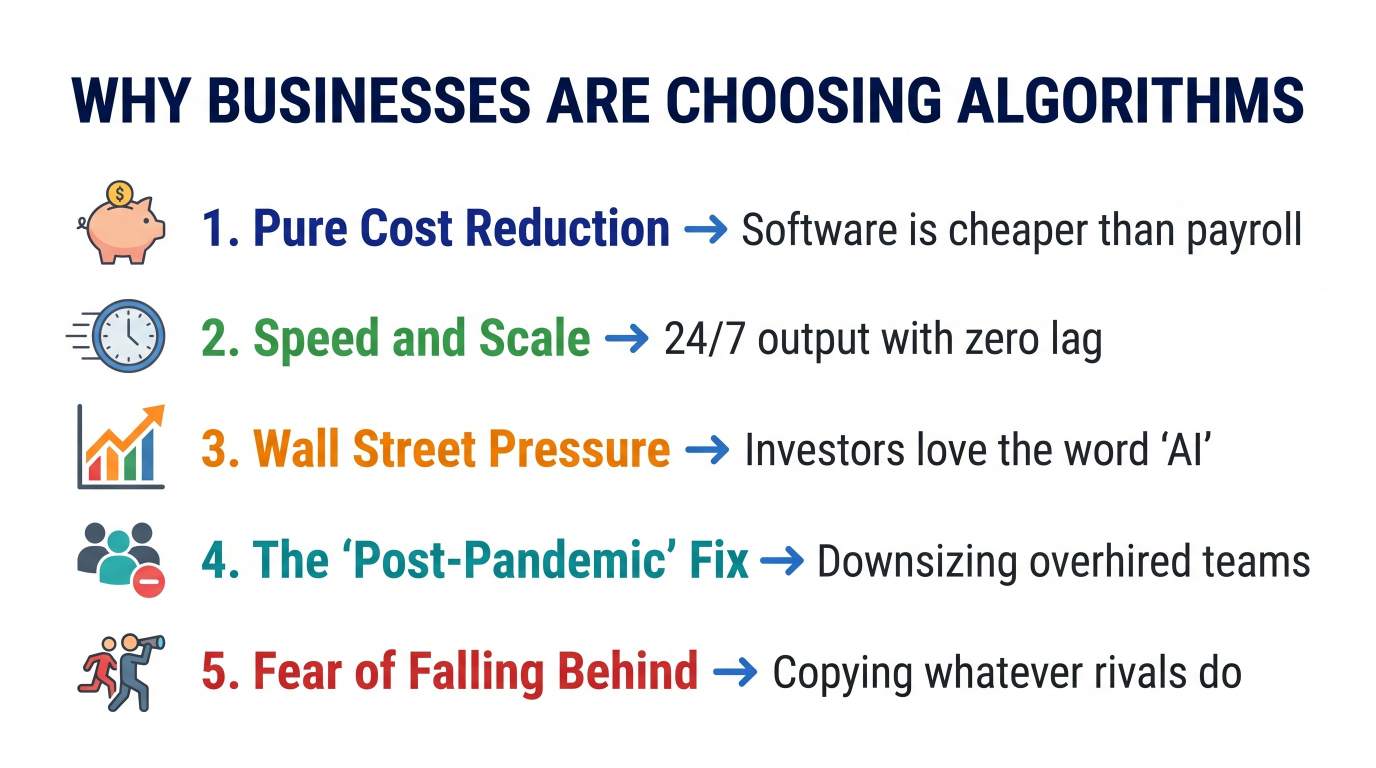
Driver 1: Pure Cost Reduction
Let us look at simple math. Hiring a skilled employee costs a lot more than just their base paycheck:
You have recruitment costs.
You pay taxes and social security.
You pay for office space, hardware, and perks.
You pay for healthcare and pensions.
Now compare that to an enterprise software license. A company might pay $30 to $100 per month for an advanced software tool that can write rough drafts, organize balance sheets, or triage customer tickets.
When chief financial officers (CFOs) compare these numbers on a spreadsheet, they see an easy way to cut overhead expenses instantly.
Driver 2: 24/7 Speed Without Burnout
Humans get tired. We need eight hours of sleep, coffee breaks, family weekends, and time off when we feel burnt out.
An automated system runs on a server rack. It does not sleep at 3:00 AM on a Sunday. It can process 10,000 support emails in two minutes without breaking a sweat. For global businesses with customers across every time zone, that round-the-clock speed is hard to resist.
Driver 3: Wall Street and Investor Pressure
Here is a dirty secret in corporate business: investors love hearing the word "AI."
When a CEO stands up during an earnings call and says, "We are integrating cutting-edge algorithms to streamline our operations," the stock price often jumps.
Investors reward efficiency. They want companies to produce higher profits with fewer humans on the payroll. In many cases, leadership announces job cuts just to signal to shareholders that they are modern, efficient, and forward-looking.
Driver 4: The Post-Pandemic Correction
Between 2020 and 2022, tech companies hired too fast. Everyone was stuck at home shopping online, streaming video, and using digital apps. Tech firms thought that boom would continue forever.
When the world went back to normal, those companies were left with thousands of extra employees they didn't need. Automated tools arrived at the perfect time to give these companies an excuse to cut staff without admitting they made poor hiring decisions.
Driver 5: Fear of Missing Out (FOMO)
Corporate executives suffer from peer pressure just like anyone else.
If Company A announces that they replaced half their customer support team with automated chatbots, Company B panics. The CEO of Company B thinks, "If our competitor is cutting expenses with automated tools, our costs will look too high. We have to do it too!" This creates a domino effect across entire industries.
3. Which Jobs Are Seeing the Biggest Impact?
In previous industrial shifts, machines replaced hard physical labor. Think of automated robotic arms building cars in factories or tractors harvesting crops on farms.
This time, the disruption is happening to desk workers, knowledge workers, and creative professionals.
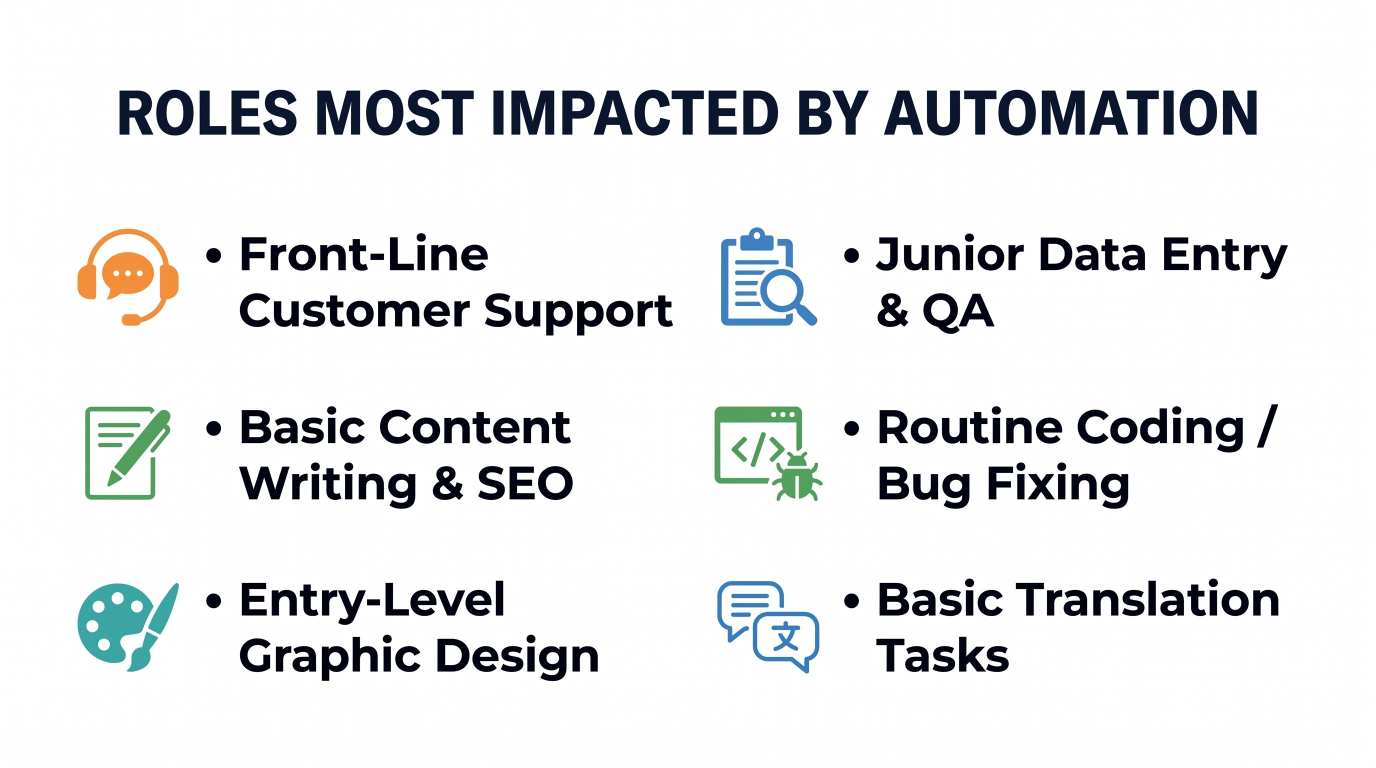
Front-Line Customer Service
Remember the last time you used a website chat box? Years ago, you were almost certainly talking to a human agent overseas. Today, you are usually talking to a smart conversational agent.
These automated tools can check order statuses, process refunds, answer return policy questions, and resolve 70% to 80% of common tickets without a person ever touching the keyboard. Because of this, large call centers are shrinking rapidly.
Entry-Level Copywriting and Translation
Basic written content has taken a massive hit. Companies that used to hire freelance writers for product descriptions, simple social media posts, and short articles are now using automated text generators.
The same thing is happening in translation. Software can instantly translate a 50-page manual into twelve languages with decent accuracy, leaving only a small amount of proofreading for human linguists.
Junior Software Engineers and QA Testers
For decades, learning to code was considered the safest career path on earth. But code is fundamentally a structured language, and machines are exceptionally good at structured logic.
Automated programming tools can write boilerplate code, spot syntax bugs, and write unit tests in seconds. Because senior engineers can now produce twice as much code using smart assistants, companies need fewer junior programmers to handle basic groundwork.
Basic Data Entry and Administrative Tasks
Sorting spreadsheet rows, transferring numbers between software programs, scheduling meetings, and generating weekly status summaries are routine tasks. Automated workflows handle these steps instantly, reducing the need for large administrative teams.
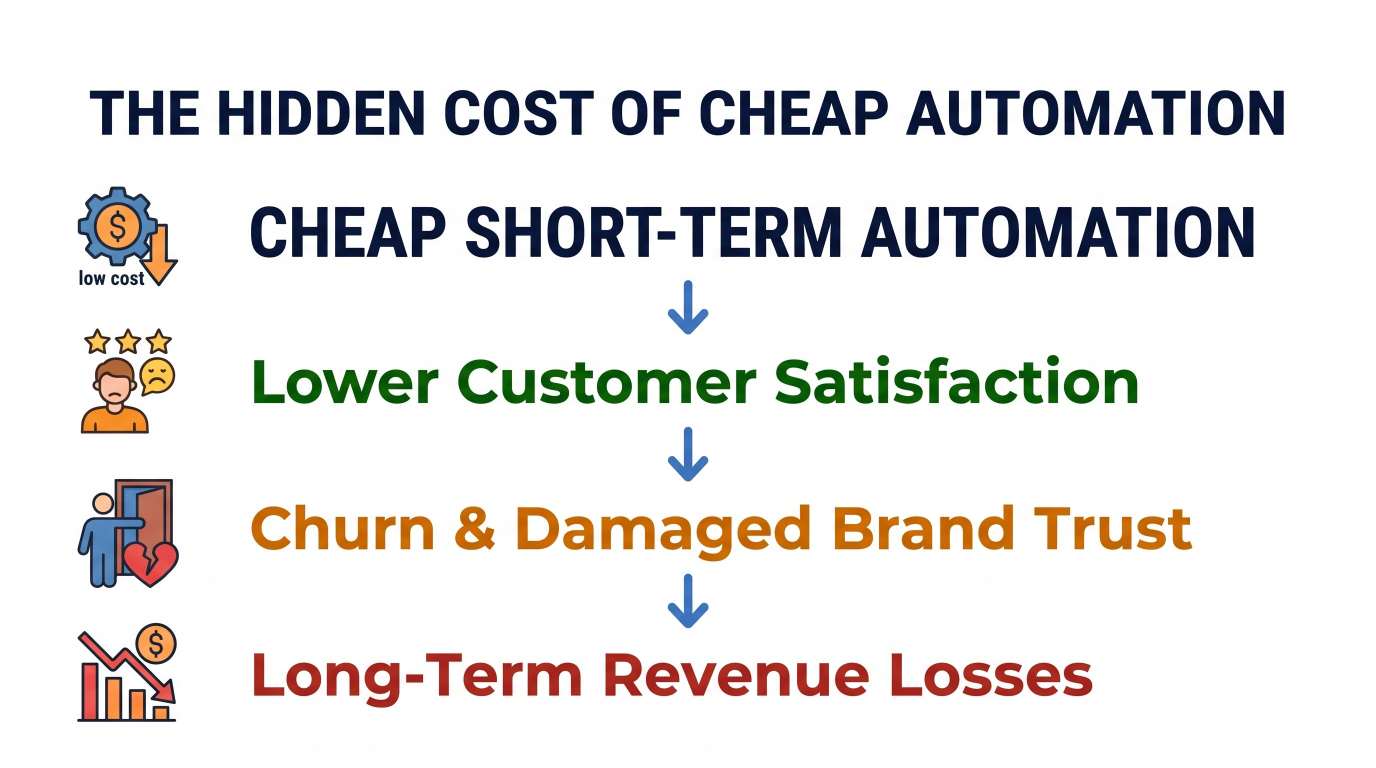
4. The Trap: The Hidden Costs Companies Are Learning the Hard Way
It sounds like a corporate dream: zero salaries, fast output, happy shareholders. But wait. Is replacing people with software really working out as smoothly as these executives claim?
Not quite. Many companies are running into serious walls.
The "Hallucination" and Quality Crisis
Automated models do not actually "know" facts the way humans do. They predict what word should come next based on patterns. Because of that, they can invent false information with total confidence.
We have already seen real horror stories:
Air Canada's chatbot gave an incorrect refund policy to a passenger, and a court ordered the airline to honor the fake rule.
Lawyers submitted court briefs with made-up legal cases generated by automated tools and were fined by judges.
Media outlets published automated finance articles packed with basic math errors, damaging their reputations.
When companies fire their experienced staff, they lose their built-in safety net.
The Loss of Empathy and Human Trust
Nobody likes arguing with a machine when they are stressed.
If your bank account is locked, your flight is canceled, or your medical insurance denies a claim, you do not want a robot spitting canned replies at you. You want a caring human who can listen, understand your frustration, and make an exception when common sense requires it.
Businesses that replace every human agent with an automated bot often see their customer satisfaction scores crash.
Nobody to Train the Future Senior Leaders
Here is a major long-term danger: if a company fires all junior workers because software can handle junior-level tasks, where will tomorrow's senior experts come from?
Senior managers, lead developers, and creative directors do not drop from the sky. They grow by spending five to ten years doing entry-level work, making mistakes, and learning how systems operate. Cutting the bottom rung of the career ladder breaks the entire talent pipeline.
5. Is This Permanent, or Is It a Tech Bubble?
You might be wondering: Is this just a short-term trend that will fade away, or is our working world permanently altered?
The honest truth sits somewhere in the middle.
Parts of this wave are clearly an overreaction. When a new technology captures the public imagination, companies overspend and rush into it out of pure panic. They lay off teams too early, realize the software cannot actually handle edge cases, and quietly hire people back a year later under different job titles.
However, the technology itself is not going away. It will continue to get faster, smarter, and cheaper.
The jobs will not return in the exact same format they used to exist. Just like bank tellers had to change how they worked when ATM machines were invented, desk workers now have to adapt to automated tools.
                 HISTORICAL PARALLEL: THE ATM

 In the 1970s, people feared ATMs would eliminate all bank
 tellers. Instead, ATMs made opening bank branches cheaper.
 Banks opened MORE branches, and tellers became relationship
 managers and financial advisors instead of cash counters.
6. How to Protect Your Career: 6 Practical Rules
Now let us turn the spotlight back on you. Reading about AI layoffs explained: why companies are firing workers for algorithms can easily make you feel powerless. But you are not powerless.
You can take clear, proactive steps today to make sure your career stays resilient, stable, and valuable.
Rule 1: Stop Doing Purely Repetitive Tasks
Ask yourself honestly: Could a smart computer program do 80% of what I do in a day if it had access to my files?
If your job is copying data from column A to column B, summarizing emails, or writing generic five-sentence updates, you are standing in the blast zone.
Start finding ways to add judgment, nuance, and strategic decision-making to your day. Focus on tasks where the correct answer depends on human context, workplace relationships, and complex trade-offs.
Rule 2: Become the Person Who Drives the Software
There is a famous saying floating around the business world:
"AI will not replace you. A person using AI will replace you."
Instead of ignoring these new tools, open them up. Learn how they work. Test their limits. Figure out how to use them to finish your eight-hour workday in four hours.
When your company decides to adopt new automated systems, you do not want to be the person being replaced. You want to be the subject-matter expert teaching the rest of the company how to use the tools effectively.
Rule 3: Double Down on Human Soft Skills
Software cannot replicate deep human connection. It cannot:
Read a room during a tense negotiation.
Build trust with an anxious client.
Motivate a discouraged coworker.
Mediate conflict between two stubborn team members.
Mentor a nervous intern.
Strong communication, genuine empathy, leadership, and emotional intelligence are suddenly the most valuable skills in the entire job market.
Rule 4: Specialize in Deep, Complex Niches
Automated models are trained on average information from the public internet. They are very good at answering common, general questions.
Where do they struggle? They struggle with hyper-specific, localized, and complex problems:
Local tax codes in specific jurisdictions.
Highly custom legacy industrial software.
Complex physical supply chains.
High-stakes medical and legal decisions.
The deeper and more specialized your knowledge is, the harder it becomes for a generic algorithm to step in and do your job.
Rule 5: Build a Public Personal Brand
If your entire reputation exists solely inside the four walls of your current company, you are vulnerable. If that company decides to downsize overnight, you start back at square one.
Start talking about your work publicly:
Share what you are learning on LinkedIn.
Write short, practical case studies.
Network with colleagues across different companies in your field.
Speak at local industry meetups.
When people in your industry know your name and recognize your expertise, finding your next opportunity is ten times easier if a layoff strikes.
Rule 6: Maintain a Financial Safety Net
Technological shifts take time to settle, and unexpected bumps happen along the way. Having three to six months of living expenses saved in an emergency account gives you breathing room.
When you have a financial safety net, a corporate restructuring does not throw your entire life into immediate crisis. You have the time and calm mindset needed to pivot, learn a new skill, and land on your feet.
7. What Ethical Companies Should Do Instead
Firing half your workforce to boost short-term quarterly profits is lazy leadership. Forward-thinking companies are taking a much better, healthier path: reskilling.
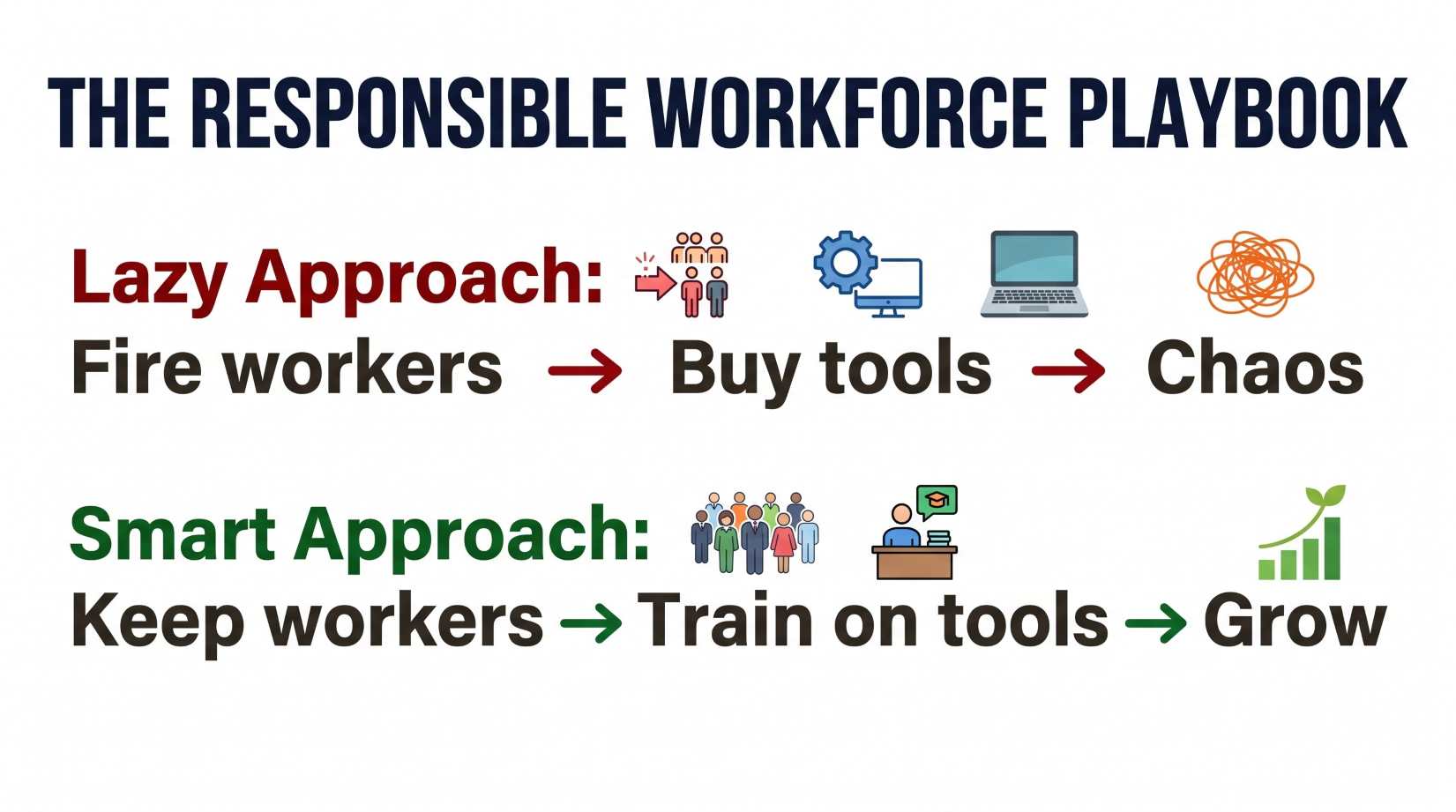
When a business gives automated tools to its existing team, amazing things happen:
The company keeps valuable institutional knowledge. An employee who has been with a business for five years understands its customers, products, and culture in a way no software tool ever will.
Employee morale stays high. Workers who feel supported and trained will work hard to innovate, rather than hiding out of fear.
Output multiplies without mass layoffs. Instead of cutting ten workers to save money, a company can empower those ten workers to produce the output of thirty workers, expanding into new products and higher revenues.
Companies that treat their people as long-term investments rather than disposable line items on an expense sheet are the ones that will win the trust of customers and workers alike over the next decade.
Summary Checklist: Navigating the New Workplace Reality
To wrap things up, keep this quick checklist close at hand as you plan your career growth:
Accept reality: Automated tools are here to stay, and businesses will keep trying to lower labor costs.
Learn the tools: Use machine learning assistants and automated workflows to speed up your routine tasks.
Focus on human connection: Sharpen your storytelling, conflict resolution, leadership, and negotiation skills.
Move toward complex problems: Step away from simple data entry and move toward nuanced decision-making.
Build external networks: Keep your resume fresh and maintain active relationships across your industry.
Protect your finances: Keep an emergency fund ready so company surprises don't derail your life.
The rise of algorithms is changing the modern workplace, but it does not mean the end of meaningful human careers. By staying adaptable, curious, and deeply human, you can navigate this transition with confidence.
Stop Wasting Hours on Busywork: Put Your Business on Autopilot
You don’t need another generic website. You need a system that solves real problems.
Most growing businesses lose hours every week to manual data entry, messy customer handoffs, and disconnected apps. We build custom web platforms designed to:
Automate repetitive tasks: Capture, qualify, and route leads automatically.
Eliminate manual busywork: Connect your payments, forms, and workflows in one place.
Scale smoothly: Handle more clients without overwhelming your team.
Turn your website into a tool that actually grows your business.
Claim Your Free 15-Minute Workflow Audit
Let’s find the bottlenecks slowing you down and build a system that runs effortlessly
Frequently Asked Questions (FAQ)
What does "AI layoffs explained" mean in simple words?
"AI layoffs explained" refers to understanding why businesses are eliminating human jobs and replacing those daily duties with automated computer software, machine learning models, and smart bots to cut operating costs.
Are algorithms really cheaper than human employees?
Yes, in direct costs. A company pays a flat subscription fee for software, avoiding expenses like medical benefits, bonuses, retirement contributions, and office space. However, hidden costs—like software errors and unhappy customers—can add up over time.
Which industries are seeing the most job cuts right now?
Technology, customer service centers, marketing, basic copywriting, media publishing, and administrative support are experiencing the highest number of automation-driven adjustments.
Can artificial intelligence replace creative jobs completely?
No. While automated systems can produce drafts, images, and basic music based on existing patterns, they lack lived human experience, authentic emotional vulnerability, original worldview, and true creative spark.
What is the safest skill to learn right now?
Complex problem-solving, strategic thinking, hands-on trades, emotional intelligence, and mastering how to oversee and direct automated systems are among the safest and most valuable skills.
Ready to grow your business?
Contact us today to find out how our strategies can scale your operations to the next level.
Contact Us