How AI Product Recommendations Transform Online Shopping
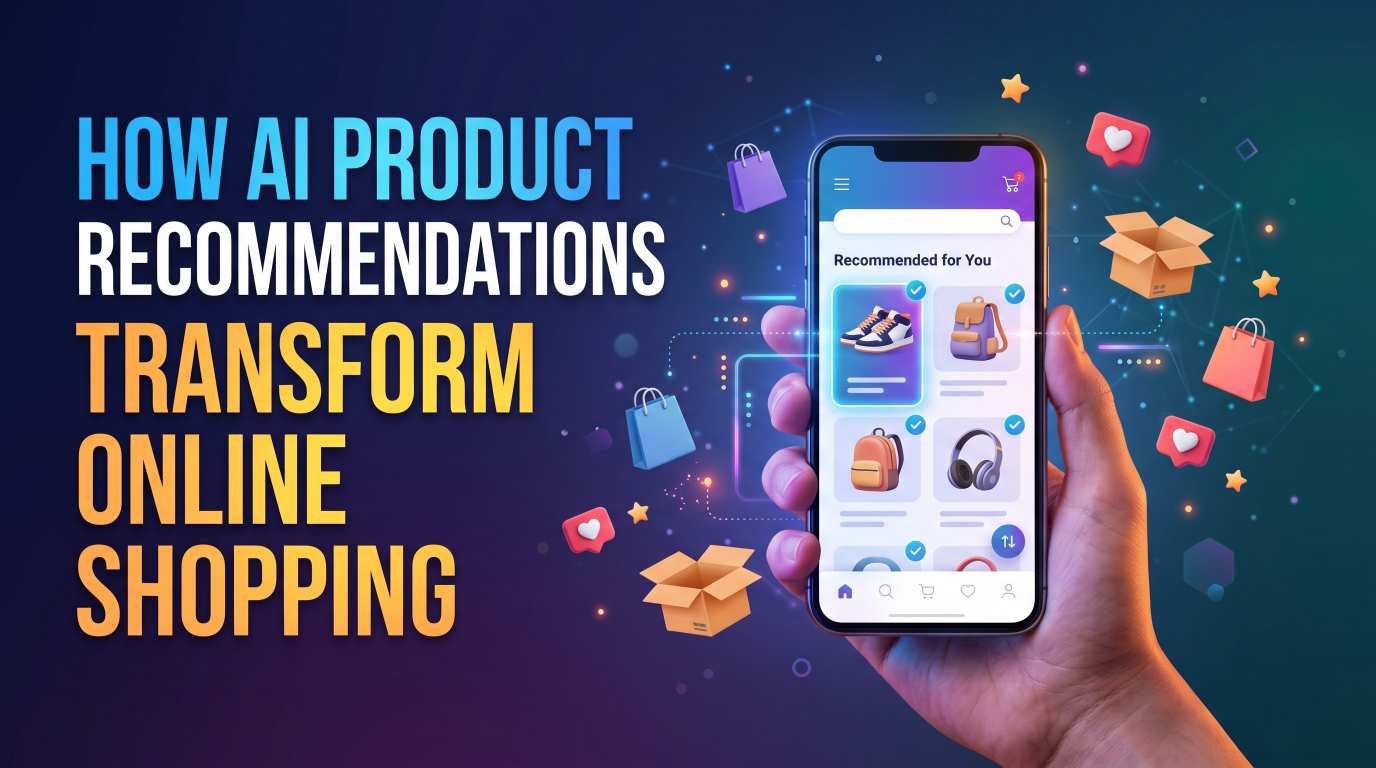
Have you ever opened an online shopping app just to look at running shoes, and ten minutes later, you find yourself looking at the exact running socks, a water bottle, and a gym bag that you actually like?
You stop for a second and think: “Wait, did this app read my mind?”
It feels like magic. But it is not magic at all. It is smart technology working behind the scenes.
The secret sauce is AI product recommendations.
Today, online shopping is completely different from what it was ten or fifteen years ago. Back then, websites showed the exact same front page to everybody. It did not matter if you were an eighteen-year-old gamer or a sixty-year-old gardener. You both saw the exact same blender on sale.
Now? Every single person gets their own custom store.
In this guide, we are going to break down how AI product recommendations transform online shopping. We will explain how the system works in plain English, why it helps businesses make billions of dollars, and why it actually makes life easier for everyday shoppers like you and me.
Grab a cup of coffee, sit back, and let’s talk about it like two friends chatting on a podcast.
1. What Are AI Product Recommendations Anyway?
Let’s keep things super simple.
When you walk into a small neighborhood grocery store or a boutique shop, a friendly shopkeeper greets you. If you go there often, the shopkeeper knows your name. They know you love dark roast coffee. They know you prefer oat milk over regular milk.
So, when a brand-new dark roast arrives, the shopkeeper smiles and says, “Hey, I just got this new coffee bean in stock today. Based on what you bought last week, I know you will love it.”
That is personal service. It makes you feel valued, saves you time, and makes you want to visit again.
Now, imagine an online store with ten million customers visiting every day. A human shopkeeper cannot talk to ten million people at once. It is impossible.
This is where AI product recommendations step in.
Artificial intelligence acts like a digital shopkeeper for millions of shoppers at the exact same second. It looks at what you like, what you click, and what you buy. Then, it shows you items that fit your personal taste.
Ready to Turn Your Store Browsers Into Buyers?
You don’t need an Amazon-sized budget to deliver personalized shopping experiences that drive repeat sales.
At GoodlySoft, we help fast-growing ecommerce brands set up, fine-tune, and scale smart AI recommendation engines that lift average order value and slash bounce rates.
Book your free 20-minute personalization audit today. We’ll review your store’s current setup and show you exactly where you’re leaving revenue on the table.
Why the Old Way of Recommending Products Failed
Before modern AI, websites used basic rules written by humans.
These rules were very stiff:
Rule 1: If someone buys a phone, show them a phone case.
Rule 2: Show the top 5 most popular items to every visitor.
Rule 3: Show items that are on clearance sale.
Do you see the problem here?
If you already bought a phone case yesterday, showing you ten more phone cases today is annoying. If the most popular item in the store is baby diapers, but you don't have kids, that recommendation is totally useless to you.
Old systems were blind. Modern AI systems have eyes, memory, and common sense.
2. How AI Product Recommendations Actually Work Behind the Screen
You do not need a degree in computer science to understand how this works. Let’s break down what happens when you click around a website.
Whenever you browse an online store, you leave tiny digital footprints. The AI looks at these footprints to understand your shopping mood.
The Signals the AI Pays Attention To
Your Click History: What items did you tap on? Did you look at red sneakers or black sneakers?
Time Spent on a Page: Did you scroll past a jacket in two seconds, or did you zoom in on the photos and read reviews for three minutes?
Cart Activity: What did you put into your cart? What did you remove?
Search Queries: What exact words did you type into the search bar?
Purchase History: What items have you bought over the past six months?
Time and Season: Is it Friday night? Is it raining where you live? Is winter coming?
The AI takes all these little clues and puts them together like puzzle pieces.
Your Clicks + Your Cart + Other Shoppers' Habits = Perfect Suggestions
The Three Main Ways AI Builds Recommendations
To make good suggestions, the AI uses three primary methods:
Method 1: Looking at the Item Itself (Content Matching)
If you look at a blue cotton t-shirt with a round neck, the system finds other blue cotton t-shirts with similar styles, prices, and fabric types. It matches products based on their features.
Method 2: Looking at Shoppers Like You (Collaborative Filtering)
Imagine a shopper named Alex. Alex buys the exact same running shoes, protein powder, and headphones that you bought.
Now, Alex buys a specific brand of gym towel that you have never seen before.
The AI thinks: “Shopper A and Shopper B have almost identical taste. Alex loved this towel, so Shopper B will probably love it too.”
Boom! The towel appears on your screen. You look at it and say, “Wow, I actually need that!”
Method 3: Real-Time Learning (Deep Learning)
This is the newest and most exciting method. It learns what you want right now, in this exact shopping session.
Maybe last month you were shopping for tools to fix your kitchen sink. But today, you are looking for birthday gifts for your niece.
Smart AI product recommendations will not bother you with plumbing wrenches today. The system notices your shift in focus within three clicks and instantly pivots to toys, board games, and children's books.
3. Why Online Stores Love AI Product Recommendations
For store owners and online brands, this technology is not just a nice toy. It is the biggest engine driving their business growth.
Here is why businesses invest millions into building and improving their recommendation engines.
Higher Sales and Bigger Shopping Carts
When a customer sees items that make sense, they add them to their cart without hesitation.
Think about the classic prompt: "Frequently Bought Together."
If you buy a camera, the AI shows you the exact memory card and spare battery that fit that camera model. You don't have to search for serial numbers or worry about compatibility. You just click "Add both to cart."
That single button turns a $500 purchase into a $600 purchase. Multiply that across thousands of orders a day, and revenue jumps dramatically.
Lower Bounce Rates
In digital marketing, a "bounce" happens when someone visits a website and leaves within seconds because they didn't find what they wanted.
When an online store uses dynamic AI product recommendations, the home page changes the second a returning user lands on it. Instead of random banners, the user sees items connected to their recent interests. They stay on the site longer, explore more pages, and view more products.
Clearing Inventory Without Deep Discounts
Every store struggles with inventory that sits on warehouse shelves for too long.
In the old days, store owners slashed prices by 70% just to get rid of slow-moving items.
With AI, the system can find the exact small group of customers who would genuinely appreciate those specific items at full price. The AI matches long-tail inventory with interested buyers, protecting profit margins while keeping warehouse shelves moving.
4. Why Shoppers Actually Prefer AI Recommendations
Let’s flip the coin and look at this from our perspective as regular shoppers.
Some people worry that technology is tracking them too closely. That is a fair concern, and privacy matters a lot. But when done responsibly, AI product recommendations solve one of the most frustrating problems of modern life: decision fatigue.
Curing the "Too Many Choices" Headache
Have you ever walked into a massive supermarket with fifty different kinds of peanut butter? You stand in the aisle for ten minutes, staring blankly, feeling tired, and almost walking away empty-handed.
Psychologists call this the Paradox of Choice.
When humans face thousands of options, our brains get overwhelmed. Online stores can list millions of items. Searching through page after page of search results is exhausting work.
AI acts like a smart filter. It cuts through the digital noise and narrows down thousands of options to five or six items that genuinely match your budget, style, and needs.
Millions of Items in Catalog
           ▼ (AI Filtering)
5 Relevant Choices on Your Screen
Saving Your Valuable Time
Your time is valuable. Nobody wants to spend two hours comparing laptop chargers to find the one with the right wattage and plug size.
When the store uses smart AI product recommendations, the correct charger pops up right below the laptop you selected. You click it, check out, and get back to your life.
Helping You Discover Great Hidden Brands
Have you ever found your favorite brand of coffee, clothing, or skin cream purely by accident?
Often, that "accident" was an AI recommendation engine at work. AI doesn't just push the biggest, most expensive brands. It surfaces smaller, high-quality products that match your specific preferences, giving you a chance to discover great items you would never have found on your own.
5. Real-World Examples: Brands Winning with AI Product Recommendations
To see how powerful this technology really is, we only need to look at the biggest digital brands in the world today.
Brand | What They Recommend | The Secret Behind Their Success |
Amazon | Products, household goods, tools | Over 35% of all purchases are driven by their recommendation engine. |
Netflix | Movies, TV shows, documentaries | More than 80% of what people watch comes from algorithmic suggestions. |
Spotify | Songs, playlists, podcasts | Discover Weekly keeps users listening for hours every single week. |
Sephora | Makeup, skincare routines | Matches products directly to skin tone, skin type, and past purchases. |
The Amazon Empire
Amazon was one of the earliest pioneers of this approach. Years ago, they reported that up to 35% of their total sales came directly from their recommendation engine.
Think about that number for a moment. More than one out of every three items bought on Amazon was not searched for directly—it was suggested by an algorithm.
Phrases like:
"Customers who viewed this item also viewed..."
"Frequently bought together..."
"Inspired by your browsing history..."
These are not random lists. They are calculated, data-backed suggestions designed to save you steps and close sales.
The Fashion World: ASOS and Zalando
Clothing is one of the hardest things to buy online. Sizing varies, colors look different under different lights, and personal style changes from month to month.
Fashion giants like ASOS use computer vision and machine learning to analyze colors, cuts, and patterns. If you browse a green summer dress, the algorithm doesn't just show you random green clothes. It shows you shoes, sunglasses, and bags that match that exact shade and fashion aesthetic. It helps you build a complete outfit in minutes.
6. How Small Businesses Can Use AI Product Recommendations Today
A few years ago, only giant tech companies with billion-dollar budgets could build recommendation systems. Small boutique owners and independent stores had to rely on manual setups.
Today, that barrier has vanished.
Thanks to modern cloud platforms and ecommerce tools, even a brand-new store running on Shopify, WooCommerce, or BigCommerce can add AI product recommendations in a matter of minutes.
Step 1: Choose the Right Tool or Plugin
There are dozens of ready-to-use recommendation apps available in modern app stores. Tools like Nosto, Rebuy, LimeSpot, and Klaviyo offer plug-and-play AI modules. You don't have to write a single line of code.
Step 2: Place Recommendations Where They Make Sense
You shouldn't paste recommendation widgets everywhere on your site. If every page is covered in popups and product carousels, visitors get annoyed.
Place them at high-intent moments:
On Product Pages: Show related accessories or alternative options in case the current item is out of stock.
In the Slide-Out Cart: Show small, useful add-ons (like socks, cleaning spray, or gift boxes) right before checkout.
On the Thank-You Page: Show complementary items with a one-click re-order discount.
Step 3: Let the Algorithm Collect Data
AI needs data to learn. When you first install a recommendation tool, give it two to four weeks to observe your traffic. As visitors browse and purchase, the system gets smarter every single day.
Step 4: Test and Measure
Keep an eye on your numbers:
Are people clicking the recommendations?
Did your Average Order Value (AOV) go up?
Are returns going down?
If a widget isn't performing well, try changing its heading from "You May Also Like" to something friendlier, like "Picked Just for You."
7. The Challenges and Ethical Side of AI Recommendations
Nothing in technology is 100% perfect. While AI product recommendations provide huge benefits, they also bring challenges that businesses and shoppers must manage carefully.
The "Filter Bubble" Problem
When an algorithm only shows you things it knows you already like, you stop seeing new things.
If an online bookstore only shows you science fiction because you bought two sci-fi novels last month, you might never discover a great biography or history book. Good AI systems must balance two goals:
Exploitation: Giving you what you already like.
Exploration: Showing you surprise items to test if your interests have expanded.
Privacy and Data Security
Shoppers today care about their digital footprint. People do not want companies selling their private browsing habits to third parties.
Store owners must be completely transparent about what data they gather and how they protect it. Modern regulations around the world require stores to respect user consent, allow cookie controls, and keep customer data secure. Trust is hard to build and very easy to lose.
The Awkward Recommendation Glitch
Have you ever bought a toilet seat online because yours broke?
And then, for the next three weeks, every site you visited showed you pictures of toilet seats?
That is an example of poorly tuned recommendation logic. A human knows that nobody collects toilet seats as a hobby. Once you buy one, you are done for the next ten years! Modern AI is getting much better at recognizing one-time utility purchases versus ongoing hobbies, but these glitches still happen when systems rely on basic tracking.
8. What Does the Future Look Like? (2026 and Beyond)
We are only at the beginning of this shopping revolution. As artificial intelligence advances, the way we discover products will evolve even further.
1. Voice and Conversational Shopping Assistants
Instead of clicking filters, selecting sizes, and scrolling through long grids of photos, shoppers will simply speak:
"Hey, find me a waterproof hiking jacket under $150 that fits comfortably over a thick hoodie, and make sure it has good reviews for cold weather."
The AI assistant will find the top three options, explain the pros and cons of each, and place the order for you.
2. Visual AI and Augmented Reality (AR)
Imagine pointing your phone camera at a living room wall, and your favorite furniture app instantly analyzes your wall color, room lighting, and floor space.
It then shows you three rugs and a coffee table that match your exact room dimensions and color palette, rendered in realistic 3D right on your phone screen.
This blends AI product recommendations directly into your physical home.
3. Predictive Restocking
In the near future, AI will predict when you are running low on everyday essentials like laundry detergent, pet food, or coffee beans before you even notice the box is empty. It will ask for your approval with a quick tap, and the item will arrive at your doorstep right on schedule.
Frequently Asked Questions (FAQ)
What is the primary benefit of AI product recommendations?
The biggest benefit is personalized relevance. Shoppers find items they love faster without sorting through thousands of irrelevant products, while store owners enjoy higher sales conversions and larger cart sizes.
Do AI product recommendations slow down a website?
When implemented correctly using modern cloud APIs, they run asynchronously in the background. That means the rest of the website loads instantly while the AI pulls personalized suggestions in milliseconds, without slowing down the page speed.
How do AI recommendations differ from standard product filters?
Standard filters rely on manual input from the user (such as selecting a color, brand, or price range). AI product recommendations work automatically behind the scenes, using behavioral patterns, past actions, and real-time signals to predict what you might want next.
Can small ecommerce shops afford AI recommendation software?
Yes. Today, there are many affordable, subscription-based apps designed for small and medium-sized stores on platforms like Shopify and WooCommerce. Many offer free starter tiers or charge based on the extra sales they generate.
Final Thoughts: The New Era of Shopping
Shopping has always been an emotional, human experience. We shop to solve everyday problems, treat ourselves after a long work week, and find thoughtful gifts for the people we love.
When online shopping first started, it felt cold and mechanical. It was just an endless digital spreadsheet of items, prices, and checkout buttons.
Now, AI product recommendations are bringing the personal touch back to commerce.
By understanding individual habits, respecting preferences, and anticipating needs, AI transforms online stores from static catalogs into helpful, intuitive shopping companions.
Whether you are a store owner looking to grow your brand or an everyday shopper looking for the perfect pair of shoes, one thing is certain: smart recommendations are here to stay, and they are making the online shopping journey faster, easier, and a lot more fun.
Ready to grow your business?
Contact us today to find out how our strategies can scale your operations to the next level.
Contact Us