How to Start a Micro SaaS Business: Complete Step by Step Guide

Imagine you run an online shop. Every single day, you spend 45 minutes downloading order receipts, resizing images, or fixing invoice dates by hand. It is boring. It gives you a headache.
Now, imagine someone comes to you and says:
"Hey, I made a tiny software tool. You click one button, and it does that entire 45-minute task in 5 seconds. It costs $15 a month."
Would you pay for it?
Of course you would! In fact, you would probably thank them for saving your time.
That tiny software is called a Micro-SaaS.
You do not need a team of 50 software engineers in Silicon Valley to build one. You do not need millions of dollars from venture capital investors. You do not even need an office. In fact, many of the most successful micro-software products are run by one person working from a bedroom desk or a quiet kitchen table.
If you have ever asked yourself how to start a micro-saas business without losing your mind, wasting thousands of dollars, or spending two years writing code nobody cares about, you are in the right spot.
In this guide, we are going to break down everything. We will talk about what a micro-saas business really is, how to dig up painful everyday problems, how to build your first version on a budget, and how to get real paying users through your front door.
Grab a cup of coffee or tea. Let’s dive straight into it.
What is a Micro-SaaS Business? (And Why Should You Care?)
Before we talk about how to start a micro-saas business, let’s clear up what words mean.
"SaaS" stands for Software as a Service. These are big web applications you already know:
Google Workspace (Gmail, Docs, Drive)
Slack
Zoom
Shopify
These giants do hundreds of things at the same time. They hire thousands of employees, run massive marketing campaigns, and try to make everybody happy.
A Micro-SaaS business, on the other hand, is tiny by design:
One specific problem: It solves one small, sharp, annoying problem.
One specific group of people: It serves a focused niche (like dentists, Shopify sellers, real estate agents, or podcast hosts).
One tiny team: It is run by a solo founder or a pair of co-founders.
Recurring revenue: Customers pay a small fee every month or year (often between $10 and $100 per month).
Have a Micro-SaaS Idea but Don't Know How to Code?
You bring the problem; we’ll build the solution. We design, code, and launch clean, scalable web and mobile apps in weeks—not months.
👉 Let’s Build Your MVP Together
Why a Micro-SaaS is Great for Solo Founders
Here is the honest truth about regular startups: most of them chase "unicorn" dreams. They raise big money, burn through it quickly, work 90 hours a week, and usually end up closing down.
A micro-saas business plays a completely different game:
High Profit Margins: Software costs very little to deliver once it is built. You do not store inventory in a warehouse or deal with physical shipping boxes.
Predictable Monthly Income: When someone signs up for $29 every month, you can plan your life and budget with real peace of mind.
Location Freedom: You can run customer support, fix small bugs, and send updates from anywhere in the world with a reliable Wi-Fi connection.
Low Operational Overhead: You do not need an office or a big payroll. Your costs are mostly server hosting, payment fees, and simple business software.
Now that we know what it is, let’s look at the exact steps to build your own.
Step 1: Find a Painful, Boring Problem
The biggest mistake first-time founders make is sitting in a dark room and trying to come up with a "revolutionary" idea.
Do not try to invent the next social network. Do not try to build an all-in-one platform for the whole world.
If you want to know how to start a micro-saas business that actually makes money, look for boring problems. Boring problems have clear cash value because people hate dealing with them.
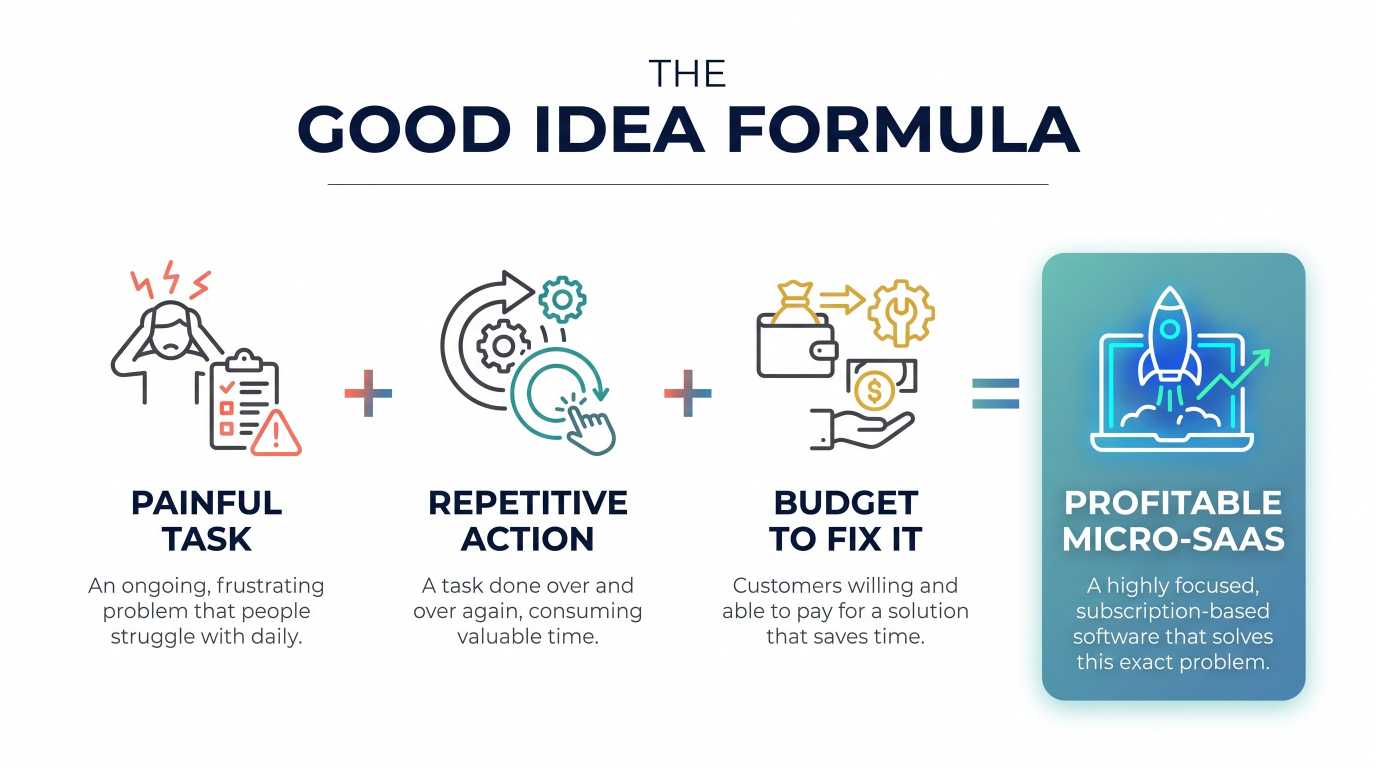
Where to Spot Real Problems
You do not need to guess what people want. People talk about their frustrations online every day. Here is where you should look:
1. App Store Review Sections
Go to big platforms that have app marketplaces:
The Shopify App Store
The WordPress Plugin Directory
The Google Workspace Marketplace
The Notion or Airtable App Directories
Look at popular apps that have 3-star or 4-star ratings. Skip the praise and read the complaints. When someone writes: "This app is great, but I hate that it cannot export to Excel automatically," write that down. That complaint is a potential product feature you can turn into a stand-alone tool.
2. Niche Communities on Reddit and Facebook
Look for groups of working professionals:
r/bookkeeping
r/propertyhandling
r/freelance
Facebook groups for local gym owners, cleaners, or wedding planners
Search these groups for words like:
"How do you guys handle..."
"Is there a tool for..."
"I hate doing this every week..."
"Why does [software name] make this so hard?"
When you see multiple people complaining about the same weekly headache, you have found a potential goldmine.
3. Look at Your Own Daily Work
What do you do at your day job or in your freelance work that feels like mindless copy-and-paste work? If you find yourself doing the same repetitive task for two hours every Friday, other people in your industry are doing it too.
Step 2: Validate Your Idea Before You Write Any Code
Never spend three months building an app until you prove people actually want it.
Validation sounds like a fancy corporate word, but it just means answering one simple question: "Are people willing to pull out their wallet to solve this?"
Compliments do not count. Friends saying, "Oh, that sounds cool!" does not count. Only time, email addresses, and money count as real validation.
The "Smoke Test" Landing Page
Here is how you validate an idea within 48 to 72 hours:
Pick a Clean Name: Do not overthink it. Keep it simple and clear.
Build a 1-Page Website: Use simple website builders like Carrd, Framer, or WordPress. It costs very little and takes just an afternoon.
State the Value Clearly:
Headline: "Stop wasting 5 hours every week on PDF invoicing."
Sub-headline: "We automatically sync your Stripe sales into clean, tax-ready summaries for your local accountant."
Add a Call to Action Button: Instead of "Buy Now," write "Join Early Access" or "Get 50% Off at Launch."
Collect Email Addresses: When people click, ask for their email address and one quick question: "What is your biggest frustration with this problem today?"
Simple Validation Page Structure:
[Header: Big Pain Point Solved]
[Video or Mockup Screenshot of the Solution]
[3 Bullet Points: Time Saved, Headaches Removed, Money Kept]
[Email Box: "Join 150+ beta users getting early access"]
Talk to 10 Real People
Send polite, direct messages to 20 or 30 people who experience this problem.
What NOT to say:
"Hey! I built this software, check it out and buy it!" (People will ignore this because it feels like spam.)
What to say instead:
"Hey [Name], I noticed you run a boutique real estate agency. I'm currently researching how local agents organize property tour schedules. I'm not selling anything at all—just trying to understand what takes up the most time during your week. Would you be open to sharing your experience for 5 minutes?"
Listen to how they talk about their day. If they complain with real emotion about a specific task, you know the pain is real. Ask them: "If an automated tool fixed that today, how much would that be worth to your business each month?"
If they give you an answer, you have validated your concept.
Step 3: Plan Your MVP (Minimum Viable Product)
Now that you have confirmed the problem exists, it is time to build your MVP—your Minimum Viable Product.
Many people think MVP means a half-broken, cheap piece of software. That is not true.
An MVP is simply the smallest, sharpest tool that delivers the core promise.
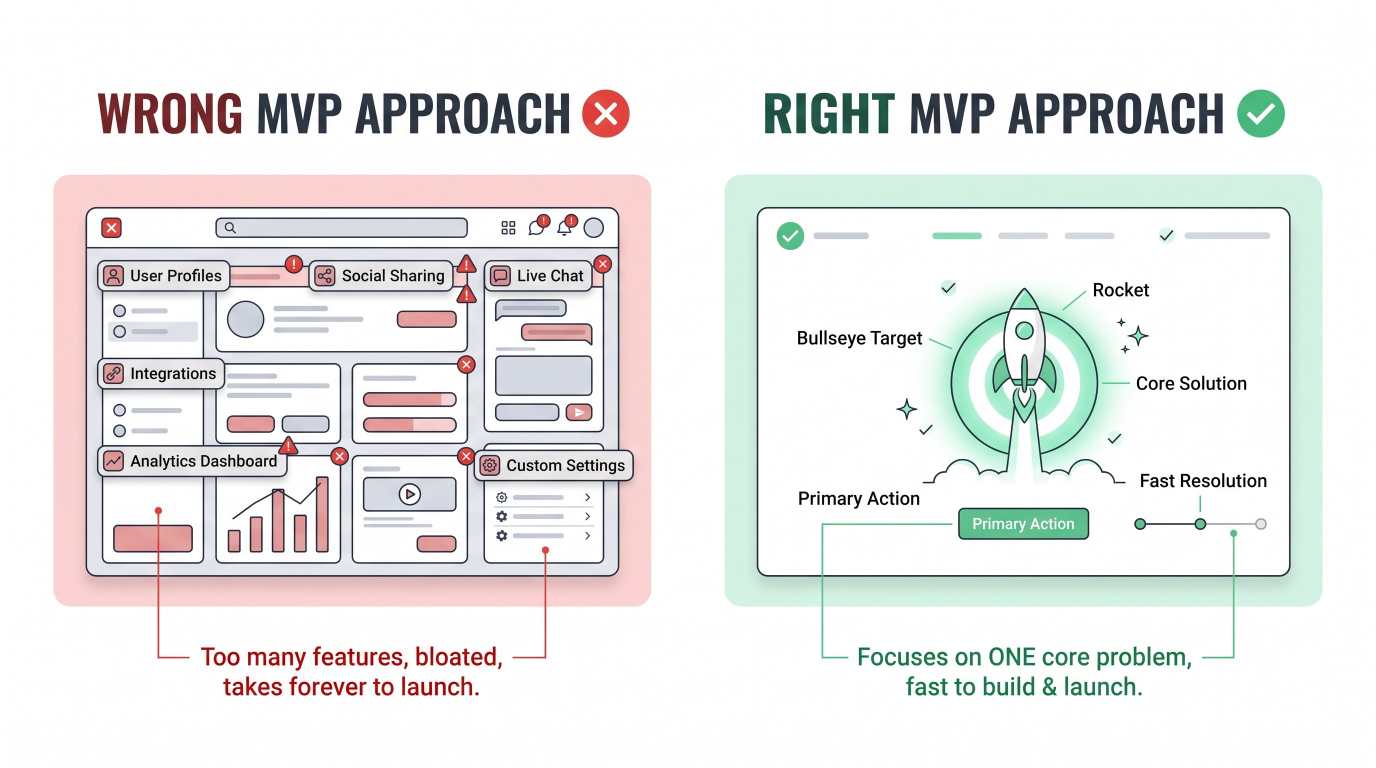
If your tool promises to remove background noise from audio files, the MVP only needs to do three things:
Let the user upload an audio file.
Clean the background noise.
Let the user download the clean file.
It does not need light/dark mode themes. It does not need social media sharing buttons. It does not need an affiliate dashboard. Keep it laser-focused.
Step 4: Pick Your Tech Stack (Keep It Simple)
You have two main paths to build a micro-saas business: writing code or using no-code platforms.
Path A: The No-Code Route (Great for Non-Programmers)
If you do not know how to code, do not spend the next two years learning computer science just to launch a tiny tool. You can launch a fully functional product using modern no-code builders:
Bubble: Excellent for complex web applications with databases, user logins, and workflows.
FlutterFlow: Great if your micro-saas needs to work as a mobile app.
Make or Zapier: Fantastic for connecting different services behind the scenes.
Airtable or Supabase: Simple options for storing your customer and app data.
Hundreds of profitable micro-saas founders make $5,000 to $20,000 per month using nothing but no-code tools. Customers do not care what programming language is under the hood; they only care that your tool solves their problem quickly.
Path B: The Simple Code Route (For Developers)
If you already know how to write software, follow the golden rule of indie hacking: Use the tech stack you know best.
Do not pick a brand-new programming language or a trendy framework just because people on social media are talking about it. Every hour you spend reading documentation for a new framework is an hour you are not talking to customers.
Love Python/Django? Use it.
Comfortable with PHP/Laravel? Build with it.
Know React and Node.js? Stick with that.
Use reliable tools for payment processing (like Stripe or Lemon Squeezy). They handle global sales taxes, currencies, and recurring subscription billing right out of the box, keeping your life easy and compliant.
Step 5: Choose a Simple, Honest Pricing Model
Pricing causes founders unnecessary stress. Many beginners price their tools way too low because they are afraid people will say no.
Let’s be clear: Do not charge $2 a month for business software.
At $2 per month, you need 5,000 customers just to make $10,000. Supporting 5,000 customers as a solo founder is exhausting. You will spend all day answering support emails and refund requests instead of making your product better.
Instead, target business-to-business (B2B) needs and price based on the value you save them.
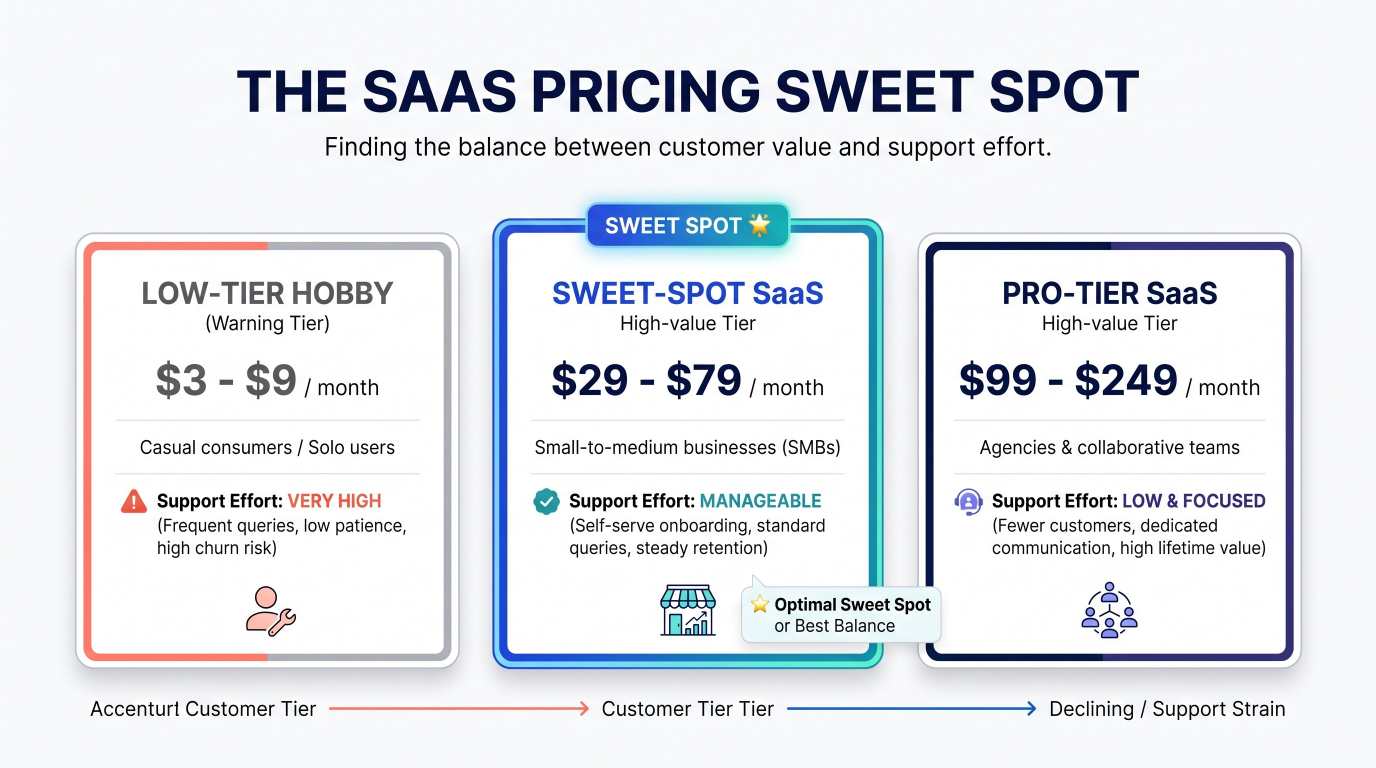
The Three Common Pricing Structures
1. Flat Monthly Subscription
Example: $29/month for full access.
Why it works: It is easy to explain. Customers know exactly what they will pay every month, and you know what you will earn.
2. Tiered Pricing (Good, Better, Best)
Starter: $19/month (Basic features, up to 100 uses)
Growth: $49/month (Everything in Starter + automation + up to 1,000 uses)
Agency: $99/month (Unlimited access, team accounts, priority support)
Why it works: Most buyers naturally choose the middle tier ($49), which increases your average revenue per user.
3. Free Trial vs. Freemium
For a micro-saas business run by a solo creator, offer a 7-day or 14-day free trial with no credit card required upfront, or offer a paid trial for $1.
Avoid completely free ("freemium") accounts unless your product naturally spreads through word-of-mouth (like a viral invite link). Free users consume server resources and send lots of support questions without ever paying you a cent. Focus your time on paying users.
Step 6: Launch and Find Your First 10 Paying Customers
Your website is live, your Stripe account is connected, and your app works. Now comes the moment that scares most people: getting actual users.
Do not expect people to magically find your website just because it is online. You have to go to them directly.
Your First Goal: Get 10 paying customers.
Not 1,000. Not 500. Just 10.
Why? Because 10 proves your idea works.
Here is the exact playbook to find those first 10 paying users:
1. Reach Back Out to Your Early List
Remember those 10 people you interviewed during the validation stage? Message them first:
"Hi [Name]! Two months ago you mentioned how frustrating invoice reconciliation was. I built a simple tool that does it in one click, and I added the exact feature you suggested. I'd love to give you a 30-day extended trial and personal onboarding if you want to try it out."
Because they helped you shape the idea, they will be excited to see the finished result.
2. Show Your Work on Public Communities
Share your journey on community platforms:
Product Hunt: Great for launch-day visibility and backlinks.
Indie Hackers: A warm, helpful community of solo software builders who share revenue numbers and feedback.
Hacker News (Show HN): Perfect if your product has a technical angle or a unique engineering approach.
X (Twitter) & LinkedIn: Post short, honest updates about what you are building, the lessons you are learning, and screenshots of your tool in action.
3. Provide Value in Niche Forums
Go back to the Reddit threads and specialized forums where people complained about the problem.
Do not just drop your link and run away. That will get you banned for spamming.
Instead, write a comprehensive, helpful answer to someone’s question. Share tips they can use for free right away. At the very end of your post, mention:
"By the way, I got so tired of doing this by hand that I built a tiny tool called [Your Tool Name] to automate the whole process. If anyone wants to test it, feel free to check it out."
When you help first and sell second, people respect you and welcome your recommendations.
Step 7: How to Scale from 10 to 100 Customers
Getting your first 10 customers takes manual, hand-to-hand outreach. Getting from 10 to 100 customers requires repeatable systems.
Let’s look at three dependable marketing channels that work well for micro-saas companies.
Channel 1: Programmatic and Problem-Focused SEO
SEO (Search Engine Optimization) is one of the most cost-effective ways to grow a software business. People who search Google for solutions to their problems already want to buy; you do not have to convince them that the problem exists.
Target specific, long-tail search phrases:
Do not target: "Accounting software" (You cannot beat multi-billion-dollar companies for that word).
Target instead: "Automated receipt generator for freelance designers" or "Shopify export tool for local clothing shops."
Write clear, helpful articles that guide people through solving their problem step by step, showing how your product makes the process 10 times faster.
Channel 2: Simple Integrations and Marketplaces
One of the easiest shortcuts to getting regular traffic is building inside an existing ecosystem:
Build an integration for Slack
Create an add-on for Google Sheets
Launch an app on the Shopify App Store
Make a plugin for Figma or Canva
These platforms already have millions of daily users looking for tools to improve their workflow. When you list your tool in their directory, you get instant visibility without paying for expensive ads.
Channel 3: Cold Email Outreach (B2B Only)
If your tool helps real estate agents, accountants, or marketing agencies, you can find their business emails through public directories or LinkedIn.
Keep cold emails short, respectful, and focused on them:
Subject: Quick question about [Agency Name]'s client reporting

Hi [First Name],

I noticed you manage digital marketing for local dentists.

Most agency owners I speak with spend 3 to 4 hours every Monday compiling monthly PDF ranking reports for their clients.

I built a simple tool that pulls those metrics and emails the branded report automatically in 30 seconds.

Would you be open to a 2-minute video showing how it works?

Best,
[Your Name]
Notice what makes this work:
It is short (under 90 words).
It mentions a specific problem they experience.
It does not demand a long phone call.
It is respectful and polite.
Step 8: Keep Your Customers Happy (Reducing Churn)
In a recurring-revenue business, making sales is only half the battle. You also need to keep people from canceling.
When a customer cancels their subscription, that is called churn.
Why Churn Matters:
If you add 10 new customers every month, but 10 customers cancel every month,
your business makes zero progress. You are running on a treadmill.
Here is how you keep your churn rate low as a solo founder:
1. Give Incredible, Friendly Customer Support
Big companies make you wait three days for an automated email response from an outsourced help desk.
When someone submits a ticket to your micro-saas, answer them quickly and warmly. Say: "Hey, I'm the founder of the product. Let me look at your account and fix that for you right now."
People love supporting indie products when they know there is a caring human behind the screen. Great customer service turns regular users into loyal fans who tell their friends about your work.
2. Make Your Onboarding Fast and Effortless
When someone signs up for your app, they should experience their "Aha!" moment within 60 seconds.
If your tool resizes images, let them upload an image immediately after signing up.
Do not make them fill out long profile forms before they can try the core feature.
Show short, helpful tooltips that point directly to the main action button.
The faster a user gets their first win, the longer they will stay with you.
3. Ask Why People Leave
When someone cancels, show a short, friendly survey with three simple choices:
"I don't need this tool anymore."
"It was missing a feature I needed."
"It was too expensive for my current budget."
"Other (tell us what went wrong)."
Read every single response. If multiple people cancel because one button is confusing or one feature is missing, go fix that issue immediately.
Realistic Costs to Start a Micro-SaaS Business
Let’s talk numbers. Many people wonder how much money they need in the bank before they start.
The good news is that starting a micro-saas is one of the most affordable businesses you can launch today. Here is a realistic budget breakdown for your first year:
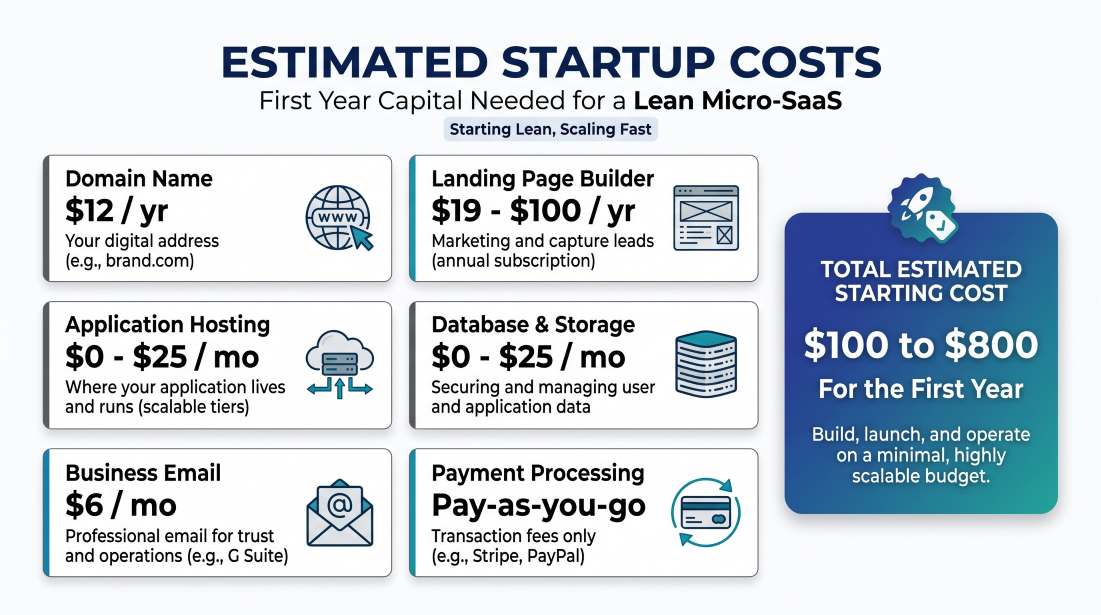
You do not need to take out a loan or risk your life savings. You can start this as a side project on weekends while keeping your full-time job.
💡 Skip the Technical Headache.
Don’t get stuck in tutorial hell or waste months learning to code. Our development team builds production-ready SaaS apps that convert visitors into paying users.
👉 Book a Free 15-Minute Discovery Call
5 Common Mistakes to Avoid When Starting Out
Before you begin, keep these common traps in mind so you do not waste your time:
1. Building for Everybody
If your website says, "The best communication tool for teams, families, and students," nobody will buy it. Be specific. "The team check-in tool designed specifically for remote software agencies." Specificity sells.
2. Waiting Too Long to Launch
If you have been working on your product for six months and nobody outside your household has seen it, you are waiting too long. Launch an imperfect version early. Real feedback from real users is the only way to make your software great.
3. Adding Too Many Features
Every new button you add to your app makes it harder to use, creates new potential bugs, and requires more documentation. Keep your app simple, clean, and reliable. Master one job before trying to do five.
4. Competing on Price Alone
Never try to be the cheapest tool on the internet. There will always be someone willing to build a worse version for free. Compete on simplicity, speed, and helpful customer support, not on rock-bottom pricing.
5. Giving Up After Two Weeks
Building software is not an overnight lottery ticket. It takes time for people to discover your website, try your product, and recommend it to their colleagues. Give yourself at least six to twelve months of steady effort before deciding whether an idea has legs.
Frequently Asked Questions (FAQ)
Can I start a micro-saas business with no coding experience?
Yes, absolutely. Platforms like Bubble, FlutterFlow, and Zapier let you build interactive, database-powered web applications without writing a line of code. You can also partner with a freelance developer or use pre-made boilerplate templates to get started quickly.
How long does it take to build a micro-saas?
A focused MVP should take between 2 to 8 weeks to build. If your build is taking longer than two months, your project scope is likely too broad. Cut non-essential features and launch the core tool first.
How much money can a micro-saas make?
It depends on your pricing and audience. Many solo founders run micro-saas tools that earn between $2,000 and $20,000 in monthly recurring revenue (MRR). Because overhead expenses are low, most of that revenue remains as profit.
Do I need to register a legal company immediately?
In the first few weeks, focus on validating your idea and confirming that people want it. Once you are ready to collect real payments through processors like Stripe, you should register an official business entity (such as an LLC or local equivalent) to open a business bank account and protect your personal assets.
Your Action Plan for This Weekend
Now you know exactly how to start a micro-saas business. But reading guides will not get you anywhere unless you take action.
Here is what you should do over the next three days:
Friday Night: Pick one industry you know well or find interesting (for example: local accountants, fitness instructors, or real estate agents).
Saturday Morning: Spend two hours browsing their forums and review sections. Write down the top 3 most common, annoying daily complaints they discuss.
Saturday Afternoon: Choose the most repetitive problem. Sketch a simple 1-page solution on a piece of paper.
Sunday: Build a clean, 1-page landing page explaining the solution and add an email waitlist form. Share it in two relevant community discussions and see what people say.
Building a micro-saas is one of the most rewarding journeys you can take as an entrepreneur. You get to solve real problems for real people, work on your own schedule, and build an asset you truly own.
Take it one small step at a time, listen closely to your users, and start building!
Ready to grow your business?
Contact us today to find out how our strategies can scale your operations to the next level.
Contact Us