How AI Changes the Cost of Software Development
Have you ever wondered why building a basic smartphone app or a company web platform can cost anywhere from $30,000 to over $250,000?
For decades, custom software has been one of the most expensive things a business could buy. If you wanted a digital product, you had to hire a room full of highly paid engineers, pay them for six to nine months, and cross your fingers that the final product matched what you had in your head.
Now, artificial intelligence is shaking up the whole process.
Every founder, tech lead, and business owner is asking the same big question: how does AI change the cost of software development? Does it actually make building tech cheaper, or does it just move the expenses somewhere else?
If you are planning to build an app, manage a tech team, or cut down your IT budget, this guide will walk you through what is happening on the ground, without the technical jargon or marketing fluff.
The Short Answer: Does AI Make Building Software Cheaper?
Yes, but it is not as simple as cutting your bill in half overnight.
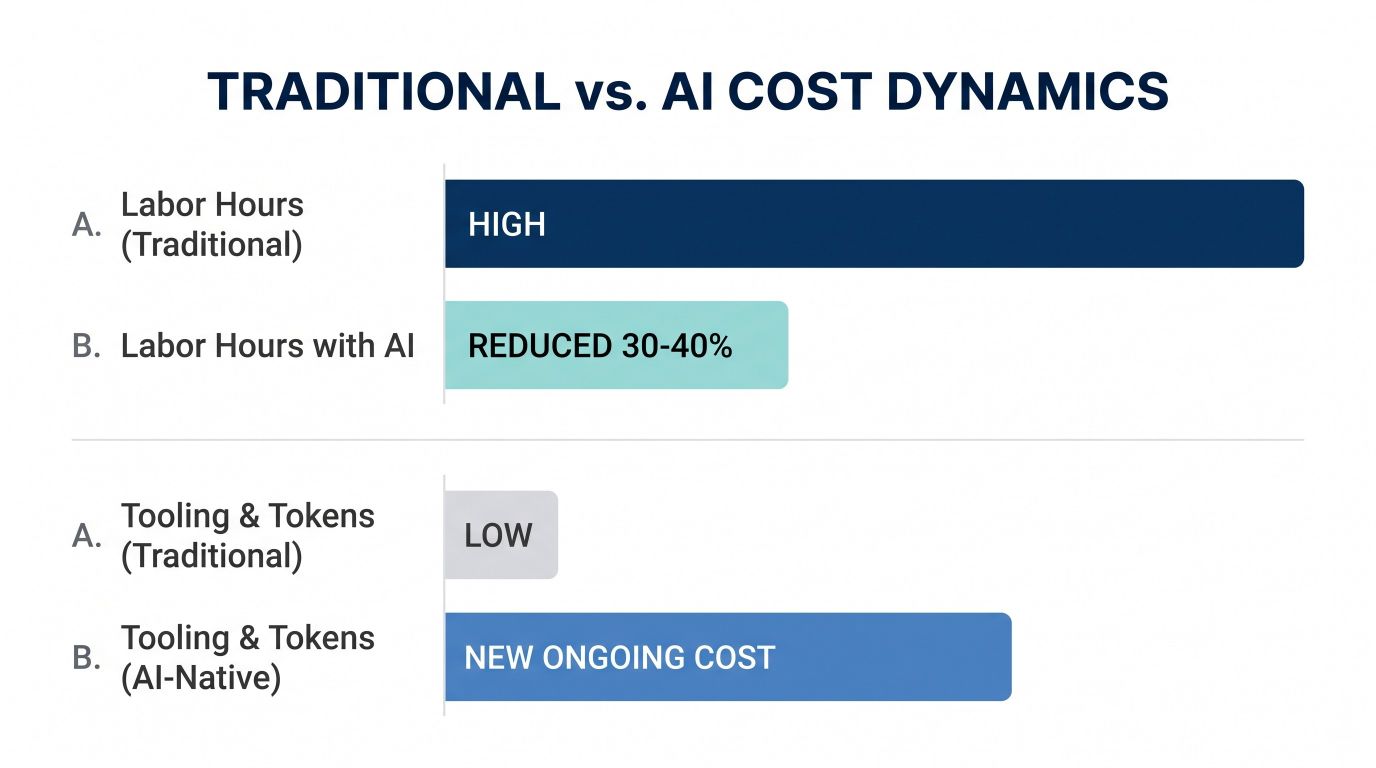
AI tools cut down the time it takes to write boilerplate code, test features, and find bugs. Because software engineers are usually paid by the hour or through high annual salaries, saving developer hours naturally lowers labor costs.
However, AI introduces brand-new expenses that never existed before. You now have API call costs, software seat licenses, new security checks, and code-cleanup time.
Here is what the trade-off looks like:
Where you save money: Junior-level coding, routine boilerplate setup, writing test scripts, creating documentation, and diagnosing common errors.
Where you spend new money: AI platform subscriptions, cloud token usage, security audits, and senior developers who have to review large piles of machine-written code.
To see how all of this changes your bottom line, let’s look at how software teams used to budget before these tools existed.
The Traditional Budget: Why Software Was So Expensive
Before AI became part of daily work, building software was almost entirely a manual craft. Every single button, database query, and security rule had to be typed out line by line by human hands.
1. Developer Salaries Took Most of the Budget
In a standard project, 70% to 85% of your total budget went directly to developer salaries or agency hourly rates. A mid-level engineer in North America or Western Europe often costs between $80 and $150 per hour. If a project took 1,000 hours, you were already looking at a baseline labor bill of $80,000 to $150,000 before factoring in design, servers, or marketing.
2. Repetitive Boilerplate Code Burned Paid Hours
Every web application needs the same basic building blocks:
User registration and login forms
Password reset flows
Database setup scripts
Basic payment gateway connections
None of these features make your product unique, yet developers had to spend dozens of billable hours writing and wiring them together.
3. Finding and Fixing Bugs Was Painfully Slow
A developer would write a feature in two days, and then spend three more days chasing down an invisible error caused by a missing comma or an edge-case bug. You were paying top dollar for someone to stare at a screen and hunt down typos.
How AI Changes the Cost of Software Development: The 5 Big Shifts
Now let’s look at the concrete shifts happening inside modern tech teams. When companies introduce smart coding assistants and automated workflows, costs shift across five main areas.
1. Massive Speedups in Routine Code Writing
Modern coding assistants act like auto-complete on steroids. A developer types a comment in plain English—such as "create a secure contact form that validates email addresses"—and the tool writes the code instantly.
Tasks that used to take three to four hours now take thirty minutes. For simple, standard features, overall coding speed can jump by 25% to 40%. When developers spend fewer hours typing out basic scripts, client invoices drop and internal sprint cycles move faster.
2. Cheaper Prototyping and Faster MVPs
In the past, building a Minimum Viable Product (MVP) to test a business idea with real users cost between $25,000 and $50,000.
Today, small teams and solo founders can build working prototypes using assisted coding tools, web builders, and pre-made templates in a matter of days. You can test your business idea with real customers for a few thousand dollars before deciding whether to invest heavily in custom engineering.
3. Automated Quality Assurance and Bug Hunting
Testing code used to be a tedious, manual chore. Quality Assurance (QA) testers had to click every button on every device to make sure nothing broke.
AI test generators can now look at an application and write comprehensive unit tests in seconds. They scan code repositories, flag common security mistakes, and suggest fixes before human reviewers even see the pull request. This shrinks the QA budget, which historically made up 15% to 25% of any software development quote.
4. Flatter Team Structures
A typical agency project used to require:
One Project Manager
One Senior Architect
Two Mid-level Developers
Two Junior Developers
One QA Specialist
With automated assistance, that same project can often be handled by one senior engineer and one strong mid-level engineer. Junior tasks like creating mock data, writing documentation, and formatting tables are handled by automated tools. Smaller teams mean fewer meetings, less overhead, and a lower total invoice.
5. Automated Documentation and Handover
Good developers hate writing documentation, and bad documentation costs businesses thousands of dollars whenever team members leave. AI models can scan an entire codebase and produce clear, readable documentation for every function. When a new developer joins the project, onboarding takes days instead of weeks, saving hundreds of paid training hours.
Cost Comparison: Traditional Project vs. AI-Assisted Project
To see how these numbers play out in the real world, let’s compare the cost breakdown for building a mid-sized SaaS web platform (such as a customer management dashboard with user accounts, billing, and reporting).
Project Stage | Traditional Development Cost | AI-Assisted Development Cost | Estimated Savings |
Discovery & Architecture | $8,000 | $6,000 | ~25% |
Front-End & Back-End Coding | $55,000 | $35,000 | ~36% |
Quality Assurance & Testing | $14,000 | $7,500 | ~46% |
Documentation & Onboarding | $5,000 | $1,500 | ~70% |
AI Subscriptions & Tokens | $0 | $2,000 | Added cost |
Senior Code Audits & Cleanup | $3,000 | $7,000 | Added cost |
Total Estimated Project Cost | $85,000 | $59,000 | ~30% Net Savings |
Notice something important in the table above: while raw development and testing costs fall sharply, auditing and tooling costs go up. Understanding these hidden expenses is what keeps your project on budget.
The Hidden Costs of AI: Where Businesses Get Caught Off Guard
If you only look at the positive side of automated development, your budget can run off track quickly. There is no free lunch in software, and AI brings its own set of brand-new expenses.
1. Subscription and Token Fees
Top-tier developer tools are not free. Team licenses for coding assistants cost between $10 and $40 per user every month.
More importantly, if your application calls large language models directly via APIs to power customer-facing features, you pay for every single word (token) processed. If your app goes viral or an automated loop runs out of control, your cloud bill can easily spike by thousands of dollars in a single weekend.
2. The Danger of "AI Slop" and Technical Debt
AI writes code fast, but it does not always write good code. It frequently generates code that works on the surface but is messy, redundant, or impossible to scale down the road.
Engineers call this technical debt. If your team accepts computer-generated code without checking it thoroughly, your app may become slow and fragile within six months. Fixing a tangled mess of machine-written code often costs more than writing clean code by hand from the start.
3. Hallucinations and Security Vulnerabilities
AI models sometimes make things up. In programming, an AI might reference an external software library or security package that does not actually exist. Malicious actors sometimes create fake packages with those exact names to slip dangerous code into unsuspecting projects—a trick known as package hallucination.
Because of this, companies must spend money on stricter security scans, dependency checkers, and manual human reviews.
4. The Senior Developer Premium
Junior developers are becoming harder to place on high-stakes projects because automated tools can do much of their routine work. At the same time, demand for experienced senior engineers who understand system design, database architecture, and security has gone up.
Senior engineers command higher hourly rates. While you may hire fewer total workers, each senior person on your payroll will cost more per hour.
How Company Size Shapes the Financial Impact
How much you save depends heavily on whether you are a solo entrepreneur, a growing agency, or an enterprise.
For Solo Founders and Small Startups
Verdict: Massive cost reduction.
A solo founder who knows how to prompt and troubleshoot can now build and launch a functional web service that previously required a four-person dev agency.
Total build costs drop from $40,000+ down to a few hundred dollars in software subscriptions and domain fees.
For Mid-Sized Agencies and Dev Shops
Verdict: Higher margins and faster turnaround.
Agencies can take on twice as many client projects with the same head count.
Instead of cutting their hourly rates, smart agencies sell fixed-price packages, deliver them in half the time, and pocket higher profit margins while delivering faster results to clients.
For Large Enterprises
Verdict: Mixed financial results in the short term.
Big companies have strict privacy, compliance, and legal guidelines. They cannot simply paste proprietary code into public web tools.
Enterprises must pay for private, isolated cloud environments and custom compliance setups. While developer productivity rises by 15% to 25%, initial setup and legal governance eat up much of the early cost savings.
Practical Ways to Lower Your Software Costs with AI Today
If you have an active software project or are planning to hire developers soon, here is how you can use these tools to protect your budget.
1. Write Clear Requirements First
Tools and models run on input. If your feature descriptions are vague, the generated code will miss the mark, wasting hours of developer time. Write down exactly what each screen does, who uses it, and what happens when someone clicks every button before anyone starts building.
2. Never Skip Human Code Reviews
Treat machine-written code like work submitted by an eager intern: fast, helpful, but in need of a senior eye before it goes live. Always require a human engineer to inspect changes for performance, logic bugs, and security holes.
3. Monitor Your API Usage Daily
If your software uses cloud models under the hood, put spending caps and rate limits on your API keys right away. Set alerts to notify you if daily spending jumps above normal thresholds so you never wake up to an unexpected cloud bill.
4. Build Modular Components
Ask your developers to build small, isolated functions rather than giant files. Small code blocks are much easier for automated tools to test, optimize, and debug without breaking the rest of your system.
The Future: What Will Software Cost in 5 Years?
Over the next few years, the price tag of writing pure code will trend toward zero. Software will stop being priced by "how many hours it took to type the code" and start being priced by the value of the problem it solves.
The biggest expense won't be hiring someone who knows how to write a database query. It will be hiring someone who understands your business, knows how to design a simple user experience, and can fit all the pieces together securely.
Software development is shifting from manual construction to smart orchestration. Those who understand how these cost dynamics work can build faster, spend less, and launch products that would have been financially out of reach just a few years ago.
Turn Your Software Idea into Reality - Faster and Within Budget.
From responsive web platforms to native mobile apps, GoodlySoft builds reliable digital products engineered for growth.
👉 Talk to Our Lead Engineers Today
Frequently Asked Questions
Can I build an entire software app with AI without hiring any developers?
You can build simple web pages, landing pages, and basic workflow automations without writing code. However, for custom software that handles private user data, processes payments, and needs to scale reliably, you still need an experienced developer to manage architecture, databases, and security.
How much does AI reduce software development costs on average?
Across most business projects, teams see a net cost reduction of 20% to 35%. While individual coding tasks can be up to 50% faster, the need for senior reviews, security audits, and software subscriptions offsets some of the total savings.
Why doesn't AI make software development 100% free?
Because writing code is only one part of building a digital product. You still have to pay for cloud servers, database hosting, user experience design, project management, and ongoing maintenance. High-level architecture and strategic thinking remain uniquely human tasks.
Does using AI in development introduce legal or copyright risks?
It can if developers use tools trained on restricted open-source code without proper licensing attribution. Most commercial tools now offer copyright indemnification and allow teams to block public code suggestions to keep their applications compliant.
Ready to grow your business?
Contact us today to find out how our strategies can scale your operations to the next level.
Contact Us